October 22, 2026
What Is Outbound Sales and How It Drives B2B Growth
Outbound sales is a proactive selling process in which a company identifies potential buyers and contacts them directly, rather than waiting for inbound interest. In the U.S., more than 8.0 million establishments with paid employees represented an enormous potential market in 2022, so sellers need a way to find the organizations most likely to need what they offer.
Maybe you've built a strong B2B service, put up a polished website, and waited for the right prospect to get in touch. The inbox stays quiet. You know there are companies that could benefit from your work, but hoping they happen to find you isn't a sales plan.
Outbound gives you a practical alternative: identify likely buyers, reach out with a relevant reason to talk, and see whether that conversation develops into a real opportunity. The aim isn't to send as many messages as possible. It's to create qualified conversations that can lead to closed revenue. By the end, you'll have a clear picture of what outbound sales is, how it works, and how to tell whether it fits your business.
Table of Contents
- The Founder Waiting for Leads
- Defining Outbound Sales
- Outbound vs Inbound Sales
- How the Outbound Process Works
- What Makes Outbound Work Today
- When to Use Outbound for B2B Growth
- Common Misconceptions About Outbound
- Building Your Outbound Playbook
The Founder Waiting for Leads
A founder opens their inbox before the first meeting of the day. There's a message from a software vendor, a calendar reminder, and a customer asking for an invoice. No new prospect has asked for a call.
Their agency solves a real problem. Its clients value the work. But the founder's next deal depends on a referral, a website visitor, or someone remembering to follow up with an old contact. Some weeks, those things happen. Other weeks, the pipeline looks like an empty restaurant before lunch.
Outbound changes who makes the first move. Instead of waiting for a prospective buyer to stumble across the company, the founder can choose organizations that fit the service and start a conversation with someone who may care about the problem it solves.
That doesn't mean blasting a generic pitch at every business on a list. A thoughtful approach might start by focusing on a particular kind of agency, finding the person responsible for client acquisition, and opening with a specific reason the service may be relevant. The prospect can still say no. But the seller has created a chance to learn whether there's a fit.
The useful shift is from waiting for attention to earning a relevant conversation. Outbound won't make every prospect a customer, and it can't replace a sound offer. It can give a business a deliberate way to reach potential buyers, test its message, and build a pipeline that doesn't depend entirely on being discovered.
Defining Outbound Sales
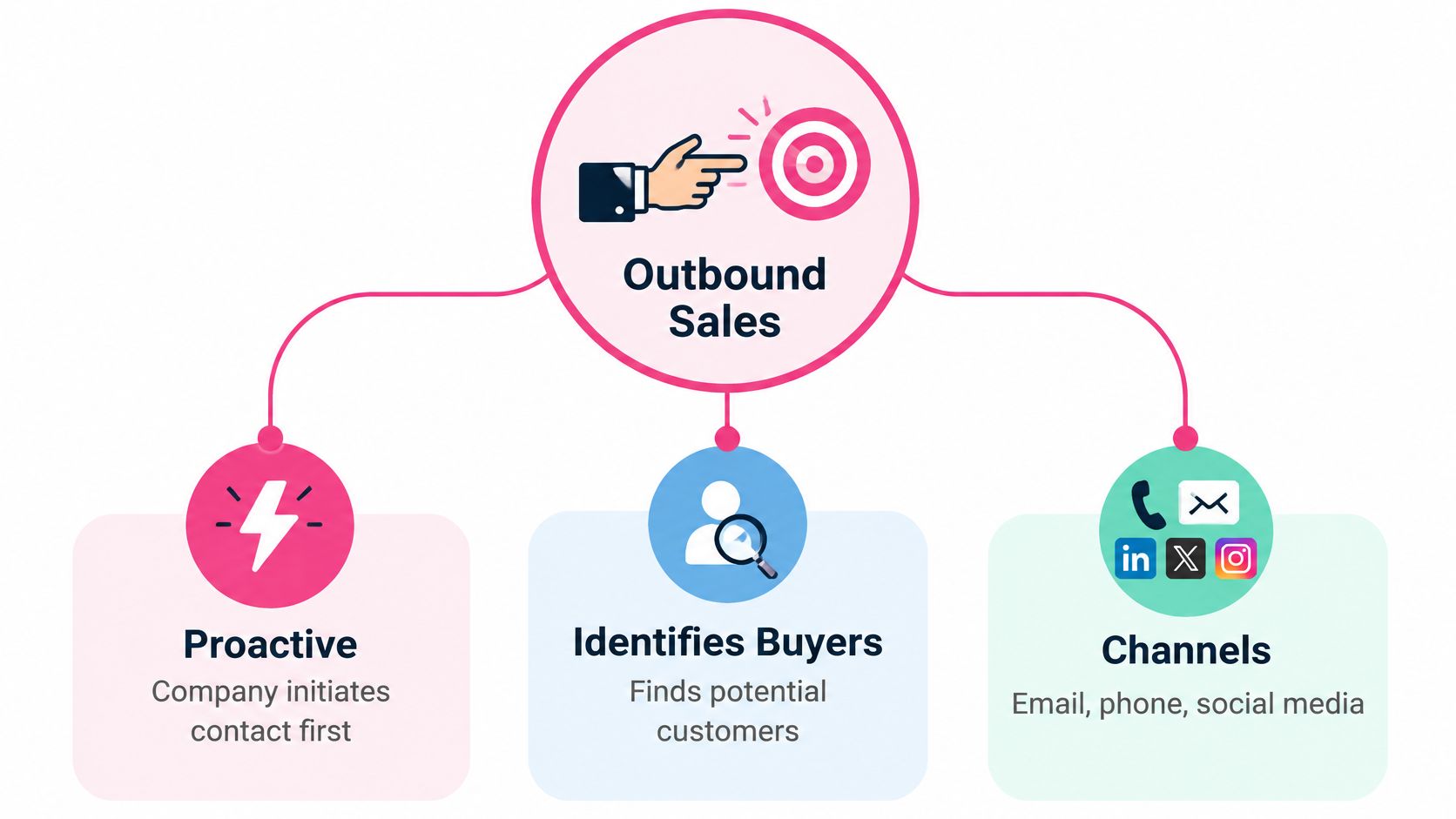
Outbound sales is a proactive selling process: a company identifies potential buyers and initiates contact through channels such as email, telephone, social media, or direct outreach. The goal is to create a qualified sales conversation with a target account or decision-maker, not just to put a company name in front of someone.
That distinction matters because a large market isn't the same as a usable prospect list. The U.S. Census Bureau reported just over 8.0 million establishments with paid employees in 2022, employing 140.0 million people and representing $8.6 trillion in annual payroll. Professional, scientific, and technical services alone accounted for approximately 976,300 establishments in the 2022 Economic Census (U.S. Census Bureau's first look at the 2022 Economic Census). Those figures describe a broad market scope, not a ready-made audience for any one seller.
A company narrows that field using criteria such as industry, company size, geography, technology use, and likely business need. For example, a provider of cybersecurity services might prioritize organizations whose operating needs and business context make that service relevant. The seller then researches suitable accounts, finds the right people, and offers a reason to talk.
More than a message
A cold email is one possible contact, not the whole discipline. A working outbound system brings together market definition, prospect research, personalized messaging, follow-up, qualification, meeting coordination, and handoff to the person who can advance or close the sale.
That system also gives the team useful ways to judge progress. Sellers can monitor contact attempts, replies, qualified opportunities, booked meetings, pipeline value, conversion rates, and closed revenue. A high reply count may look encouraging, but if the conversations aren't with likely buyers, it doesn't necessarily signal progress.
A useful outside perspective is this guide on AI-driven outbound sales, which can help readers think through where automation may support the work. The central question remains human and commercial: does the outreach reach an appropriate buyer with a message that gives them a reason to engage?
Outbound vs Inbound Sales
The simplest difference between outbound and inbound is who starts the conversation. In outbound, the seller contacts a prospect. In inbound, a prospect arrives through activities such as search, content, referrals, or other marketing and asks for information or shows interest.
Each approach gives the business a different kind of control. Outbound lets a team choose which accounts to approach and when to begin. Inbound depends on people discovering the company and taking action, which can make it an important source of interest but less useful when a team needs to reach a particular buyer or market directly.
| Dimension | Outbound | Inbound |
|---|---|---|
| Who initiates | The seller contacts a selected prospect. | The prospect reaches out or signals interest. |
| Targeting | The team chooses accounts and buyer roles to approach. | Marketing attracts an audience, and sales qualifies incoming interest. |
| Timing | Outreach can start when the seller is ready to test an offer or enter a market. | Interest depends on when a buyer discovers the company and decides to act. |
| Typical activity | Research, direct outreach, follow-up, qualification, and meeting setting. | Content, search visibility, referrals, campaigns, and responding to inquiries. |
| Cost planning | Costs often relate to people, data, messaging, and outreach infrastructure. | Costs often relate to producing content, developing reach, and attracting demand. |
| Pipeline signal | Teams can see how selected accounts progress through outreach and sales. | Teams can see which leads arrive, then assess their fit and readiness. |
Neither method is a universal winner. Inbound can attract prospects who are already looking for help, while outbound can create a route into accounts that aren't actively searching. Many B2B businesses benefit from combining them, using inbound to build awareness and outbound to pursue specific markets or buyers.
A common confusion is to treat outbound as an instant shortcut. It can help a team begin targeted conversations without waiting for organic interest, but its results still depend on the quality of the offer, the accuracy of the targeting, and the relevance of the message. If those pieces are weak, greater activity just produces more chances to learn that they're weak.
How the Outbound Process Works
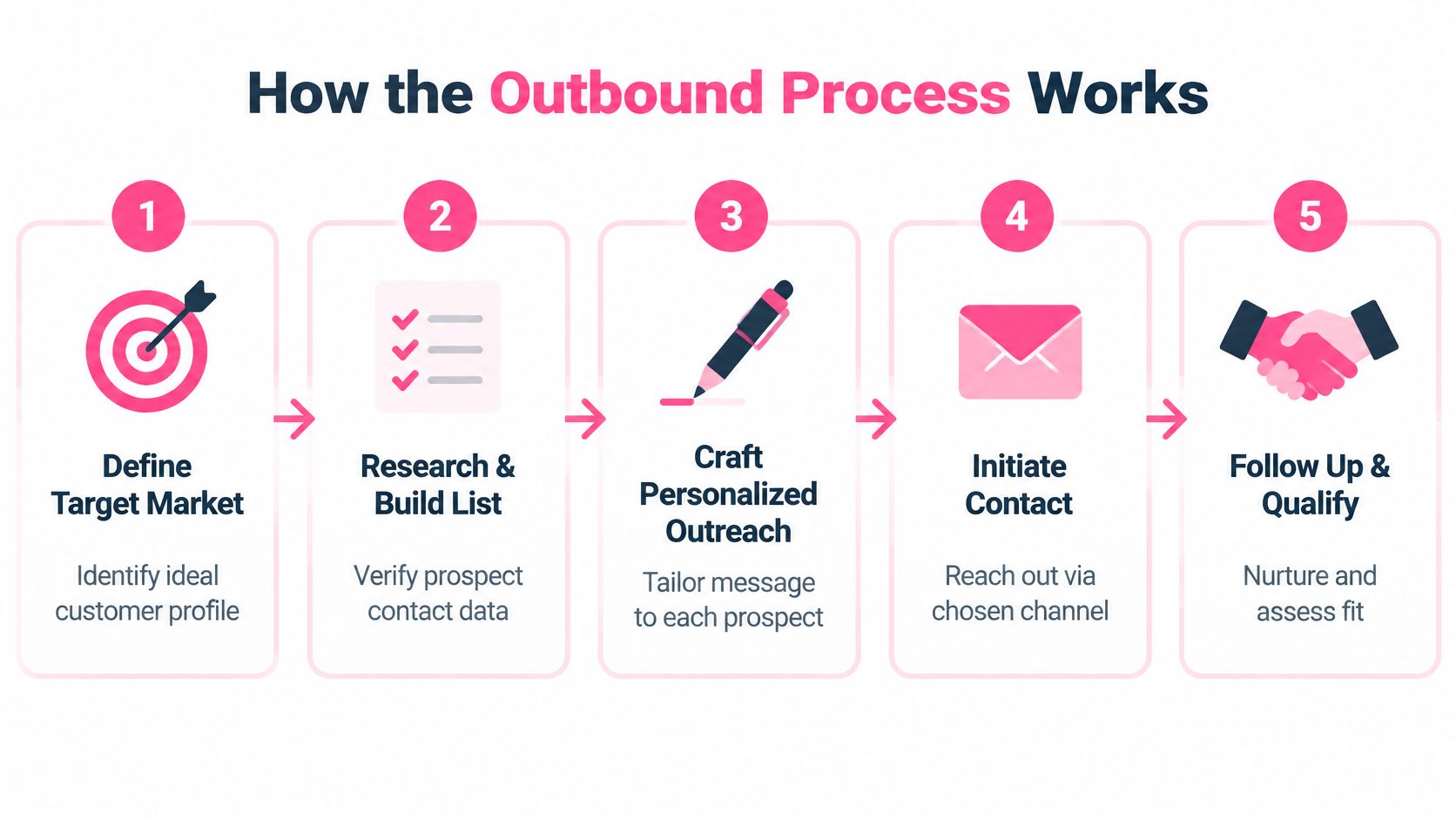
Think of outbound as a funnel that starts with a business hypothesis and ends with a commercial outcome. Each stage should help the team decide who to contact, what to say, or what to do next.
Define the target market. Describe the kind of organization that benefits from the offer. Include firmographic or operational details, such as industry, size, geography, technology use, or a particular business problem.
Research and build the list. Find accounts and the people whose roles connect to the problem. Verify the information before outreach. A list with fewer suitable buyers can be more useful than a large collection of poorly matched contacts.
Write a relevant message. Explain why you're contacting this person, what problem you may be able to address, and what a reasonable next step could look like. For practical guidance on clear business communication, see this guide to professional emails.
Choose channels and initiate contact. Email, phone, and social outreach each offer different ways to begin a conversation. Choose based on the buyer and the kind of interaction that makes sense, rather than treating every channel as interchangeable.
Follow up and qualify. Silence isn't the same as a no, but a reply isn't automatically a qualified opportunity either. Respond to the person's actual situation, assess fit, and stop if they decline or opt out.
Book and hand off the meeting. When there's a suitable next step, coordinate the meeting and give the closer enough context to continue the conversation without making the prospect start over.
Follow the whole funnel
RAIN Group's research covered 488 buyers representing $4.2 billion in purchases across 25 industries and 489 outbound sellers. It found that top prospectors performed better through stronger value propositions, more accurate targeting of senior buyers, and more customized, value-focused first meetings. The study reports 2.7 times more conversions and 1.8 times more quality outcomes, including meetings, conversations, and demonstrations (RAIN Group's sales prospecting research). The practical lesson is to improve relevance and meeting quality, not to make raw activity the goal.
Teams can keep the steps organized with a CRM, a calendar tool, and a thoughtful sequence of follow-ups. If you're drafting a sequence, an email sequence generator can help you plan its structure. Use any tool to support the process, not to replace good judgment about whether a message belongs in someone's inbox.
The video below offers another visual way to follow the outbound process from targeting through qualification.
What Makes Outbound Work Today
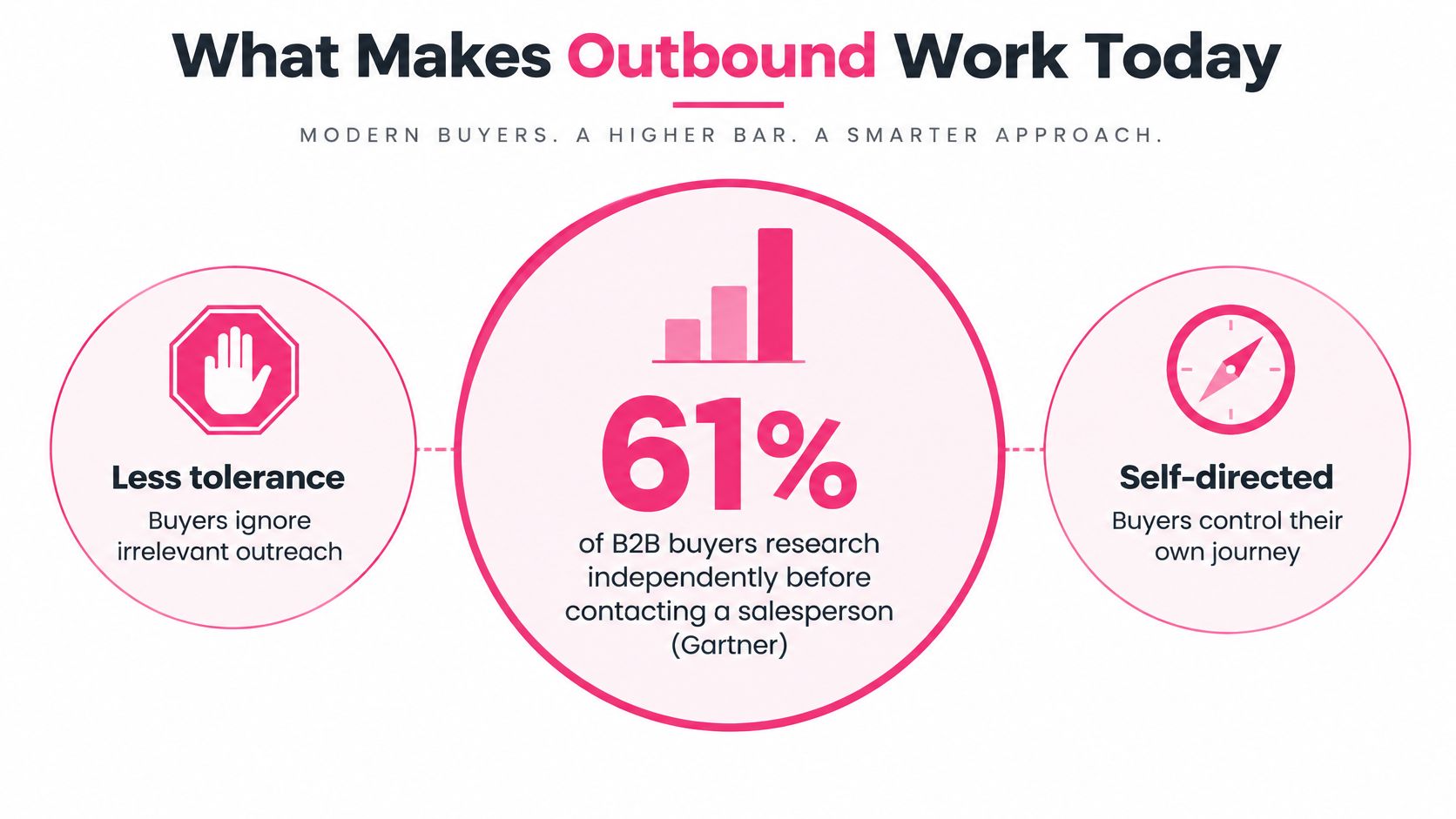
The modern buyer doesn't need a salesperson to repeat information they can find independently. Gartner surveyed 632 B2B buyers in August and September 2024. It found that 61% preferred an overall rep-free buying experience, while 73% actively avoided suppliers that sent irrelevant outreach (Gartner's findings on B2B buyer preferences).
Those findings don't mean buyers never want to speak with sellers. They point to a more useful distinction: a seller should make the interaction worthwhile. Buyers may prefer to gather general information on their own, while valuing a seller's help when they need to assess whether an offering fits their organization. Outreach has to earn that conversation with relevant context, not just ask for time.
Relevance, persistence, and trust
A practical program defines its ideal customer, matches the offer to a business problem, and checks that its claims make sense for the prospect. It also treats follow-up as part of the process. HubSpot's compilation of sales research reports that 44% of salespeople give up after just one follow-up attempt (HubSpot's compilation of sales statistics). A considered follow-up can clarify the business problem, share a relevant detail, or offer an easy way to schedule. It should stop when a person declines or opts out.
Channel choice should reflect the job the message needs to do. Social outreach might establish familiarity, email can make the business case easy to review, and a call may help resolve urgency or complexity when it's appropriate. None of those channels is valuable just because it generates a reply. Track whether the conversation is relevant, whether the meeting happens, and whether it advances into a qualified opportunity.
Email infrastructure matters too. Google's sender rules require bulk senders delivering more than 5,000 messages a day to Gmail accounts to authenticate mail, avoid unwanted messages, and make unsubscribing easy. Google recommends keeping user-reported spam below 0.1% and preventing it from reaching 0.3% or higher (Google's email sender guidelines). A deliverability checker can be one part of monitoring whether your sending setup is healthy.
When to Use Outbound for B2B Growth
Outbound makes sense when a company knows which buyers it wants to reach but can't count on those buyers to discover it on their own. That may be the case when organic demand is insufficient, a business is entering a new industry or geography, or a higher-value solution needs a focused conversation to explain its fit.
The size and variety of the market offer another reason for a targeted approach. U.S. Census Bureau data for 2023 show 8,361,342 business establishments, of which 7,152,312 had 19 or fewer employees. That is roughly 85.5% of establishments (Census Bureau data on U.S. small businesses). A market isn't made up only of large enterprises with formal procurement teams. Many smaller organizations make purchasing decisions through an owner or a lean team, and outbound gives sellers a way to find and approach them directly.
Ask yourself a few practical questions:
- Is the pipeline unpredictable? Outbound can create a deliberate way to test interest among chosen accounts.
- Are you entering a new market? Targeted outreach can help you learn whether buyers in a new segment respond to the offer.
- Does the solution need explanation? A relevant conversation may help assess fit more directly than broad promotion.
- Can you serve the demand you generate? Outreach only helps if the business can respond to interest and deliver what it promises.
Outbound isn't an automatic fix for a vague offer or a weak customer fit. Start with a clear hypothesis about who needs the service and why, then track whether the conversations become opportunities. A cold email ROI calculator can help frame the financial assumptions, but the inputs still need to reflect your own costs and sales process.
Common Misconceptions About Outbound
Outbound gets misunderstood when people reduce it to one tactic or one metric. A cold email is a contact method. A reply is an engagement signal. Neither one, by itself, describes a complete outbound system.
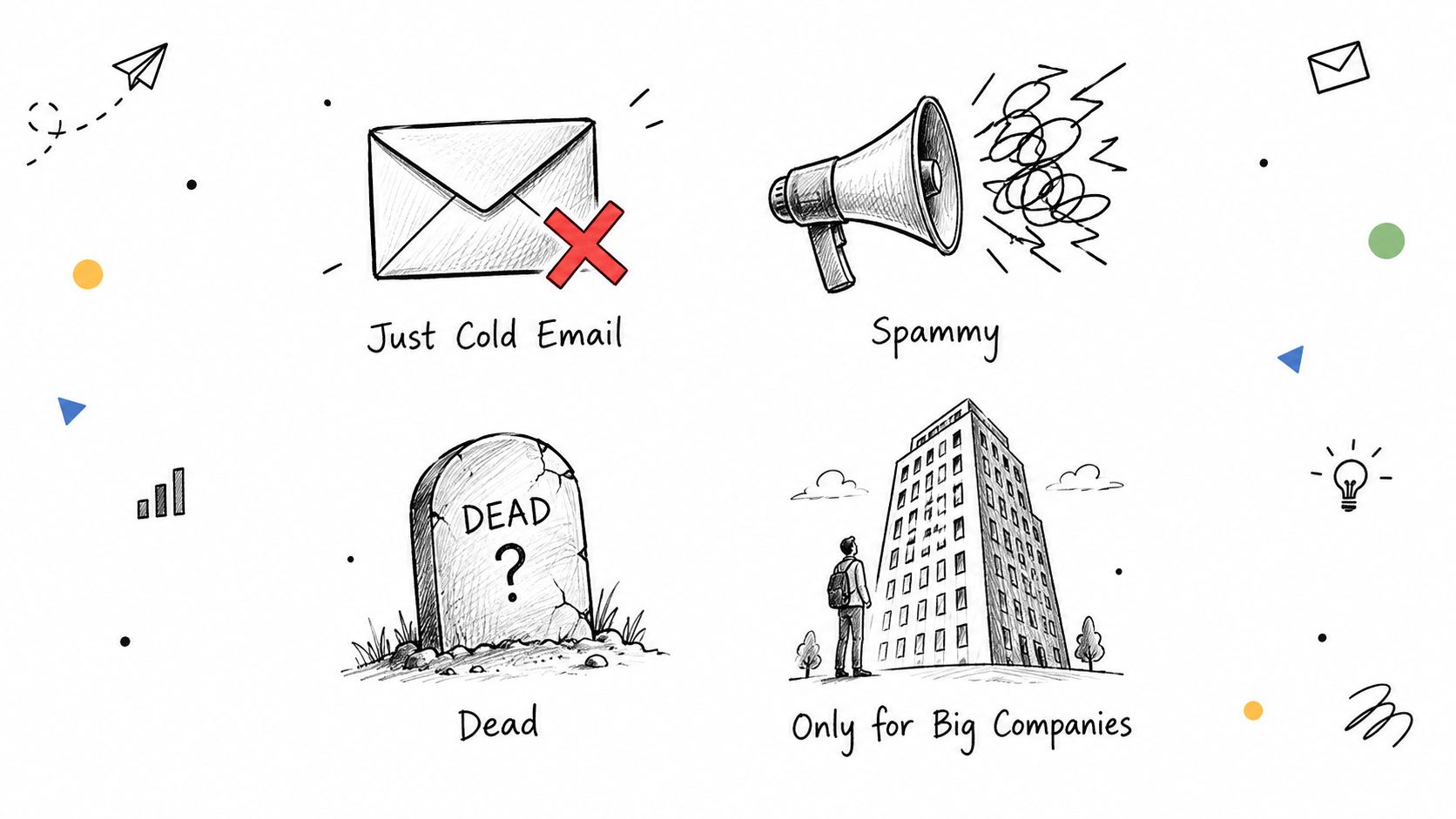
It's not just cold email
Professional outbound can use email, telephone, social media, or coordinated outreach across channels. More important, it includes choosing suitable accounts, understanding roles, explaining the offer clearly, following up thoughtfully, and qualifying any interest. LinkedIn reports that its network includes more than 130 million decision-makers among 1.2 billion members (LinkedIn's overview of its B2B audience). The point isn't to contact everybody. It's to identify the people whose responsibilities connect to the problem being addressed.
It isn't automatically spam
Unwanted, irrelevant outreach can damage trust. That doesn't make every proactive message spam. In the United States, the CAN-SPAM Act applies to commercial email, including business-to-business messages. The Federal Trade Commission says commercial emails must use accurate sender information, avoid deceptive subject lines, identify the message as an advertisement, include a valid physical postal address, and provide a clear opt-out method. Senders must honor opt-out requests within 10 business days, and each separate violating email can carry a penalty of up to $53,088 (FTC guidance on CAN-SPAM compliance).
It isn't only about volume or enterprise
Small businesses are part of the addressable market, and teams can focus on a narrow group of well-matched buyers rather than pursuing enterprise accounts alone. The measurement should also go beyond how many messages went out or how many people replied. A campaign that produces replies but few qualified opportunities may have a targeting or qualification problem. An email grader can help assess the copy, but a stronger test is whether the conversation advances toward a genuine business need.
Building Your Outbound Playbook
A useful playbook starts with the buyer, not the sending platform. Write down the kind of organization you can help, the person likely to influence the relevant decision, and the business problem your offer addresses. Then build a verified list and write an opening message that explains why you chose that prospect.
Next, plan how the team will handle the conversation after the first contact. Decide how follow-ups will add context, which replies count as qualified interest, when a meeting should be booked, and how the closer will receive the background. Set up the sending process with reputation and opt-out handling in mind. Keep the workflow simple enough that the people running it can see what happens to each account.
A practical rule: Don't judge an outbound service by the number of contacts it delivers. Ask how it defines a qualified meeting, handles poor-fit replies, and connects activity to closed revenue.
That last question matters when comparing ways to run outbound. An in-house team gives you direct control, but it requires people, research, messaging, and campaign management. A service provider may handle more of the workflow. A pay-per-close model offers a distinct way to evaluate that service because payment is tied to closed business, rather than only to outreach activity or booked meetings. You'll still want clear definitions of attribution, qualification, and what happens when an opportunity takes time to close.
If you're planning campaign capacity, an outbound volume planner can help turn a target into a manageable operating plan. Keep your claims grounded in what your business can demonstrate, and make your broader marketing useful too. For example, teams building authority through educational content may also benefit from learning about ethical link building methods. The aim is a trustworthy growth system: clear positioning, relevant outreach, careful follow-up, and measurement that reaches all the way to revenue.
Ever Outbound Inc. provides fully managed B2B client acquisition on a pay-per-close basis, with human-led prospect research, personalized outreach, managed sending infrastructure, and appointment setting. If you want support building a system focused on qualified sales calls and closed deals, visit Ever Outbound Inc..