October 26, 2026
What Is a Sales Cadence? Examples and Best Practices
A sales cadence is a planned, repeatable sequence of prospect touches that specifies who is contacted, through which channel, with what message, when each touch happens, and when the sequence stops.
You've sent a promising prospect an email. They haven't replied, your inbox is quiet, and you're wondering whether to follow up or drop the opportunity without a word. A cadence replaces that guessing game with a plan, without turning you into the person who sends the same pitch until someone blocks you.
Table of Contents
- A Sales Cadence in Plain Terms
- The Five Parts Every Cadence Needs
- Why Channel Mix Beats a Single Inbox
- How Timing and Speed Set the Rhythm
- Cadence Examples for Each Buyer Type
- Myths That Make Cadences Fail
- Build Your First Cadence or Hand It Off
A Sales Cadence in Plain Terms
A sales cadence organizes prospect interactions to help you make contact, establish whether there's a fit, and progress toward a sales conversation.
Say a rep sends an email on Monday, hears nothing, and declares the lead dead. A colleague instead plans six touches over three weeks across email, phone, and LinkedIn. In this hypothetical scenario, the prospect books a meeting after the fourth touch, and the remaining outreach is canceled.
The difference isn't a magic email. It's orchestration, coordinating each action around what happened before it.
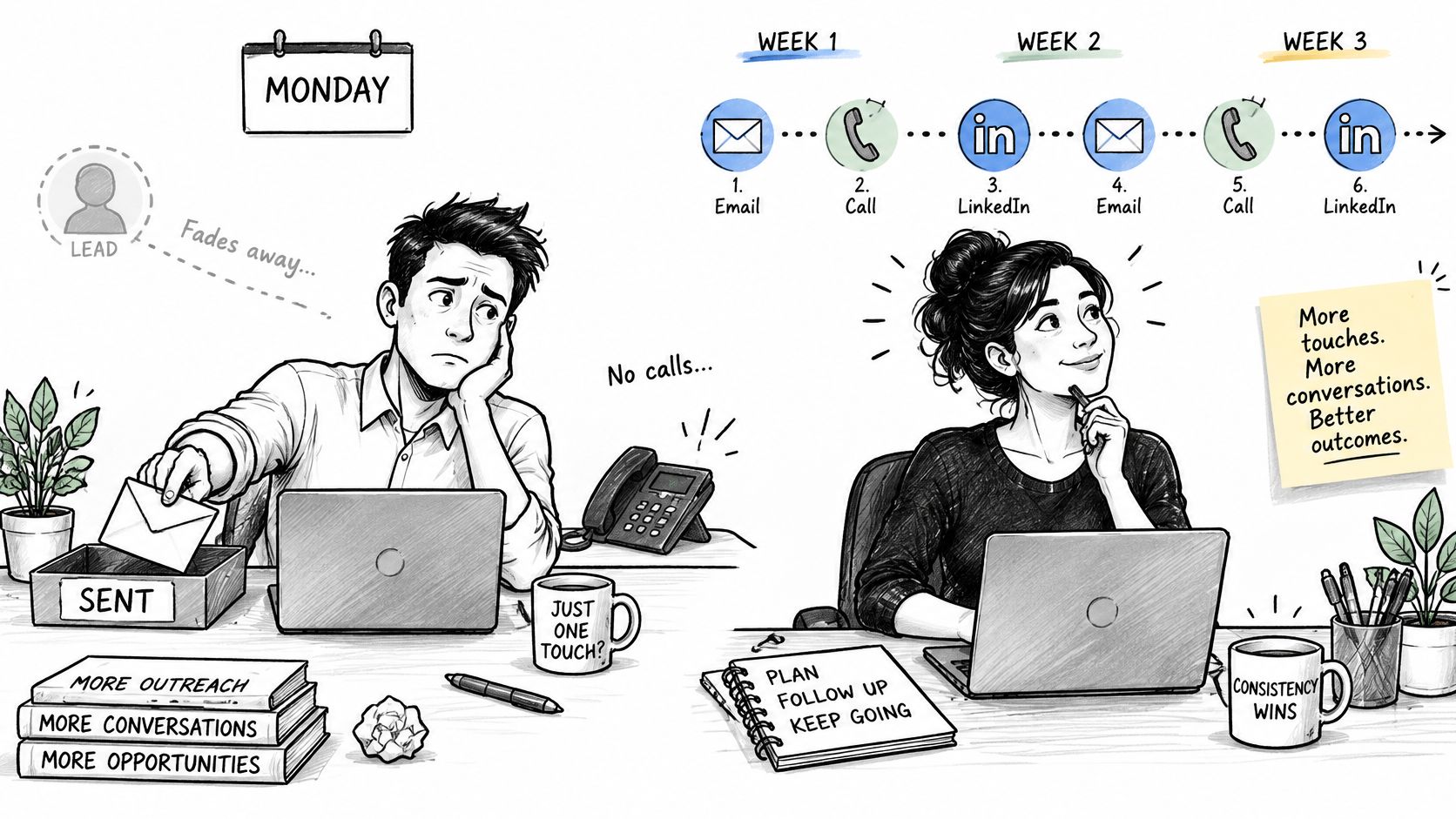
A rhythm, not a drum solo
One email is a single drum hit. A cadence is a rhythm with variation, not someone hammering the cymbals because nobody applauded.
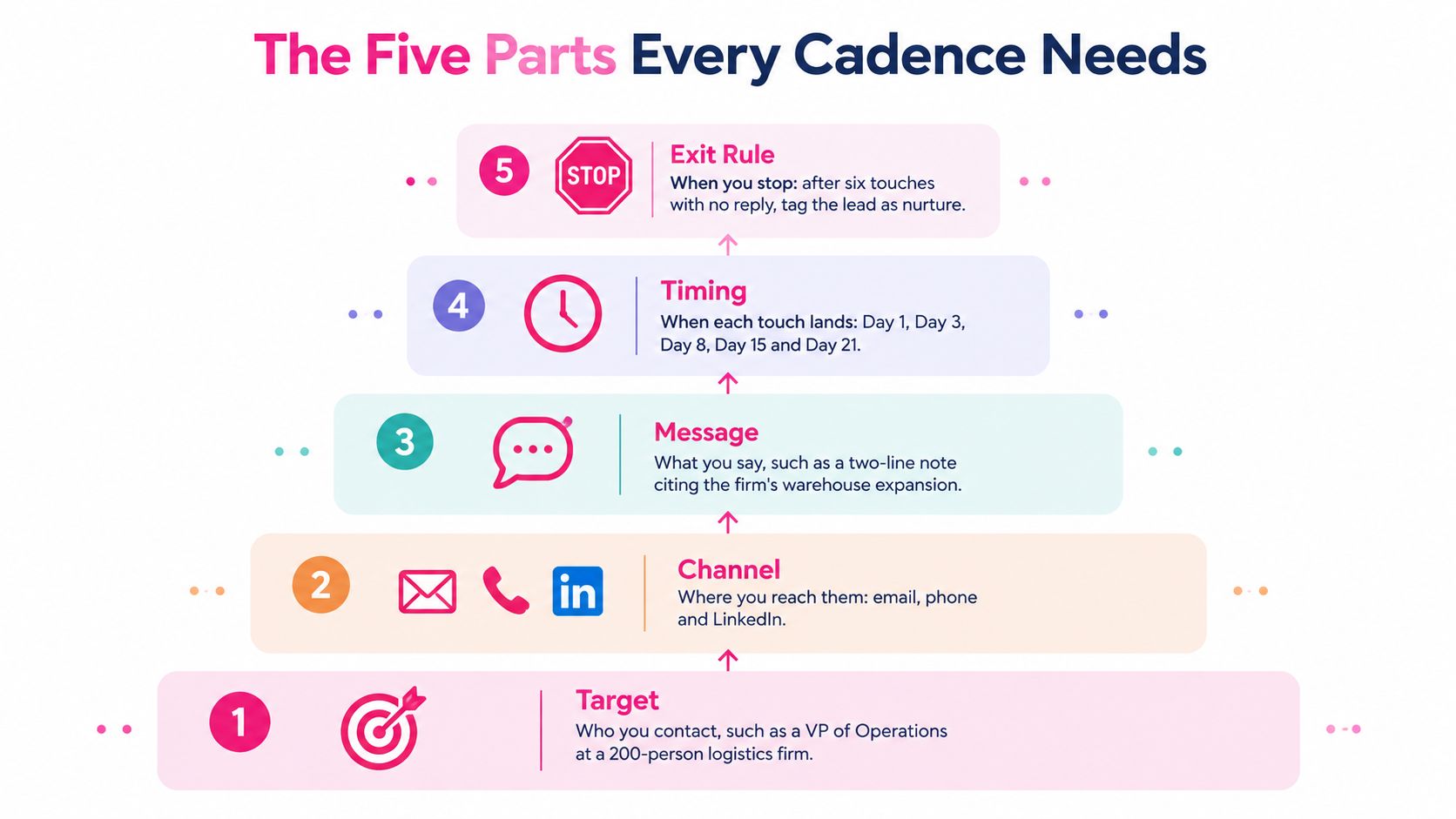
The plan specifies who, channel, message, timing, and stopping conditions. That makes follow-up repeatable without requiring every buyer to receive identical treatment.
The InsideSales Successful Sales Cadence study, covering 479,140 sales activities across 1,456 cadences, found no universal sequence for every market or buyer segment. Its generally productive range was 2 to 7 attempts, not an instruction to keep adding touches indefinitely.
Practical rule: Design a process you can explain and measure, rather than copying a template you can only schedule.
For measurement beyond emails sent, Crescade's guide to metrics for B2B sales performance provides useful context for connecting outreach to business outcomes.
So, what is a sales cadence in practical terms? Orchestration, timing logic, and stop logic, working together.
The Five Parts Every Cadence Needs
Build the buyer definition before writing the opening line. Otherwise, you'll polish a message for someone who may never need what you sell.
For a hypothetical campaign, choose a VP of Operations at a 50-person agency, not anyone with an agency email address. Their responsibility for delivery capacity gives you a reason to discuss project handoffs, staffing pressure, or operational bottlenecks.
The five parts of a sales cadence
| Component | Question It Answers | Example | Common Mistake |
|---|---|---|---|
| Target | Who gets the touch? | VP of Operations at a 50-person agency | Contacting a generic inbox or whole company |
| Channel | Where does the touch arrive? | Email on day 1, call on day 3 | Using one channel for the whole sequence |
| Message | What does this touch say? | A new result or a useful resource | Repeating the first pitch word for word |
| Timing | When does the next touch happen? | Illustrative gaps of 2-3 days, then 4-5 days | Fixed intervals that ignore replies |
| Exit rule | When does the sequence stop? | Reply, meeting booked, opt-out or hard bounce | No stop rule, so outreach continues after a clear rejection |
The table is a worked design example, not a performance benchmark. Think of the components as stacked building blocks.
Give each touch a job
Each interaction tests a useful assumption. Does this person recognize the problem? Is it urgent? Can they influence the purchase? Would they rather talk than exchange emails?
Choose the channel using actual buyer behavior. If your conversations suggest operations leaders review email in the morning, test that window in their local time zone. Don't turn a hunch about working habits into a permanent scheduling rule.
For messaging, separate the angles: a relevant result, a diagnostic question, then a useful resource. A buyer evaluating alternatives needs comparison material; someone still identifying the problem needs help understanding it.
A human should handle high-intent behavior, such as a request about implementation. An objection should change the next message, not trigger another generic introduction.
Use the email sequence generator to draft distinct messages after you've defined those jobs. A generator can help with wording, but you still need to decide what each touch should accomplish.
Why Channel Mix Beats a Single Inbox
Sequences combining phone, email, and LinkedIn produced response rates 287% higher than single-channel outreach in benchmark summaries compiled by iSales, which also cites a separate 178% improvement for multichannel outreach compared with email alone.
Those are reported comparisons, not a forecast for your campaign. They don't mean adding a LinkedIn message automatically multiplies your replies.
The practical mechanism is simpler: a buyer may miss your email, recognize your name from a voicemail, and later respond on LinkedIn. You've offered another context and another response path, rather than merely another inbox notification.
Give channels different responsibilities
- Email carries the detail. Use it for the case, supporting evidence, and a resource the buyer can review or forward.
- Phone and voicemail add a human voice. Prioritize live contact for warm prospects who want help. If unanswered, leave a concise explanation that makes the next email recognizable.
- LinkedIn supports lighter interaction. A relevant comment or short note can suit the setting better than a full pitch. The LinkedIn outreach guide offers a starting point for planning that part of the sequence.
- Task-based follow-up adds preparation. Assign a rep to find a relevant article, review company news, or prepare a research note before contacting the buyer again.
A channel switch without a new angle is the same interruption wearing a different hat.
Suppose you email an agency owner about slow client onboarding. Your call can ask where handoffs get stuck, while a later social interaction can contribute something useful to their discussion about delivery.
Copying the email into a connection request doesn't create that progression.
Match channels to the buyer's professional habits and the permission you have. Respect applicable calling and messaging rules, and remove a channel from the plan when the buyer asks you to. Being reachable somewhere isn't the same as inviting a pitch there.
How Timing and Speed Set the Rhythm
Contacting a web-generated lead within one hour made salespeople roughly seven times more likely to qualify it than waiting longer, according to Harvard Business Review findings summarized by Pel Hughes. That summary also reports nearly 40% of companies replied within an hour, about 16% within a day, approximately 24% after more than a day, and over 20% never responded.
That's an inbound response finding, not permission to chase cold prospects at high speed.
The distinction matters when reading a timeline like this one: the immediate-response milestone applies to an inquiry, while the spaced milestones illustrate planned follow-up.
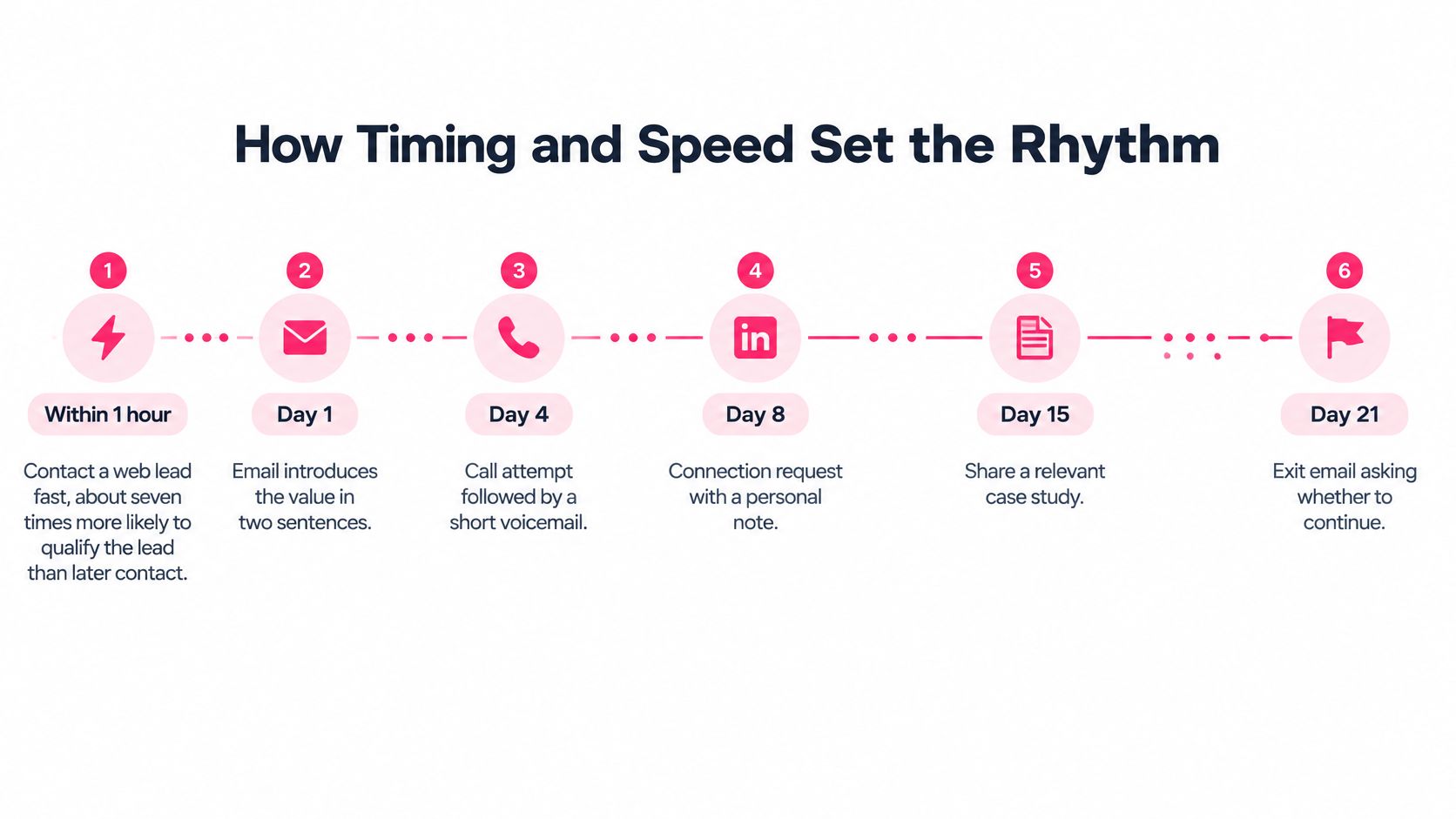
Separate response speed from follow-up spacing
Assign incoming inquiries to a named owner, with backup coverage when that person's unavailable. A confirmation email can acknowledge receipt, but it doesn't replace answering the buyer's question.
For growing teams, Truespeak's guide to stop losing enquiries as your business grows is useful context for planning reliable routing and follow-up ownership.
Cold prospects need a slower schedule. Widen the gaps rather than making daily contact your default.
Reported response rates by follow-up number, compiled in Sendspark's sales follow-up guide, are 21%, 17%, 13%, 9%, and 14%, respectively, for the touches below.
| Touch | Gap Before It | Reported Response Rate |
|---|---|---|
| First follow-up | 2-3 business days | 21% |
| Second follow-up | 3-4 days | 17% |
| Third follow-up | 4-5 days | 13% |
| Fourth follow-up | 5-7 days | 9% |
| Break-up email | About one week after the last touch | 14% |
These rates come from different sources and aren't one controlled experiment. Treat them as direction, not promises, and don't add them together to predict total replies.
Check capacity before scheduling
Use the outbound volume planner to consider follow-up workload alongside new outreach. Leave room for human replies, not just scheduled sends.
Watch median first-response time, contact rate, positive-reply rate, and conversion by touch number. Those measures help distinguish slow handling from poor targeting or weak messaging.
For an additional video resource on the topic:
Cadence Examples for Each Buyer Type
Say you're contacting a cold agency owner about improving delivery handoffs. You introduce the problem by email, follow with a call, and later share a practical resource rather than forwarding your original pitch.
A representative schedule in Apollo's follow-up guide uses email on day 1, a call or voicemail on day 3, a value-adding email on day 5, a social touch around day 8, email on day 12, another call on day 15, and a final email around day 21. The guide also describes a commonly cited B2B pattern of 8-12 total touches over 17-21 days, including 3-6 follow-up messages after initial outreach.
Those aren't identical counts. The representative schedule lists outreach occasions; a broader plan may count separate activities within an occasion. Define what counts as a touch before comparing campaigns.
Make the message progress
For the agency owner, the introduction could identify a delivery challenge suggested by their service model. The next email might share a handoff checklist, while the later call asks whether onboarding or ongoing delivery creates more friction.
The final message should close the loop politely. It shouldn't manufacture urgency or imply the buyer has failed to complete an assignment.
Cadence patterns by buyer type
The following are illustrative starting plans, not measured averages or validated prescriptions. The cold pattern follows the published range; the other rows show how you might adapt a plan to different triggers.
| Buyer Type | Trigger | Lead Channel | Touches and Pace |
|---|---|---|---|
| Cold agency owner | No prior contact | Email, then phone | 8-12 touches over 17-21 days |
| Inbound demo request | Form fill | Phone within one hour | 4-6 touches over 10 days |
| SaaS trial user gone quiet | Usage drops after sign-up | Email with in-app prompt | 4-5 touches over 2 weeks |
| Referral | Warm introduction | Email from referrer, call within a day | 3-4 touches over 7-10 days |
| Event attendee | Badge scan or booth conversation | Email within 24 hours | 4-5 touches over 2-3 weeks |
A referral needs continuity with the introduction, not a cold company overview. An event attendee needs the context of the conversation, and a badge scan alone shouldn't be treated as unrestricted permission.
Let behavior change the plan
Consider a hypothetical SaaS trial user who signs up, uses the product twice, and goes silent. A helpful email might ask whether importing their existing workflow caused trouble, supported by an in-app prompt.
Then the user returns and requests integration information. Instead of leaving them in a low-frequency nurture sequence, assign a human call within a day in this example.
The trigger changes the task. You're responding to a current need, not rewarding a software event with more automated email.
Myths That Make Cadences Fail
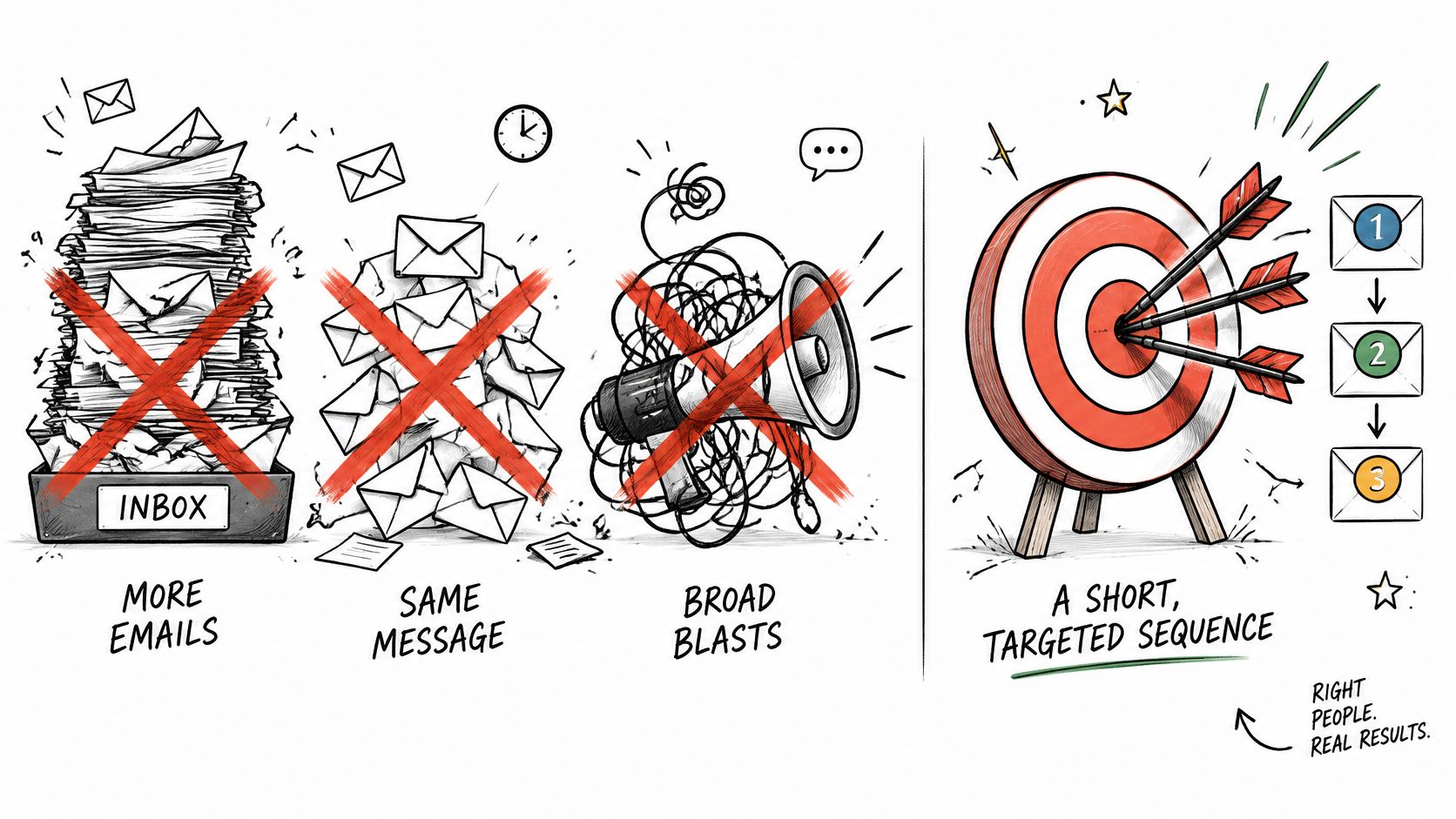
Myth one, more touches always win. Apollo's sales cadence overview reports that 73% of B2B buyers actively avoid suppliers sending irrelevant messages, while 61% prefer an overall buying experience without sales representatives. A shorter, highly targeted sequence can outperform a longer one when you avoid wasting attention and protect sender reputation.
Myth two, a cadence is just automation. Scheduling software can send an email; it can't take responsibility for interpreting a nuanced objection. When a buyer says they're locked into a contract, a rep needs to understand timing and permission before deciding what happens next.
Myth three, one template fits every market. A recruiting firm contacting an agency founder and a cybersecurity seller approaching an IT leader need different evidence, language, and expectations. Swapping the job title isn't meaningful adaptation.
Write a stop policy before launch
- Set maximum attempts. Define the end of an unanswered sequence and record the disposition.
- Require new value. Each follow-up needs a meaningful addition or changed context.
- Suppress clear refusals. Remove contacts after opt-out or an explicit rejection, and share that status across tools.
- Revalidate contact details. Check role changes and address quality before reusing old lists.
Deliverability check: Fixing irrelevant outreach means changing targeting and content, not simply moving the campaign to another mailbox.
Review draft quality with the cold email grader, then verify that your workflow honors the buyer's response.
Treat compliance as a design requirement
CAN-SPAM requires identification and an opt-out mechanism. GDPR treats work email addresses as personal data and requires a documented lawful basis for processing.
Those are planning principles, not a complete compliance checklist or legal advice. Rules differ by country, and permission requirements need review before you launch across markets.
Build Your First Cadence or Hand It Off
Start with a small, clearly defined campaign this week.
- Choose a buyer and offer. Keep the audience narrow enough that the problem is recognizable.
- Map five to eight hypothetical touches. Name the channel and the new angle for each before scheduling anything.
- Separate operating tracks. Give inbound replies priority; give cold prospects breathing room.
- Document stopping rules. Include maximum attempts, opt-out handling, and ownership of exceptions.
- Review conversions weekly. Examine which touches produce qualified conversations, not just completed activities.
Choose who'll operate it
Build in-house if you have reps, clean lists, and the capacity to manage deliverability. Hand it off if research, copywriting, and domain warmup would stall your team.
For smaller teams organizing follow-up ownership, Baikou's guide to managing leads for local service businesses offers useful CRM context.
At Ever Outbound, we're pay-per-close. Our done-for-you process has four steps: we build your verified decision-maker list, write and send short, specific copy on warmed domains, book interested prospects onto your calendar, and you show up to close.
We verify decision makers before sending, and you pay only on deals you close. Compare any delivery arrangement on verified lists, deliverability controls, and stop rules, not its promised volume of activity.
At Ever Outbound Inc., we're pay-per-close, providing done-for-you B2B outreach from prospect research and copywriting to follow-up and calendar booking. Visit us to discuss how we'd build and run a sales cadence for your buyers, so you can focus on qualified conversations and closing deals.