November 16, 2026
Prospect Definition Sales Explained for Modern Teams
A sales prospect is a potential customer who fits the seller's target profile and may buy, but has not yet shown interest or a real need.
Say it's Tuesday afternoon and your CRM is glowing with a few thousand names. Half of them grabbed a checklist last spring. Your manager wants a forecast by Thursday, and someone on the team is already counting every row as money. You can do that, or you can do what a decent host does before a dinner: write the guest list before anyone has replied.
That's the useful version of prospect definition sales. Fit and reachability earn a place on the list. Readiness is what pulls a chair out. Each label changes the next action, so a cold name never gets treated like a booked dinner.
Table of Contents
- What a Sales Prospect Really Is
- Prospect, Lead, Opportunity and Customer Side by Side
- The Two Tests Every Prospect Must Pass
- How Prospects Move Through Your Pipeline
- Prospect Examples From Agencies, SaaS and Consultants
- Mistakes and Consent Rules That Turn Prospects Into Dead Ends
- Build Your First Prospect List This Week
What a Sales Prospect Really Is
You're hosting Saturday. Before a single RSVP lands, you write names on a card: people who like this kind of evening, live close enough to come, and won't start a fight over the seating. Nobody has said yes. They're still on the list.
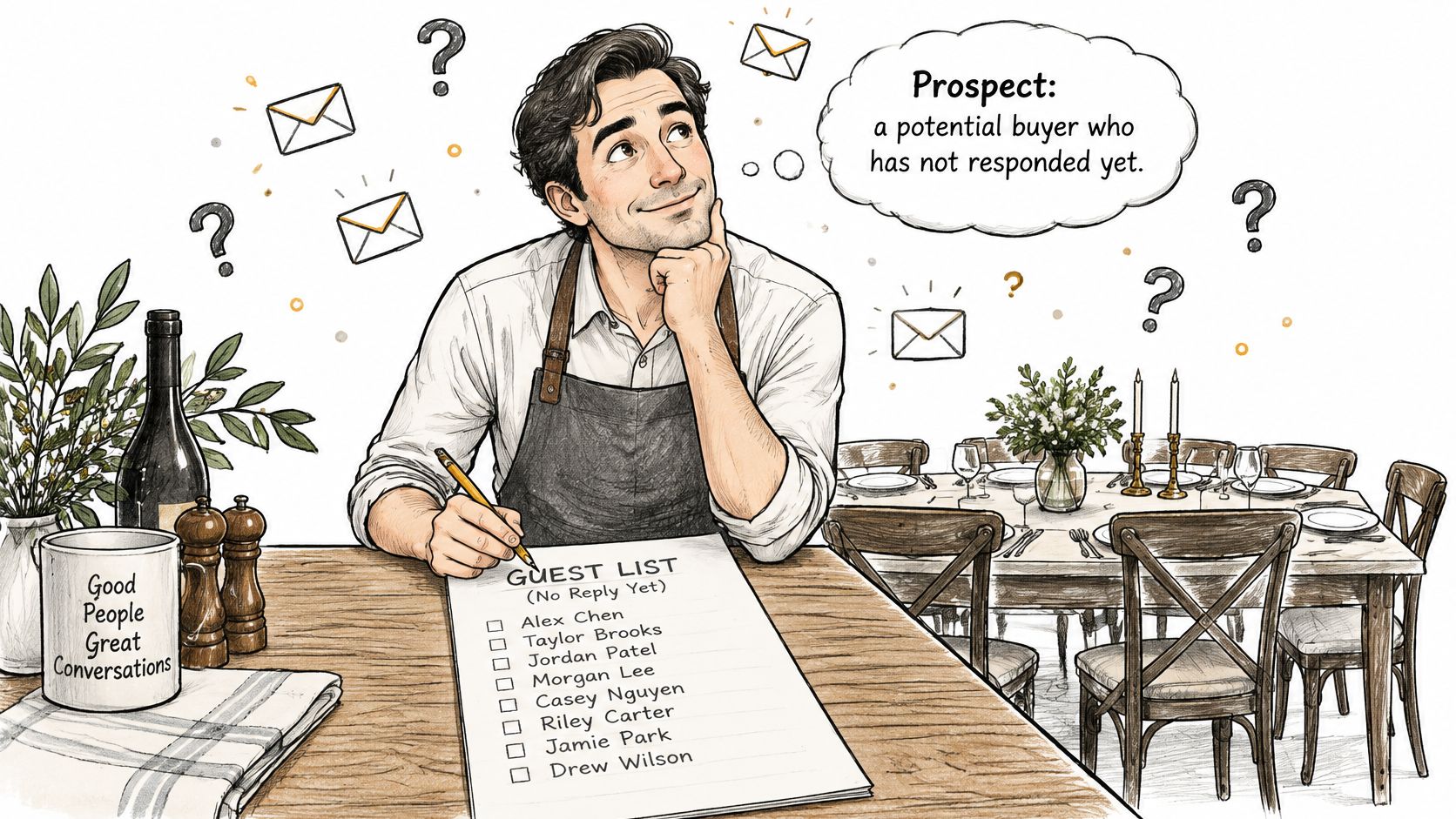
A sales prospect is a potential customer who matches your target profile and can be reached through a permitted channel, but has not yet confirmed a need, interest, or purchase timeline.
A name is not a guest
A contact is any row in a database. A cousin's old intern, a scraped email, a booth scan from a show you barely remember. A prospect is a name you can defend in one breath: this account looks like who you sell to, and you have a lawful way to reach a relevant person.
Three later labels are not prospects, no matter how excited the spreadsheet looks.
- A booked meeting needs a yes on the calendar.
- An opportunity needs a real project, a decision path, and a timeframe.
- A customer needs a signature.
Each of those waits on its own evidence. Calling them early is how forecasts go funny.
If you can't say, in one sentence, why this account matches your ideal buyer and how you'd reach them, it's still a contact.
Run that test on the next twenty rows. Yes means prospect. No means leave it in the contact pile until you can answer both parts.
Prospect, Lead, Opportunity and Customer Side by Side
Five labels, five different jobs. Mix them up and marketing celebrates a download while finance forecasts a deal that doesn't exist.
| Stage | What It Means | Who Owns It | Typical Signal |
|---|---|---|---|
| Lead | A potential customer captured from a form, list or inbound interest | Marketing or SDR | Form fill or content download |
| Prospect | A profile-matched person or account researched for outreach | SDR | Target industry, size and a reachable decision-maker |
| Qualified prospect | A prospect with a confirmed need and some willingness to talk | SDR or account executive | Named pain and a positive reply |
| Opportunity | A recognised project with a decision process and timeframe | Account executive | Counted in the pipeline forecast |
| Customer | A buyer that has signed | Account management | Signed contract |
Where teams swap the name tags
The messy rows are lead, prospect, and qualified prospect. A form fill is a lead. Someone wanted the PDF. A prospect is the account you researched because industry, size, and a reachable decision-maker line up. They may never have clicked anything. A qualified prospect has named a pain and sent a reply that isn't "remove me."
Salesforce describes a prospect as a lead that has been qualified as a good fit and then placed into the sales pipeline, and it says prospects advance only when they meet defined exit criteria for the current stage. In that usage, "prospect" sits closer to the qualified row above than to a researched name who hasn't spoken. Check what your CRM means before you rename fields, or you'll tidy the database and scramble the forecast.
If those fields live in three tools that don't agree, it helps to compare client record tools and pick one place where stage, owner, and signal stay visible.
Playbook line: the label is the next action. Leads get research. Prospects get a permitted first note. Qualified prospects get a call. Opportunities get a forecast line.
The Two Tests Every Prospect Must Pass
The expensive habit is treating a fit-matched contact as ready to buy. They look like your buyer on LinkedIn, so someone dumps them into a sequence that asks for a meeting this week. Most of them weren't shopping. They were just employed.
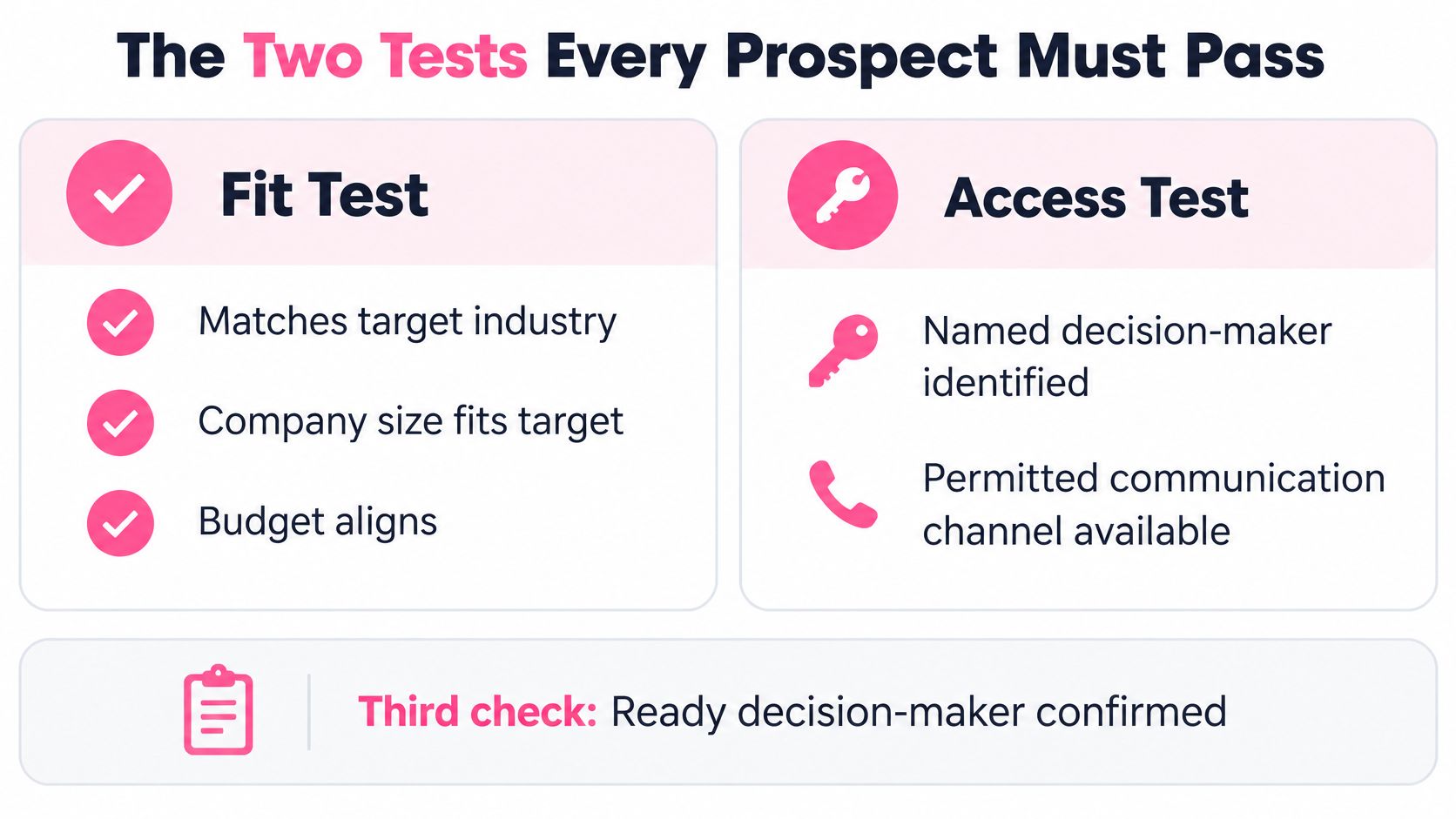
Two tests create a prospect. A third check decides whether they're ready.
Fit, then access
The fit test asks whether the account matches you on industry, company size, geography, buyer role, and decision authority. The accessibility test asks whether you have a named person and a channel you're allowed to use in that region. Pass both, and you have a prospect. Fail either, and you're still holding a contact.
Readiness is separate. Five yes-or-no questions keep the labels honest. If you want a worked version of the same split, the notes on how we qualify cold accounts follow the same order.
- Does the account sit in your target industry and size band?
- Is the person a decision-maker or a strong influencer?
- Is there a reachable contact on a channel you're allowed to use in that region?
- Is there a plausible pain your offer solves?
- Is there a trigger, such as a new hire, a funding round, or a product launch?
Questions 1 to 3 decide prospect status. Questions 4 and 5 decide readiness.
Say a 40-person consultancy just hired a head of sales, you can email that person lawfully, and your offer is outbound for firms that size. Fit, access, pain, and trigger all land. That's a qualified prospect. A similar firm with no trigger stays on a nurture list, not in the bin and not on this week's call sheet.
A short walk-through of the same guest-list logic sits here if you want it beside the checklist.
Write the five answers on the account, then write the label they earned. If question 3 is no, stop. A perfect fit you can't lawfully reach is not a prospect yet.
How Prospects Move Through Your Pipeline
List size is a vanity mirror. Movement is the work.
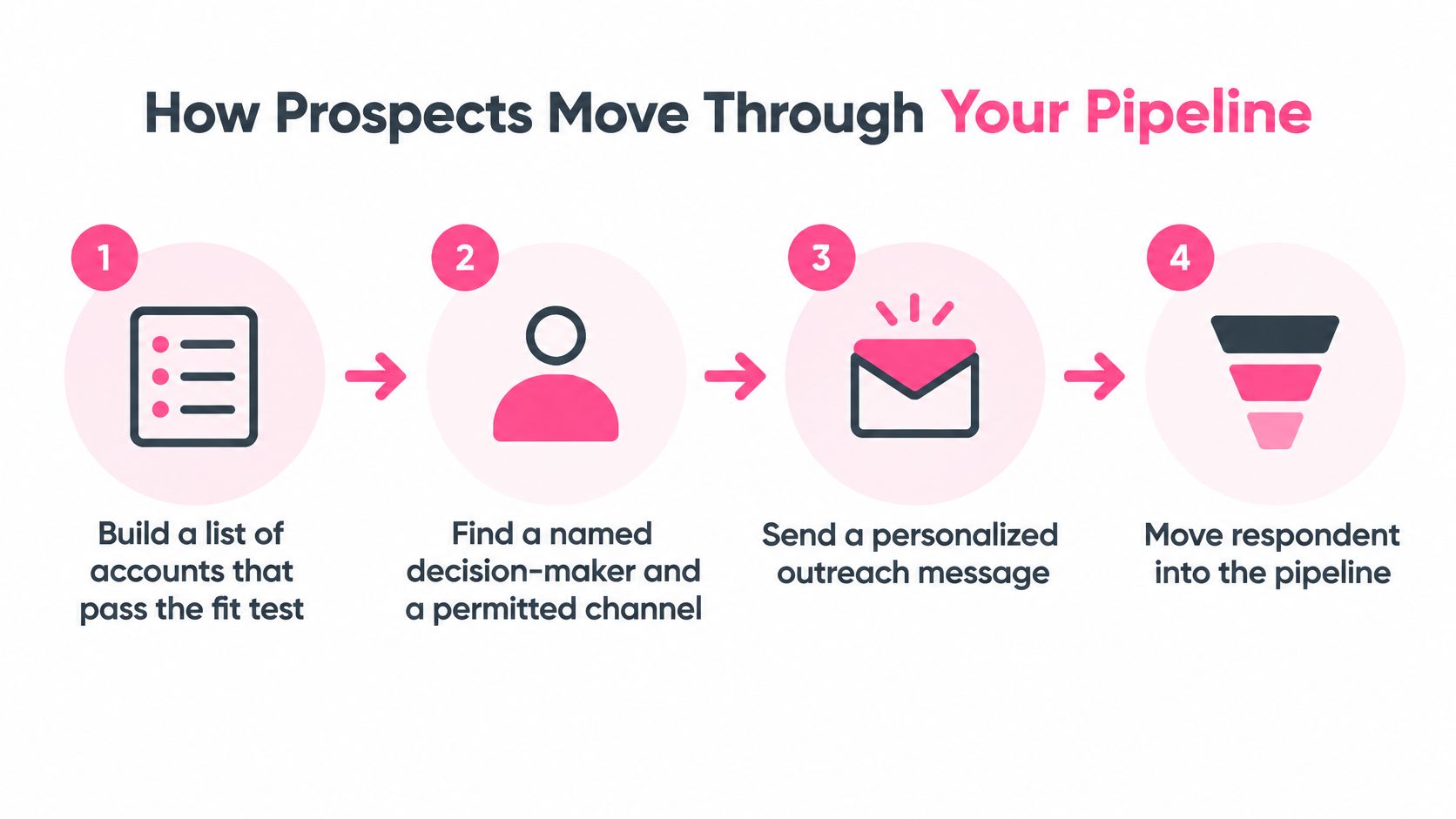
- Build the fit list. Pull accounts that pass industry, size, geography, and role. Stop adding "maybe" logos to hit a round number.
- Name a person and a permitted channel. A company with no reachable buyer is research, not outreach.
- Send one specific angle. One pain, one proof, one ask. A generic pitch teaches them to ignore you. If the site is how buyers find you first, get more enquiries from your site so inbound and outbound aren't telling two stories.
- Sort every reply. Not now, interested, or not a fit. Don't leave "saw this" sitting in a shared inbox.
- Nurture not-now on triggers. A new hire, a budget cycle, a launch. Not a fixed monthly blast.
- Open a qualified record and book the call only after a real interest reply.
- Promote to opportunity only when need, timeline, and authority are all confirmed. Until then it stays off the forecast.
Empact's roundup of buyer-journey findings reports that 63% of B2B leads take at least three months to decide and 20% take more than a year. A good-fit account that says "not now" in March can still be the right guest in September. The cadence should follow their business, not your send calendar.
A funnel you can sketch on a napkin
Say you start with 1,000 accounts. About 300 pass fit and reachability. Sixty reply. Twenty qualify. Five become opportunities. Those figures are a teaching sketch, not a benchmark. They show why a fat list says almost nothing about revenue.
Our own path is the short version of steps 1 through 6: we build the verified decision-maker list, write and send short copy on warmed domains, book interested prospects onto your calendar, and you show up to close. The detail lives in how the outbound process runs, and we're pay-per-close.
Prospect Examples From Agencies, SaaS and Consultants
The tests don't change. The fields on the card do.
A marketing agency sells to brand managers at companies of 20 to 200 people in two cities. Fit is industry plus headcount. The trigger is a campaign that just launched and looks thin. Record: "Brand manager, 80-person retailer, city A, pain is inconsistent creative, trigger is last week's product drop."
A B2B SaaS founder sells to heads of operations at firms already on a complementary tool. The trigger is a new integration or a hiring round, not a generic "scaling fast" line. Teams that sell this way can mirror the pattern in outbound built for SaaS companies. Record: "Head of ops, 120 employees, uses the adjacent platform, pain is manual handoffs, trigger is three ops roles posted this month."
A consultancy wants CEOs of mid-size firms in a leadership shuffle. The trigger is a new appointment or a board review, not a cold note about "transformation."
An IT managed service provider wants IT managers at regulated firms of 50 to 250 people. The trigger is a compliance deadline with a date on it.
Say a SaaS team had been calling 4,000 contacts "prospects." They ran the fit test, kept 600, and replies picked up because the list finally matched the offer. That 4,000-to-600 cut is a scene, not a promise. Entering a new vertical or a new country means writing the definition again. We rebuild prospecting and messaging from scratch for that move, rather than recycling last year's guest list.
Same five questions. Different industry, size band, and trigger on every card.
Mistakes and Consent Rules That Turn Prospects Into Dead Ends
The costliest mistake is forecasting leads. A download is not a deal, and putting it on the revenue slide trains the whole company to chase noise.
Oracle's CRM documentation separates the mechanics cleanly. A lead is a potential customer. Once it meets the organisation's qualification requirements, it can convert into an opportunity. Leads are not included in pipeline forecasts. Opportunities are. A lead becomes forecastable only after that conversion, not when someone exports a CSV.
Permission is not a vibe
Two consent mistakes wreck otherwise good lists, and both should be fixed before anyone hits send.
The European Data Protection Board says legitimate interest is not an automatic exemption for direct marketing. Unsolicited direct-marketing email is generally governed by the ePrivacy Directive's prior-consent requirement, so a perfect ICP match can still be ineligible for that channel. Check channel and country while you build the list, not after the first complaint. Our own rules for that sit on the privacy page.
The European Commission says that, at the latest with the first communication, you must tell people their data is being processed for advertising and that they can object at any time. Put that notice and a working opt-out in email one.
Paste these three lines into the playbook.
- Forecast: only opportunities carry a revenue number.
- Channel: no list goes live until consent rules for that country are checked.
- First email: advertising notice and objection path, or it doesn't send.
Build Your First Prospect List This Week
Your job before Friday is small on purpose. Review the first 50 accounts against the tests. Fifty is enough to see whether the list is a guest list or a phone book.
- Export and dedupe. One row per account. Merged duplicates hide bad data.
- Mark fit yes or no on industry, size, geography, and buyer role.
- Mark accessibility yes or no on a reachable contact and a permitted channel.
- Mark readiness on pain and on a real trigger.
- Label each row prospect, qualified prospect, or nurture, and put a trigger date on every nurture account.
You can do that review with a spreadsheet and a stubborn afternoon. If the export is a mess, a lead list cleaner takes the duplicate hunt off your plate before you score anyone.
Outside help is optional. Ever Outbound can build and verify lists against the same fit, accessibility, and readiness rules. When prospects reply with interest, we nurture them with timely follow-ups and book qualified calls directly onto your calendar. The work runs in four steps: verified decision-makers, short copy on warmed domains, interested prospects booked to your calendar, and you showing up to close. We're pay-per-close, so you pay only when a deal closes from that work. The Friday review still works if you never call us.
Block 90 minutes before Friday and finish the 50. You'll know which names belong on the list, which ones can be invited now, and which ones should wait for a real reason to knock.
Ever Outbound Inc. runs done-for-you B2B outreach that starts with a real prospect definition, not a dumped contact file, and we're pay-per-close. We research decision-makers who pass fit and access, write the first note, and book interested buyers onto your calendar so your team spends time on conversations that earned the label. If your pipeline is still a guest list with no RSVPs, visit Ever Outbound Inc. and see how the four steps would run on your market.