October 23, 2026
Outsourced Sales Team Models That Actually Close
A SaaS founder opens the calendar on Monday and sees plenty of room for sales calls. The product works, customers like it, and the offer is clear enough. But prospecting happens in bursts between product decisions, client work, and whatever just caught fire. Hiring an employee sounds like the grown-up move, until the founder remembers that someone will need to train, manage, and support that hire while the pipeline stays quiet.
An outsourced sales team is rented commercial capacity. It can take a narrow slice of the work, like prospecting and meeting generation, or manage research, messaging, qualification, follow-up, and pipeline coordination. It isn't a magic closer, and the client still has to decide what happens when a prospect says yes.
That distinction matters more than it might seem. Outsourced-sales market estimates vary because providers define the category differently, grouping services such as lead generation, appointment setting, outsourced SDRs, channel sales, and full-cycle selling in different ways. The useful signal is that outside sales capacity has evolved from a stopgap for staffing gaps into a way to test markets or customer segments without building a complete internal revenue organization (overview of outsourced sales teams).
Think of a kitchen. One restaurant rents a prep cook; another rents the whole line. Neither should expect a stranger to plate the dish and decide whether it tastes right without the owner involved. The same boundary question sits underneath every sales partnership. Before sending a campaign, choose whether you need part-time prospecting, a research-and-qualification unit, or a managed meeting-to-pipeline operation.
Table of Contents
- Why an Outsourced Sales Team Exists
- Three Outsourced Sales Team Models
- What an Outsourced Sales Team Fixes and Misses
- Onboarding an Outsourced Sales Team Safely
- KPIs for an Outsourced Sales Team
- Choosing an Outsourced Sales Team Partner
- Start With Meeting to Close Rules
Why an Outsourced Sales Team Exists
A creative agency owner can have excellent client work and still struggle to start conversations with the next client. A consultant can know exactly whom they help and still spend the week delivering work instead of contacting prospects. A recruiter, MSP, coach, or cybersecurity firm can have a compelling offer but no reliable owner for outbound.
The temptation is to hire an SDR and hand over a laptop, a CRM login, and a vague instruction to “get meetings.” But a new hire can't create a pipeline process from thin air. Someone needs to define the audience, explain the offer, review the messaging, coach the outreach, and decide whether a booked call is actually qualified. If the founder is already stretched, that management work can become the job.
An outsourced sales team provides capacity for a defined part of that job. It may identify prospects and book meetings, or take on more of the operational chain, including research, personalized outreach, reply handling, qualification, and calendar coordination. That flexibility can help a company test a new segment before committing to a full sales department. For a closer look at the trade-off between outside support and a first internal hire, compare outsourcing sales with hiring an SDR.
The catch is that rented capacity doesn't make unclear ownership disappear. If an external team books a call, who prepares for it? Who follows up if the prospect doesn't show? Who decides whether the conversation created a real opportunity? Those are revenue-operating questions, not administrative details.
Market estimates for outsourced sales vary considerably because the category can include everything from lead generation to full-cycle selling. So don't treat any single market-size figure as the buying decision. The practical point is simpler: external sales capacity gives a business another way to test demand and create conversations without immediately hiring, training, and supervising a complete revenue team.
Three Outsourced Sales Team Models
The easiest way to choose a model is to draw a line around the work. Who researches accounts? Who writes the message? Who watches replies? Who puts the meeting on the calendar? Three common arrangements put that line in different places.
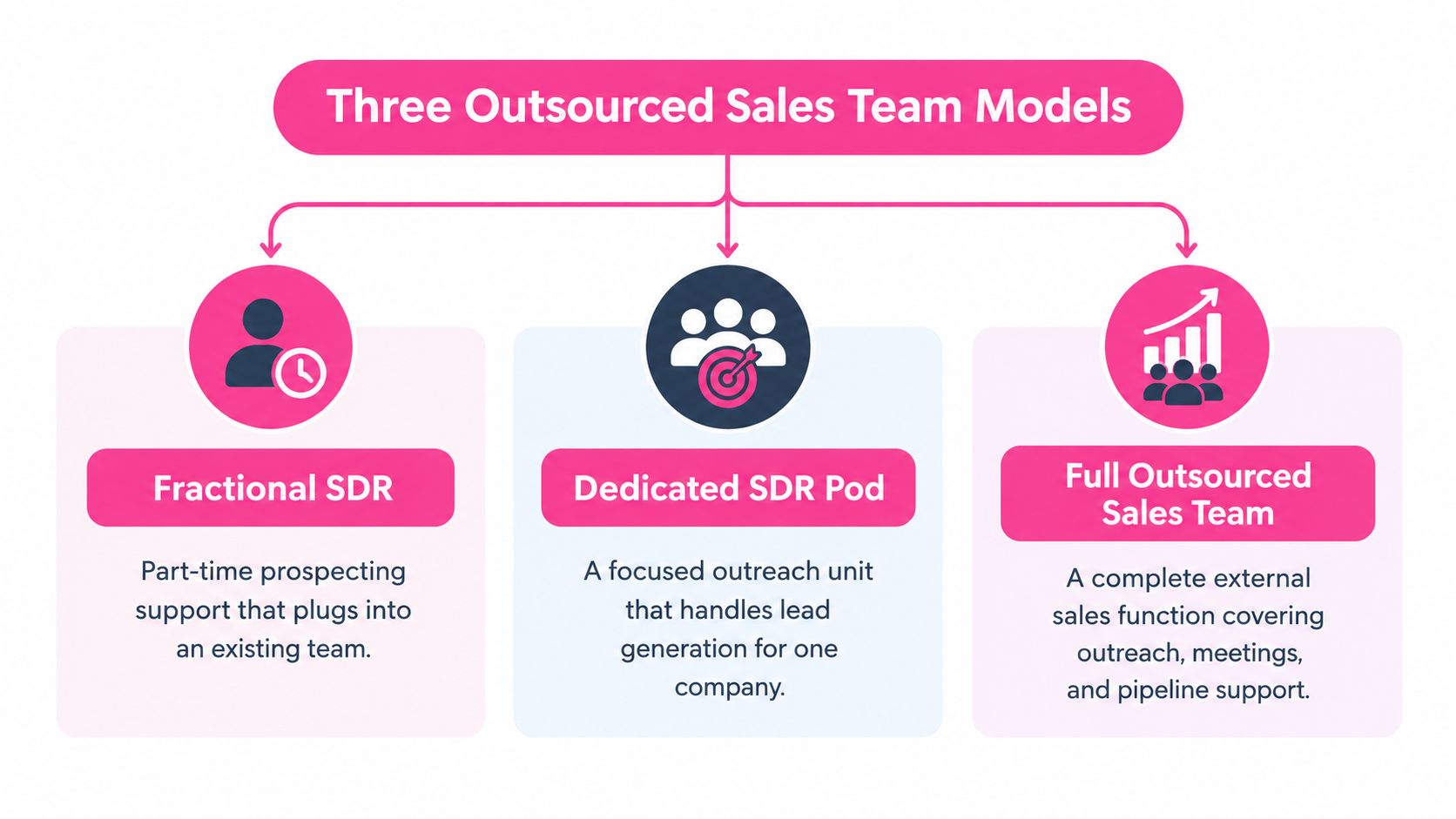
A fractional SDR works part time inside the client's existing sales process. This can fit when the company already has a usable CRM, approved messaging, and a clear way to handle positive replies, but needs more prospecting hours. It gets awkward when the client expects the SDR to invent the audience, repair the offer, and manage the pipeline without direction.
A BDR-style pod takes on a wider slice. The team may research accounts, build and run sequences, and qualify responses before handing an interested prospect to an internal closer. The client still needs to supply product knowledge, a clear definition of qualification, and a salesperson ready to run the meeting.
Managed appointment setting is the more complete operating service. The provider may help frame the offer, build verified prospect lists, write multistep outreach, monitor replies, and coordinate booking. The client typically shows up to sell. For teams comparing compensation structures, it helps to understand pay-per-meeting sales programs, while remembering that the payment trigger doesn't define who owns the rest of the funnel.
| Model | Primary job | Client still owns | Best fit |
|---|---|---|---|
| Fractional SDR | Add prospecting hours to an existing process | Messaging, coaching, reply handling, and closing | A team with a working motion but limited capacity |
| BDR-style pod | Research, outreach, and initial qualification | Product expertise, sales calls, and opportunity decisions | A team that needs a broader prospecting unit |
| Managed appointment setting | Manage outreach through qualified calendar booking | The sales conversation and revenue decision | A B2B business that wants outside campaign operations |
These models aren't a ranking from basic to superior. They're different choices about where the handoff happens. Agencies, SaaS companies, consultants, and other B2B service firms can use that modularity to add pipeline work without building an entire revenue department. External sales capacity has moved beyond filling a temporary staffing hole; it can also help a business enter a market or test a segment while keeping fixed headcount lean.
What an Outsourced Sales Team Fixes and Misses
An outsourced sales team can absorb some frustrating work: inconsistent prospecting, limited research capacity, and the day-to-day effort of keeping outreach moving. If the team also monitors responses, it can help prevent an interested prospect from sitting unanswered while everyone assumes someone else owns the inbox.
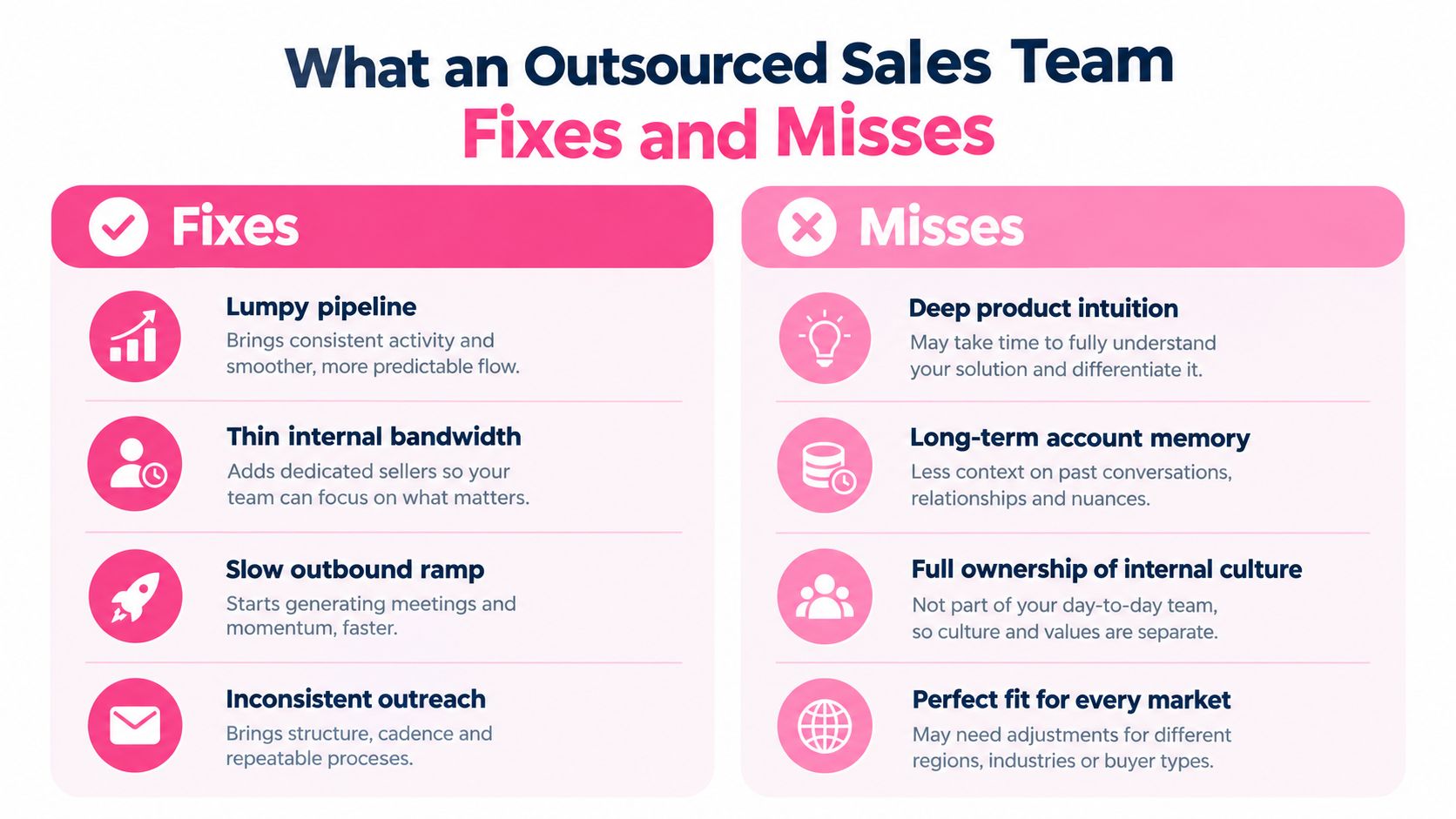
The match between problem and service matters. Lumpy pipeline may call for a consistent calendar of qualified conversations. Thin prospecting skills may call for specialist research and decision-maker messaging. Slow replies may call for a monitored queue and clear ownership. A new segment may call for a targeted test rather than an immediate permanent hire. If the basics of meeting quality are fuzzy, start by defining what makes a lead meeting-ready.
But outside help has limits. A vendor can't substitute for deep product intuition, years of account history, or a client team that understands what customers are buying and why. A campaign may open a door; it can't make the offer fit the prospect.
Blunt truth: Booked meetings are inventory, not revenue.
That's why pricing deserves a careful read. A retainer may buy dependable capacity, but the provider can be paid even if the program doesn't create closed business. Pay-per-close can align the provider's compensation with revenue from its efforts, but it can't fix a weak offer, a closer who disappears, or an unclear rule for attributing a deal.
| What outside support can improve | What the client still has to own |
|---|---|
| More consistent prospecting and outreach | Product expertise and a credible offer |
| Research and campaign execution | Fast, thoughtful sales follow-up |
| Reply monitoring and meeting coordination | Discovery, objection handling, and closing |
| A controlled test of a new audience | Fair attribution and CRM ownership |
Shared or multi-touch deals make attribution harder. So does a prospect who buys long after the campaign, or a contract that ends while the provider's records and learnings remain in its systems. Those are commercial rules, not copywriting problems. Decide them before launch, and don't assume a compensation model will do the work for you.
Onboarding an Outsourced Sales Team Safely
The risky moment in an outsourced campaign arrives after launch week, when the first positive reply lands in a shared inbox nobody owns. Before that happens, settle the basics: the offer, the audience, a relevant and verified prospect list, approved messages, and a named person watching replies.
Map the handoff chain next. Treat the program as a meeting-to-close system and decide, before anyone sends an email, who owns the booked meeting, who owns getting the prospect to show up, who converts the meeting into an opportunity, and who closes the deal. A provider can run outreach well and still watch the program stall because those four ownerships were never assigned.
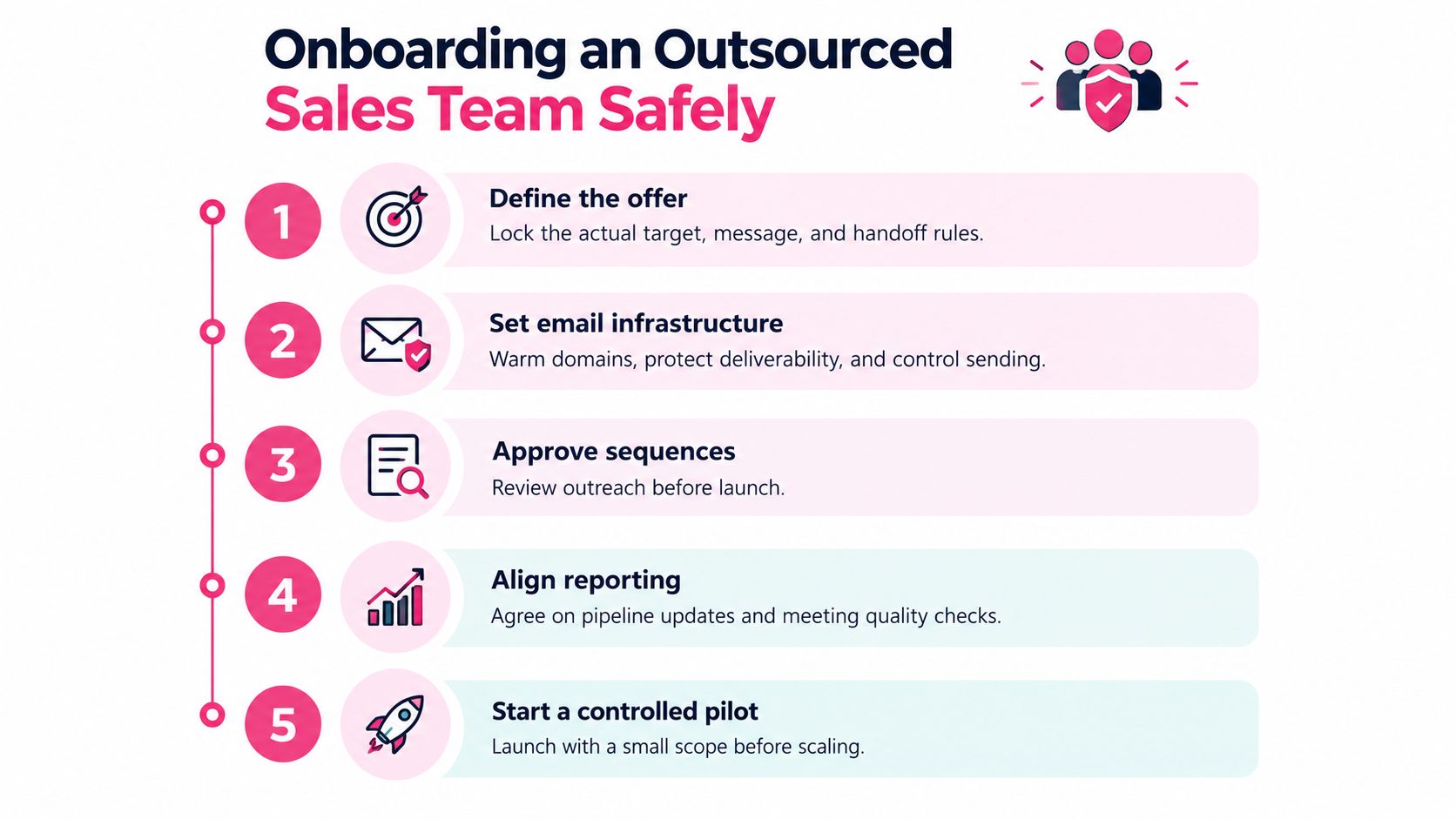
Sending setup comes after that. SPF, DKIM, and DMARC let receiving services verify that mail is authorized and tied to the domain it claims to come from. These records work like a return address and a wax seal on a letter: they prove where the letter came from, though they cannot make the recipient glad to receive it.
Gmail adds its own requirements. Since February 1, 2024, senders reaching Gmail accounts must authenticate with SPF and DKIM, maintain valid forward and reverse DNS records, use TLS, and keep the spam rate reported in Google Postmaster Tools below 0.3%. Google recommends keeping that rate below 0.1% (Gmail sender requirements). Senders delivering close to 5,000 or more messages in a day to personal Gmail accounts face stricter rules: SPF, DKIM, and DMARC authentication, alignment between the From domain and an authentication domain, one-click unsubscribe, and unsubscribe requests processed within two days (Google's bulk sender guidance).
Keep control over campaign risk
Domain pools and daily sending caps spread workload across mailboxes. They cannot rescue a poor list, unwanted outreach, or a burned sender reputation. Agencies running campaigns for several clients should separate sending identities so one client's complaints don't become every client's problem. Watch bounces and complaint rates, and when either climbs, pause the mailbox and fix the cause. Pushing the same volume through a weakening sender only digs the hole deeper.
Reply handling deserves the same contract-level clarity. A positive response should land in a monitored queue, get escalated the same day, and reach a person who can answer a real question or coordinate the meeting. The managed campaign workflow should spell out who owns each handoff, from first reply to held meeting to accepted opportunity. Pressing send is the easy part.
KPIs for an Outsourced Sales Team
A high send count can look busy while telling you little about revenue. Track whether the right prospects respond, whether they take a meeting, whether they show up, and whether your sales team accepts the opportunity.
Speed belongs on the scorecard because interested prospects can lose momentum quickly. A Harvard Business Review audit of 2,241 U.S. companies found that the average responding company took 42 hours to respond. Companies that contacted a lead within an hour were nearly seven times more likely to qualify it than those waiting another hour, and more than 60 times more likely than those waiting at least 24 hours (Harvard Business Review lead-response audit). InsideSales also reports that conversion rates are more than eight times higher when the first response attempt happens within five minutes rather than between five minutes and 24 hours. In its supporting data, only 4.7% of organizations met the five-minute callback window, while average response time was 44 hours (InsideSales response-time analysis).
Those benchmarks make a useful operating target: acknowledge positive replies within five minutes during staffed hours and escalate them the same day. AI can flag intent and route a response, while a human checks context, answers the prospect's question, and protects the quality of the conversation.
Build a weekly scoreboard
Use a short scorecard that links campaign execution to sales outcomes:
- Median first-response time: How long does a prospect wait after showing interest?
- Positive-reply-to-meeting conversion: How often does a relevant reply become a booked call?
- Meeting show rate: Are prospects attending, or does the calendar fill with no-shows?
- Qualified-opportunity rate: Does the internal sales team accept the resulting opportunities?
- Technical and commercial health: Review delivered rate, an inbox-placement proxy, positive replies, qualified meetings, and opportunities per 1,000 delivered messages.
Define an accepted meeting before the first campaign launches. A no-show shouldn't count as a win, and a call with someone outside the agreed audience shouldn't become qualified just because it happened. For teams evaluating how to review and learn from calls, this guide to comparing call notetakers for field sales offers a useful look at tools that can support consistent call reviews. The weekly review should end with specific decisions: keep the targeting, revise the message, improve handoff speed, or stop a campaign that isn't creating accepted opportunities.
Choosing an Outsourced Sales Team Partner
A creative agency may want white-label fulfillment. Its team can sell acquisition work under its own brand while an outside partner handles the research and campaign operations. The agency still needs to price the service carefully, protect its client relationships, and own the result it promises.

A B2B SaaS company or consulting firm may want qualified sales calls without hiring and coaching an internal SDR team. A recruiter, MSP, coach, or cybersecurity firm may instead want to test a new audience before opening a local sales office. The right partner depends on whether the business needs additional hands, a managed outreach process, or both. If staffing is on the table, this overview of choosing a sales staffing agency can help clarify what to evaluate.
Cross-border delivery is common in outsourced sales. North America accounted for more than 41% of global outsourced-sales contracts in a 2025 estimate, while India, the Philippines, and Eastern Europe were described as major talent hubs. That same estimate reported multilingual support across more than 20 languages (outsourced sales service market overview). Distributed teams can help a business test new markets, but distance only works if the client can see campaign activity and participate in timely handoffs.
Ever Outbound is one pay-per-close option. It provides done-for-you B2B client acquisition, with a human team handling research, copywriting, and appointment setting, supported by AI and managed sending. Its scope can run from cold-traffic offer creation and verified lists through warmup, follow-up, and calendar booking, with a client platform for campaigns, replies, and bookings. The client shows up to the calls and closes; it's a fit when the client is ready to own that part of the sale, not when they want to hand off closing entirely.
The service charges a 5% commission only when a deal closes from its efforts, with the first two closes commission-free. Plans start at $97 a month plus that commission. Those terms can be useful to weigh, but they don't remove the need to establish quality standards and attribution before the campaign begins. For a visual walk-through of a managed outbound setup, watch this overview before deciding whether the delivery model fits your team.
Start With Meeting to Close Rules
Before anyone sends an email, define the handoffs that turn a booked call into a business outcome. Outsourced sales arrangements often get slippery here: the provider counts a meeting, the client questions its quality, and nobody agreed on what should happen if the prospect buys later.
Write down these definitions:
- Accepted meeting: What audience, role, need, and confirmation make a booked call count?
- Show rate: Does the metric include only meetings that take place?
- Sales-qualified opportunity: What must the client learn or confirm before accepting the opportunity?
- Pipeline attribution: How will shared and multi-touch deals be credited, and what happens when a prospect closes months later?
- Closed-won: What record proves the deal closed, and how will the agreed commission or outcome be calculated?
Then decide who owns CRM records, campaign data, and learnings if the relationship ends. Make sure the client team has a clear obligation too: respond promptly, run real discovery, update the CRM, and tell the provider why it rejected a meeting. Without that feedback, the external team can't reliably distinguish a bad-fit prospect from a weak handoff or an internal closing problem.
Pay-per-close can remove retainer risk, but it can't compensate for a weak offer or slow closing. If you're considering that structure, write down the pay-per-close terms and deal-credit rules alongside the meeting definitions, before anyone starts outreach.
Your next step is a working session, not another vendor demo. Put the offer on the table, name the person who owns the calendar and the sales call, and settle the attribution rules. Only then compare partners on the work they'll own and the evidence they'll provide.
Ever Outbound Inc. provides done-for-you B2B client acquisition on a pay-per-close basis, with a human team managing research, personalized outreach, replies, and qualified meeting bookings. If that meeting-to-close setup fits your sales motion, visit Ever Outbound Inc. to review the managed service and client platform.