October 24, 2026
Lead Generation for SaaS That Fills the Calendar
It's Monday, and you're staring at a dashboard that looks healthier than your calendar. Demo requests are up, webinar registrations look respectable, and someone has labeled a pile of outbound replies “engaged.” Your sales team still has room for lunch, errands, and an ambitious afternoon nap.
Table of Contents
- Why SaaS Lead Generation Feels Broken
- Design an Offer Cold Buyers Will Take
- Mix Inbound and Outbound by Buyer Stage
- Qualify Leads Before You Celebrate Volume
- Keep Outbound Mail Out of Spam
- Choose Who Runs SaaS Lead Generation
- Book the Next Qualified Call
Why SaaS Lead Generation Feels Broken
The mistake is assuming those names represent buyers waiting for a salesperson to explain the category. Some are researching. Some are collecting material for colleagues. Some have already chosen a favorite and need another vendor for comparison.
Lead generation for SaaS isn't a contest to collect contact details. It's the work of earning a place in a buying decision, then turning that position into a qualified conversation.
McKinsey's 2024 B2B Pulse research found that buyers use an average of 10 interaction channels, compared with 5 in 2016; Gartner research cited in the same coverage found that 61% prefer an overall rep-free buying experience, according to this summary of B2B buying and lead-generation research.
That doesn't mean buyers never want sales help. It means you shouldn't require a conversation before letting them understand what you sell, where it fits, or why they should consider it.
Your CRM records activity, not conviction
A downloaded guide tells you someone wanted a guide. An outbound reply might mean interest, confusion, or a polite request to disappear. Neither deserves a victory lap.
Meanwhile, another prospect might arrive after reading reviews, checking integrations, and discussing your product internally. Treating both contacts as equivalent makes your reporting neat and your decisions worse.
More names in a spreadsheet is not a pipeline. A pipeline needs buyers taking meaningful steps toward a purchase.
A single form can't capture that journey. An isolated cold sequence can't support every stakeholder. And a raw lead count can't tell you whether anyone intends to buy.
Replace the scoreboard
Keep activity metrics for troubleshooting, but run the commercial review around:
- Qualified meetings held: Did the right person attend with a relevant problem?
- Buying-stage movement: Did the account move into evaluation, technical validation, or a purchasing discussion?
- Closed revenue: Did the acquisition work produce customers, not just conversations?
For a measurement starting point, use FOMOchat's guide to measure SaaS lead generation performance while defining your own acceptance criteria.
The operating priorities are straightforward: offer, targeting, channel mix, qualification, and inbox health. None compensates indefinitely for the others. Brilliant copy won't rescue an irrelevant offer, and pristine reporting won't persuade a buyer who can't see a reason to meet.
Design an Offer Cold Buyers Will Take
“Book a demo” is a scheduling instruction. It isn't an offer.
A stranger needs to understand why your product deserves attention before agreeing to watch someone share a screen. Start with a narrow customer and a recognizable problem, not a tour of everything your engineering team shipped.
Build an ICP card you can reject accounts against
Your ideal customer profile, or ICP, should make exclusion easy. If almost any company qualifies, you've written a market description, not a targeting rule.
Use this checklist to make the selection concrete.
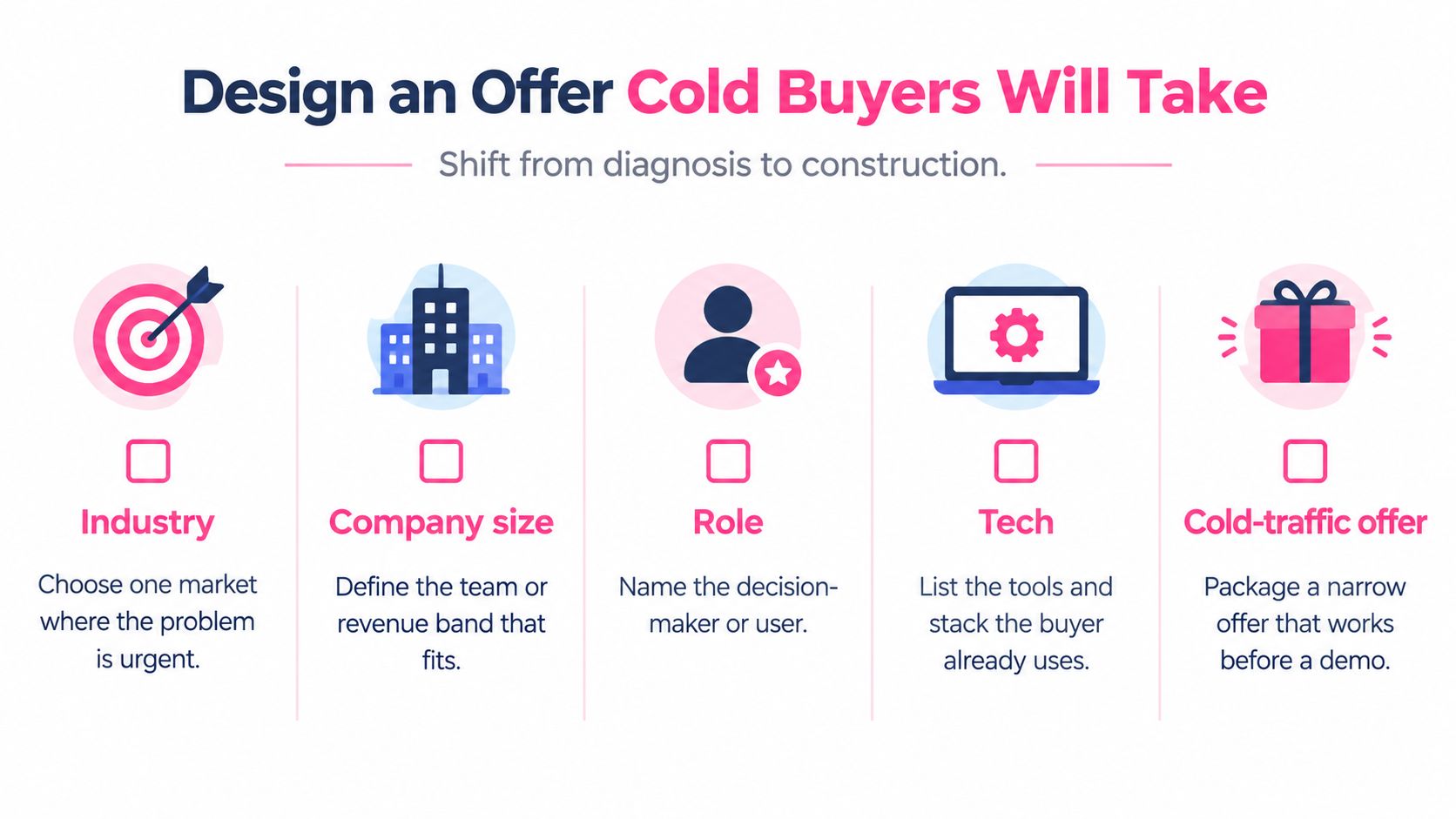
For a hypothetical security SaaS product, the card might look like this:
- Industry and size: Mid-market professional services firms with a lean internal IT team.
- Role and authority: The IT leader who owns access controls, with a named security or finance stakeholder involved in approval.
- Technical environment: Microsoft 365 and a supported identity platform.
- Problem: The team can't confidently identify stale access across connected applications.
- Urgency: An upcoming audit, a recent acquisition, or a change in security responsibilities.
Those details are targeting hypotheses, not proof of demand. Validate them in conversations and disqualification notes before expanding the list.
Make the invitation useful before the demo
Compare these hypothetical messages.
Weak: “We're a security platform. Would you like to book a demo?”
Sharper: “Preparing for an access review? We can walk through how our product identifies stale permissions in your existing environment, using a sample report you can inspect before the call.”
The second invitation names a problem, explains the work, and offers something the buyer can evaluate. Only offer that report if you have it. An attractive promise your rep can't deliver is a sales problem disguised as good copy.
Attach checkable proof: a relevant customer result you're permitted to publish, a genuine review, or documentation showing how the product handles the specific risk. If proof is thin, narrow the promise rather than decorating it.
If you're using AI to draft variations, MyMentions' guide to test and refine your AI prompts is a useful companion. Supply the ICP, exclusions, available evidence, and delivery limits. Don't let the model manufacture credibility.
At Ever Outbound, we're pay-per-close. We build a compelling, conversion-tested cold offer from scratch to turn cold prospects into booked calls, so it has to be something a rep can close.
Before spending on distribution, finish this sentence: We help [specific buyer] address [specific problem], and the next conversation lets them evaluate [specific evidence or outcome].
Mix Inbound and Outbound by Buyer Stage
Your buyer doesn't care which department owns the channel. They care whether they can answer the question in front of them.
Someone diagnosing a problem needs education. Someone assembling a shortlist needs comparisons and evidence. A named account with a relevant trigger may need a direct introduction, even if nobody there has visited your website.
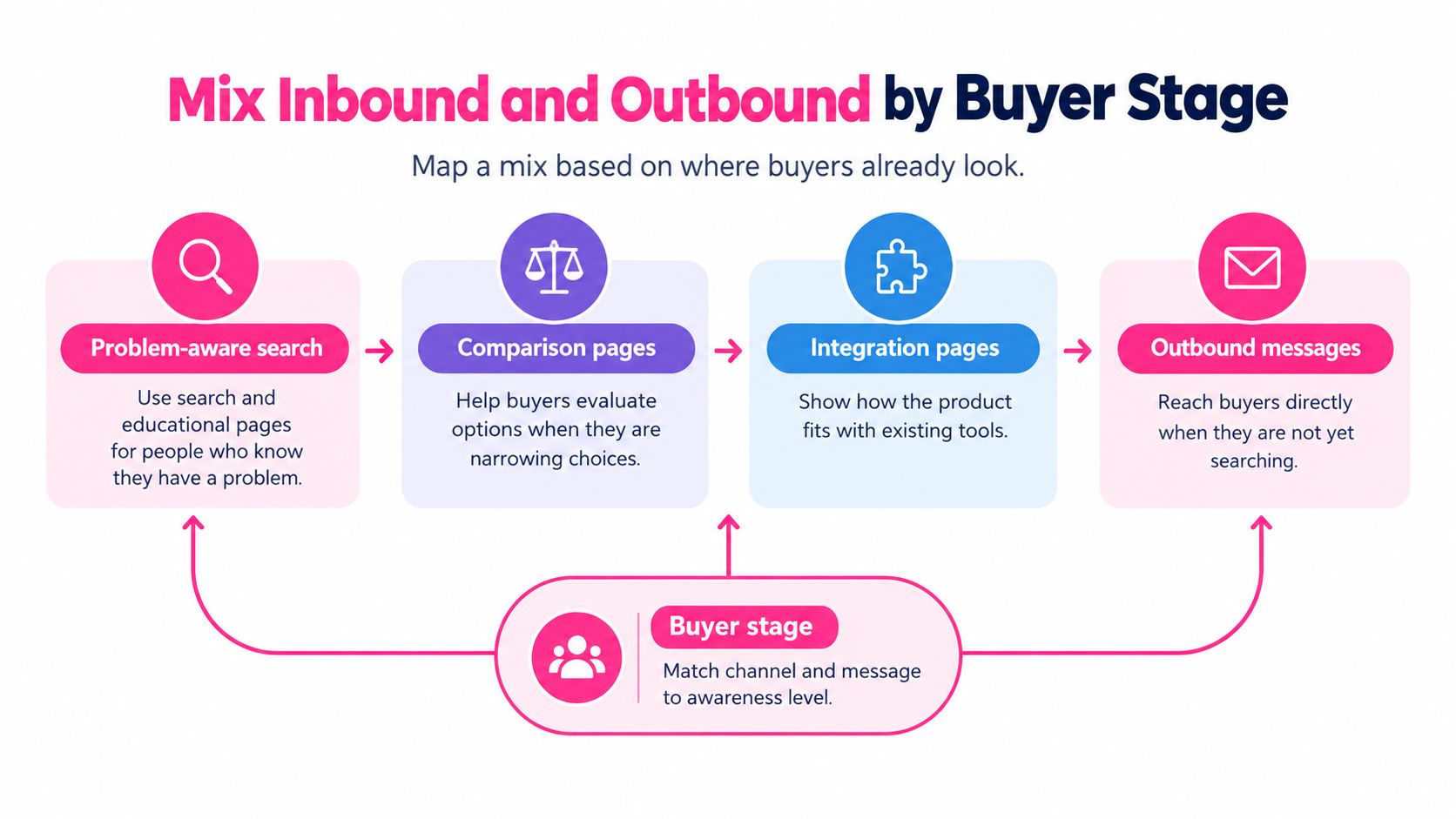
Use buyer stage as the organizing principle.
Discovery no longer belongs to Google alone
In G2's 2025 survey of 1,169 B2B decision-makers, 79% said AI search changed how they research software, 29% start through LLMs more often than Google, and generative chatbots influenced shortlists more than vendor websites, 17.1% versus 12.8%; enterprise buyers ranked review sites at 56% and AI search at 55%, while SMB buyers remained more reliant on Google at 47%, according to G2's software buyer behavior report.
The recommendation isn't to abandon SEO and chase chatbot mentions. It's to stop treating your website visit as the beginning of every evaluation.
Publish precise category language, public product documentation, integration details, and customer evidence. Give humans clear answers and AI systems material they can potentially retrieve and cite. No formatting trick guarantees inclusion in an AI answer.
Keep claims consistent across your website, review profiles, sales materials, and partner descriptions. If each tells a different story, buyers have to resolve the contradiction themselves.
Build different mixes for different accounts
| Buyer situation | Useful assets and channels | Recommended next action |
|---|---|---|
| Recognizes a problem | Educational search pages and practical guides | Help diagnose the issue |
| Builds a shortlist | Comparison pages, reviews, customer proof | Explain fit and limitations |
| Checks technical compatibility | Integration pages and public documentation | Make validation straightforward |
| Matches the ICP but hasn't engaged | Targeted email or LinkedIn outreach | Introduce a relevant reason to talk |
For enterprise acquisition, I'd prioritize review credibility, technical depth, and materials that stakeholders can circulate internally. For SMB acquisition, I'd keep problem-aware search prominent and make the route from explanation to evaluation less demanding.
That's a starting allocation, not a permanent budget rule. Judge each segment by its qualified opportunities and commercial outcomes.
For another perspective on the outbound motion, watch the accompanying video.
Outbound should point only at accounts that match the ICP, with a destination suited to their likely question. Don't send a technical evaluator to a vague homepage and hope they enjoy the scavenger hunt.
Use the outbound volume planner to model sending capacity against the available account pool. Capacity is a limit, not a quota. A smaller relevant audience is preferable to padding a campaign with companies your sales team wouldn't accept.
Qualify Leads Before You Celebrate Volume
Four hundred new leads this month and three real conversations on the calendar. I've watched that exact gap fool entire SaaS teams into raising spend. Responsive's 2025 buyer study found that 90% of buyers research before first contact, 61% begin with a preferred vendor, and nearly half remain open to switching, with the RFP response named the most critical factor in the final decision, according to Responsive's study of the B2B buyer's mind.
Qualification here is bigger than confirming an email address. You're deciding whether you can enter a shortlist that may already exist, and what could change the buyer's current preference.
Read the multiplication before approving more spend
The B2B SaaS Stage Conversion Benchmarks summarize 2025 figures attributed to First Page Sage and Powered By Search: 2.3% visitor-to-lead, 31% lead-to-MQL, 13% MQL-to-SQL, and roughly 0.09% visitor-to-SQL; lifting visitor-to-lead conversion to 3.0% would raise downstream SQL volume by about 30% if later rates held, per this analysis of SaaS lead-generation funnel leakage.
| Stage | Benchmark | What it implies |
|---|---|---|
| Visitor to lead | 2.3% | Few visitors ever identify themselves |
| Lead to MQL | 31% | Contact capture doesn't establish qualification |
| MQL to SQL | 13% | Marketing acceptance isn't sales readiness |
| Visitor to SQL | About 0.09% | One weak gate restricts everything downstream |
Treat these as diagnostic context. Don't force them onto every segment; your definitions and acquisition mix matter more than the benchmark.
Require fit and a meaningful buying signal
Score on fit plus behavior. Fit covers the account, technical environment, use case, and relevant role. Behavior covers actions that cost the buyer something: requesting a technical evaluation, describing a current problem, pulling in another stakeholder.
An email open shouldn't outweigh an unsupported integration or a buyer who says there's no project.
For shared marketing-sales vocabulary, Refport's guide covers lead scoring and attribution explained. Then write your SQL acceptance rule:
- Discovery completed: a two-way exchange happened; a calendar booking alone doesn't count.
- Pain validated: the buyer described a consequential problem.
- Timing understood: a credible evaluation window or trigger exists.
- Buying process mapped: the rep knows who participates and what approval requires.
Qualification rule: A buyer with a preferred vendor can still be worth pursuing. A buyer with no reason to reconsider isn't.
Require CRM fields for source, account fit, pain, timing, current vendor, stakeholders, next action, and disqualification reason. Record buyer-reported discovery alongside tracked touches. First-touch or last-touch attribution alone will lie to you.
Scrub any imported list with a lead list cleaner before it reaches your CRM. If you'd rather skip list hygiene altogether, Ever Outbound sources and vets leads, builds a prospecting list of verified decision makers from scratch, and can scale outreach to 3x your pipeline without hiring an SDR or buying an ad.
Review leakage weekly by source, segment, and representative. Find where accepted accounts stall. When requirements shift or an incumbent slips, that's your opening. Chase it.
Keep Outbound Mail Out of Spam
A clever offer is useless if the prospect never sees it. Treat sending infrastructure as production equipment, not a box somebody checked during onboarding.
Google's rules beginning February 1, 2024 require senders to Gmail accounts to use SPF or DKIM, valid forward and reverse DNS, TLS, and spam rates below 0.3% in Postmaster Tools; senders exceeding 5,000 messages per day face additional requirements including SPF and DKIM together, DMARC, aligned sender domains, and one-click unsubscribe for promotional messages, according to Google's email sender guidelines.
Run the checks before raising volume
Use this as a pre-send operating checklist.
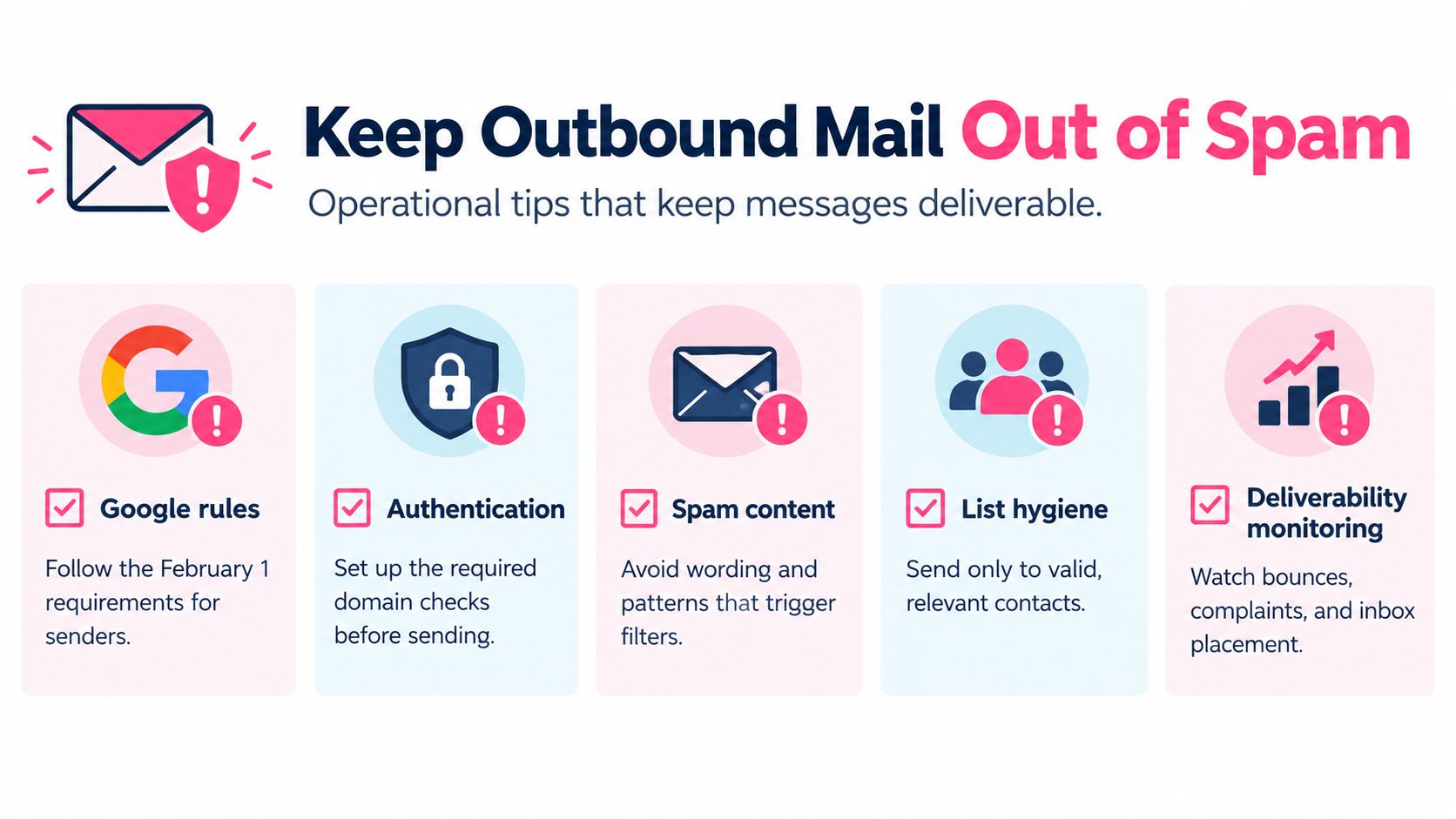
- Authenticate first: Have whoever owns your email infrastructure verify the required records and alignment.
- Increase cautiously: Warm sending domains before a spike, cap daily volume, and don't treat warmup as permission to send irrelevant mail.
- Monitor the primary domain: Review reputation across campaigns and mailboxes, not just individual sender accounts.
- Honor exits immediately: Stop sequences when someone books, unsubscribes, or is disqualified.
- Investigate deterioration: Watch bounces, complaints, and available delivery signals before authorizing additional sends.
Google defines a bulk sender as an entity sending close to 5,000 or more messages to personal Gmail accounts within 24 hours, counting messages from the same primary domain toward that threshold, according to its bulk-sender guidance. Spreading activity across mailboxes doesn't erase that aggregation.
Run the email deliverability checker as part of your review, then investigate any flagged issue with your infrastructure owner. A tool check doesn't replace ongoing monitoring.
Before you scale: Confirm that authentication, suppression, monitoring, and ownership work. More sending won't repair a broken operating process.
Don't reduce deliverability to a list of supposedly forbidden words. Relevant recipients, responsible sending practices, and working unsubscribe handling deserve more attention than swapping “free” for an awkward synonym.
Choose Who Runs SaaS Lead Generation
You can understand the system and still decide you don't want to operate it. That's reasonable. Hiring someone to press “send” without assigning responsibility for research, copy, replies, and infrastructure is not.
Choose based on control, available expertise, and commercial risk, not the prettiest activity report.
Compare the operating models
| Option | Path to a qualified meeting | Research and copy ownership | Deliverability responsibility | Your job on the call |
|---|---|---|---|---|
| Build in-house | Depends on existing skills and setup | Your internal team | Your team owns setup and monitoring | Diagnose, demonstrate, and close |
| Hire an SDR | Depends on recruiting, onboarding, and support | SDR, with management and marketing input | Must be explicitly assigned | Support discovery and advance the sale |
| Retainer agency | Depends on onboarding and campaign readiness | Agency, subject to your approval | Define ownership in the engagement | Validate fit and close |
| Managed pay-per-close team | Depends on offer and campaign readiness | Managed research and copy team | Managed operation, with client visibility | Attend qualified calls and close |
In-house gives you the most direct control. It also gives you the operating burden. Someone needs to own list quality, reply handling, and campaign changes when the founder gets busy.
An SDR can build valuable account knowledge, but hiring doesn't automatically supply strong messaging or healthy infrastructure. Use the comparison with hiring an SDR to examine the responsibilities you'd retain, not just the job title you'd add.
A retainer agency can provide execution capacity. The trade-off is straightforward: you pay for the engagement whether or not deals close. That can make sense when the scope and accountability are clear, but it isn't outcome-based pricing.
Understand what a managed team actually handles
At Ever Outbound, we're pay-per-close. We build prospecting and messaging from scratch when a client enters a new vertical or geography, starting with a cold offer suited to that market.
Our process has 4 steps:
- Build the list: Research and verify the decision-makers.
- Write and send: Use short copy on warmed domains.
- Book interested prospects: Put qualified conversations directly onto your calendar.
- You close: Show up, run the sales conversation, and advance the deal.
The boundary matters. A managed team can handle prospecting and appointment setting; it can't attend as your product expert or make your commercial decisions.
You still need available calendar space, credible demonstrations, and a sales owner who follows through. Outsource execution if that's the constraint. Don't outsource accountability for what happens once the buyer joins the call.
Book the Next Qualified Call
Pick a segment you can serve well and write the cold offer. Not a positioning deck. A clear invitation tied to a problem the buyer recognizes and evidence you can show.
Then make an operating decision. If you're running the motion internally, stand up the first authenticated sending domain and assign an owner to replies and bookings. If you don't want to manage infrastructure, book a working conversation about handing over execution.
Choose the route, then commit to the work
- Keep it internal: Assign named owners for research, messaging, sending health, and sales handoff.
- Use managed execution: Bring your product limits, customer evidence, and target segment to the working call.
- Protect selling time: Make sure someone can take the meetings and move legitimate opportunities forward.
At Ever Outbound, we're pay-per-close: fully done-for-you client acquisition starts at $97 a month, your first 2 closes are commission-free, and then it's 5% only when a deal from our work closes.
The pay-per-close option, cold email system, LinkedIn outreach, and AI Setter are ways to deliver the same commercial outcome: qualified meetings. Choose the delivery route around your buyers and operating needs, not because another tool would look impressive in the stack.
Review the meeting-ready leads approach, then book a conversation if you want to evaluate the fit. During that call, we walk through how campaigns are built and what to expect.
Whichever route you choose, use the same standard. Show up to real calls, learn why buyers progress or decline, and judge the motion by closed revenue, not lead rows.
At Ever Outbound Inc., we're pay-per-close, with managed prospect research, outreach, and appointment setting built around qualified sales conversations. Visit us to book a call, bring the SaaS segment you want to reach, and work through how a campaign would get the right buyers onto your calendar.