November 17, 2026
8 Follow Up Email After No Response Templates That Work
The first email went out on Tuesday morning. It was specific, it was short, and the address was verified. Then the thread went quiet, and now you're staring at your sent folder wondering whether the answer is a second email or a quiet retreat.
Silence after a cold email is rarely a flat no. More often it's a full calendar, a message buried under forty others, or a contact who doesn't own the problem you described. A study of 2,241 U.S. companies that submitted test leads, summarized in Bebop's sales follow-up statistics, found that only 37% responded within an hour and 23% never responded at all. Among the ones that did reply within 30 days, the average response time was 42 hours. Your prospect isn't unusually rude. They're normal.
The eight templates below are sorted by why the reply never came, not by email category. Each one carries a send window, a tone note, and the personalization step that turns a routine nudge into a message worth answering. Find the reason closest to your situation and send that one today.
Table of Contents
- 1. The Simple Bump
- 2. The Value-Add Follow-Up
- 3. The Breakup Email
- 4. The Different-Angle Follow-Up
- 5. The Yes/No Question Follow-Up
- 6. The Social Proof Follow-Up
- 7. The Referral Request Follow-Up
- 8. The Calendar-Link Low-Commitment Follow-Up
- How the 8 Follow Up Email Templates Compare
- Pick One Template and Send It Today
1. The Simple Bump
The cheapest follow up email after no response is a two-line reply that pulls your original message back to the top of the thread. It bets the prospect was busy rather than hostile, and it asks for one small thing.
Send window: 3 to 4 business days after the original. Tone: light, unhurried, zero guilt. Personalize: restate the offer in one clause so nobody has to scroll.
The payoff outweighs the effort by a wide margin. Large outreach datasets keep reaching the same conclusion: adding even one follow-up lifts replies meaningfully over relying on the initial send alone, a pattern tracked in Mega Web Vision's follow-up statistics. On scheduling, Selzy's guide to follow-up emails puts the first touch at 1 to 3 days after the original, with later attempts landing around day 7, day 14, and day 30. For a bump, I favor the slower end of that range. Twenty-four hours reads like panic; three or four days reads like patience.
Subject: Re: Quick question about lead follow-up
Hi Dana, bumping this to the top of your inbox in case it got buried. Would a 15-minute call next week make sense?
Why a bump beats a rewrite
A second full pitch reads like you never noticed the silence. The bump acknowledges it and shrinks the ask to a single question. Take the prospect who read your email on Tuesday and then spent three days in onboarding calls. Your reply arrives Friday as a courtesy, not a complaint.
- Reply in the thread: the "Re:" line and quoted history carry the context, so your copy doesn't have to.
- Ask one question: two questions give the reader two reasons to postpone.
- Cap it at two bumps: after the second, switch to a template that adds something new.
If you're mapping the whole cadence, the email sequence generator lays out each touch and its send day.
2. The Value-Add Follow-Up
A follow-up that adds nothing is a reminder that you were ignored. This one arrives with something useful in hand: a benchmark, a teardown, a checklist, or a short read on what's changing in the prospect's market.

Send window: day 5 to 8, once the bump has had its turn. Tone: generous and curious, with no invoice attached. Personalize: tie the resource to one specific thing you noticed about their business, such as three open recruiter roles or a new service page.
The evidence on how many touches to run is real but blurry at the edges. A systematic review of email survey research found that the number of follow-up contacts was among the factors with the greatest influence on response rates, and that multiple reminders generally beat a single one. The same review found no universal interval that consistently outperformed the rest, which is your permission to test against your own audience instead of copying a cadence off a screenshot.
Subject: Thought this benchmark might be useful
Hi Marcus, I came across a report on median response times for inbound B2B leads and thought of your team's pipeline goals. Happy to send the summary if useful. Is this a priority for you this quarter?
What to send instead of "just checking in"
Say you sell into staffing firms and you noticed the prospect just opened a Dallas branch. That's your hook, and the resource should speak to it.
- Make it theirs: reference a specific trigger, like a new location, a funding announcement, or a job post for a sales leader.
- One link, no attachments: attachments trip spam filters, and a single link keeps the message scannable on a phone.
- Keep the ask smaller than the gift: "want the summary?" is easier to answer than "got 30 minutes this week?"
3. The Breakup Email
Sooner or later every thread needs a door. The break-up email closes it politely, tells the prospect you're stepping back, and gives them one last easy chance to say "not now" or "yes." It fits the prospect who never replied at all: the message landed, the timing didn't, and a clean exit is the easiest thing left to answer.
Send window: day 18 to 25, or after three unanswered touches. Tone: calm and final, never wounded. Personalize: name the original problem you raised and the quarter you're writing in.
Volume has a ceiling, and the data is blunt about it. Cirrus Insight's analysis of more than 20 million cold emails found that five follow-up emails produced roughly a 7% reply rate, while stretching the sequence to ten emails dropped it to about 3%. Hunter's state of cold email report puts campaigns with follow-ups at an average 4.9% reply rate against 3% without them, then flags diminishing returns after roughly the fifth step and rising spam complaints after repeated attempts. Past a certain point, one more nudge costs you sender reputation and buys nothing.
Subject: Should I close your file?
Hi Priya, I have not heard back, so I will assume the timing is off and stop reaching out. If I should keep in touch, just let me know. Either way, wishing you a strong Q4.
How to close a thread without burning it
- Lead with the close: "Should I close your file?" asks for a decision, which is why it pulls more replies than a soft "just following up."
- Offer a two-word exit: "not now" and "remove me" are both answers, and both keep your list clean.
- Record the outcome: mark the contact closed, set a reopen date for next quarter, and stop the sequence. A thread you close cleanly is one you can reopen later.
When a break-up email does pull a reply, speed decides what happens next. Ever Outbound's team nurtures interested replies with timely follow-ups and books qualified calls directly onto the client's calendar.
4. The Different-Angle Follow-Up
If your first email talked about lead volume, this one asks about response speed. The subject changes, the problem shifts, and the message reaches a different priority in the same building.
Send window: day 7 to 10, as the second or third touch. Tone: curious, not defensive. Personalize: anchor the new angle to a trigger you can point at, like a new market, a product launch, or a hiring push.
Timing explains why the angle has to change. In a peer-reviewed analysis of email-based surveys, more than 80% of electronic responses arrived within three days of the initial message, with the heaviest concentration on the send day itself. Cold outreach doesn't follow that curve exactly, but the direction holds. By day seven the thread has lost its momentum, and a repeat of the original pitch has nothing left to ride on.
Subject: Different angle on the same goal
Hi Tom, my last note focused on lead volume. A different question: how many of your qualified leads actually reach a discovery call within 48 hours? Tell me if that is a bigger issue for your team.
Two follow-ups that say the same thing in different words are one follow-up sent twice.
One angle per message
- Change one variable: switch the metric, the stakeholder, or the funnel stage. Do one per email, not three.
- Use a trigger you can name: "saw you opened a Dallas office" beats "noticed your impressive growth."
- Log which angle lands: tag replies by angle in your CRM and after twenty sends you'll know which argument your market pushes back on.
Before it goes out, run the copy through the cold email grader to check whether the new angle is fresh or just reworded.
5. The Yes/No Question Follow-Up
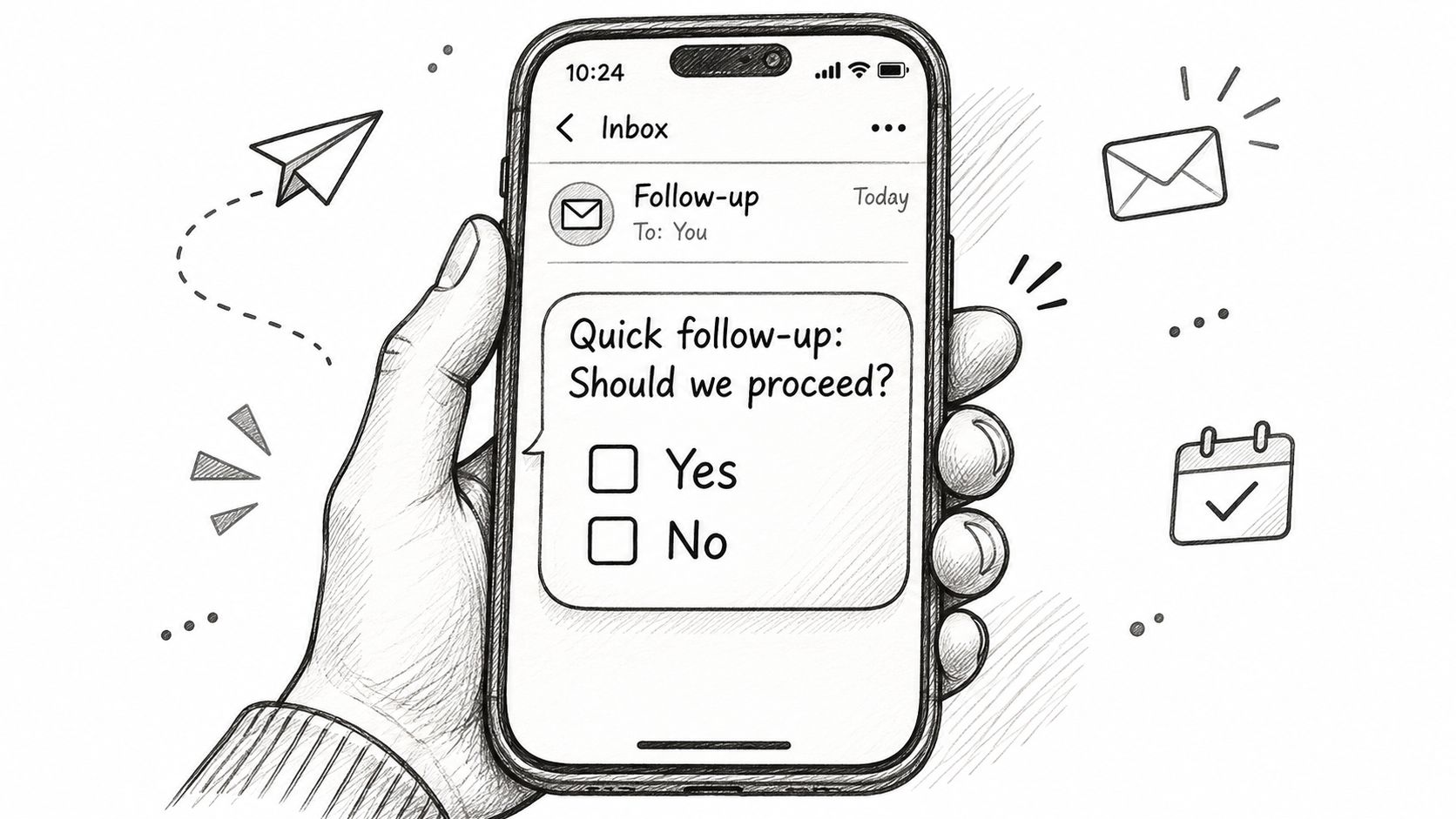
Silence doesn't always mean no. Often the prospect never got far enough into your pitch to form an opinion, and a call request feels like work. This template strips the decision down to one word, which makes replying cheaper than ignoring you.
Send window: day 10 to 14, after a value or angle message. Tone: breezy, and a one-word answer counts as a win. Personalize: write the question around their actual quarter, not around your product.
Second touches do the heavy lifting in cold outreach, and roundups of follow-up email data point the same direction: sequences with at least one follow-up consistently outpull single-send campaigns. A yes/no question is how you make that second touch cost the reader nothing.
Subject: Quick yes or no
Hi Lena, is booking more qualified sales calls a priority for your team this quarter? A simple yes or no works.
Why one word beats a paragraph
A question that needs a paragraph to answer gets postponed until Thursday, and Thursday never comes. A question that needs one word gets answered between meetings on a phone.
- Test the question first: if you can't answer it yourself with yes or no, it isn't closed.
- Follow a yes within the hour: two specific times, not a link dump.
- Log the no's: a clean no ends the guessing and frees the slot for a warmer prospect.
This is the template for the prospect who went quiet because the ask felt too big, not because the answer was no. Once a yes lands, route the reply into qualification so the next message is a calendar proposal rather than another question.
6. The Social Proof Follow-Up
A short, verifiable result from a similar company does more than another paragraph of claims. This template pairs one case with one question and lets the proof carry the weight.
Here's the thinking behind proof in a follow-up before you write your own version.
Send window: day 12 to 16, or the moment a prospect replies with vague interest. Tone: matter-of-fact, no victory lap. Personalize: match the case to their vertical, company size, or role.
Subject: How a B2B agency booked 12 calls in a month
Hi Raj, we recently helped a consulting firm in a similar niche book qualified discovery calls through a managed outbound program. Happy to share the case study if it is relevant to your team.
Proof that survives scrutiny
- Use numbers you can defend: a result the client approved, with the measure named, beats a rounded-up claim that falls apart on the call.
- Match the vertical: if your best result is a staffing firm that filled three roles in a month, lead with that when you're emailing staffing firms.
- Keep the claim small: "one agency, one month, twelve calls" is more believable than a percentage with no context.
Keep one approved version of each case study ready to send, and point readers to a social proof page instead of pasting screenshots into the email body.
7. The Referral Request Follow-Up
A good share of the silent threads in your pipeline are silent for a boring reason. You wrote to the wrong person. This follow-up stops pushing and asks for directions instead.
Send window: day 10 to 14, or immediately after a "not my area" reply. Tone: helpful, zero blame. Personalize: name the role and one reason you believe that role owns the problem.
Subject: Who should I speak with?
Hi Ben, I may have reached the wrong person. Who on your team handles client acquisition or pipeline planning? If you point me in the right direction, I will reach out with a short, relevant note.
Ask for a role, not a name
"Who should I talk to?" invites a shrug. "Who owns pipeline planning?" invites a name and a forwarded email.
- Name the role: marketing operations, head of sales, founder. Specific titles get specific answers.
- Offer a forwardable blurb: two sentences the contact can paste to a colleague, so the introduction costs them nothing.
- Credit the referrer: open the next email with "Ben suggested I reach out," and watch the reply arrive faster.
Referrals also protect your domain. A fresh thread to a new address at the same company gets read, where a fourth nudge into a dead mailbox does not.
8. The Calendar-Link Low-Commitment Follow-Up
Once interest shows up, stop selling and start scheduling. This one wraps a ten-minute slot in low-pressure language and kills the "when works for you?" loop before it starts.
Send window: day 12 to 20, or within an hour of any positive signal. Tone: take-it-or-leave-it, and mean it. Personalize: make the agenda line about the priority they mentioned.
Subject: 10 minutes next week?
Hi Mia, if it is useful, here is a link to a 10-minute slot next week. No prep needed. If the timing is off, just let me know and I will stop reaching out.
Make booking the easiest reply
- Show real availability: a calendar with four open slots converts better than one that looks like an empty warehouse.
- Write the time zone in the body: "10:00 a.m. ET" prevents the silent reschedule.
- Add one agenda line: "ten minutes on response times and what your team tracks" tells them what they're agreeing to.
Practical rule: one link, one time zone, one agenda line. Every extra element is friction.
If you want the booking handled end to end, the booking page is where the calendar lives.
How the 8 Follow Up Email Templates Compare
| Item | Core Strength | Main Drawback | Best Stage to Use |
|---|---|---|---|
| The Simple Bump | Low-effort reminder that preserves the original thread | Offers little new value and is easy to ignore if repeated | First follow-up, 2 to 4 business days after the initial email |
| The Value-Add Follow-Up | Builds credibility by sharing relevant insight or resources | Requires research; generic content can feel like spam | After an initial message stalls, when you have a useful, relevant resource |
| The Breakup Email | Creates closure and often prompts a clear response | Can feel abrupt or harm brand perception if guilt-based | Final step in the sequence |
| The Different-Angle Follow-Up | Reopens the conversation with a fresh pain point or outcome | Requires research and can confuse prospects if the shift is abrupt | After the original pitch gets no response or seems too broad |
| The Yes/No Question Follow-Up | Makes replying easy and helps qualify interest | A simple answer may not advance the deal without follow-up | When you want to qualify interest before proposing a meeting |
| The Social Proof Follow-Up | Builds trust with a specific, relevant client result | Requires approved, verifiable results | When the prospect needs evidence or reassurance |
| The Referral Request Follow-Up | Helps identify and reach the right decision-maker | May make the original contact feel bypassed | When the original contact may not own the topic |
| The Calendar-Link Low-Commitment Follow-Up | Reduces scheduling friction with a short, optional meeting | Can feel pushy if sent before interest is established | After interest has been confirmed or implied |
Pick One Template and Send It Today
Silence is a signal to change your approach, not a verdict on the lead. The prospect who ignored a generic nudge may still answer a specific question about their quarter. The one who ignored two emails may reply to a break-up because it finally hands them a graceful way to say no.
Work in order. Send the simple bump three or four business days after the first email. If the thread stays quiet, arrive with something useful, then change the angle entirely, then shrink the ask to a yes or no. Close the loop with a break-up so every lead gets an explicit final chance instead of fading into a list you never clean.
Judge the sequence, not the email. A campaign graded on its first touch will always look worse than it is, because most replies arrive later in the thread. Count positive replies, booked meetings, unsubscribes, and spam complaints together. A template that lifts replies while raising complaints is a net loss, however good the thread reads.
Set stop rules before you need them. A prospect replies, opts out, hard-bounces, or hits your frequency limit, and the sequence ends that minute. Nobody should receive a fourth follow-up while an unanswered question from them sits in your shared inbox. Answering what a person wrote beats every template on this page.
Match the pressure to the relationship. A contact you've never spoken to gets fewer attempts and lighter asks than a warm referral or an active deal. The break-up email exists for the cold ones. It is not a tactic to run on a client who owes you a signed contract.
If you want a team to run these steps for you, Ever Outbound (we're pay-per-close) handles timely follow-ups on replies and books qualified calls directly onto your calendar. We never move or cancel a booked meeting on your behalf, so the meeting you see is the meeting that happens. You show up, run the call, and close.
Ever Outbound Inc. runs the whole outbound motion on a pay-per-close basis, so you pay a 5% commission only when a deal closes from our work, and your first two closes are commission-free. A human research and copywriting team builds the verified lists and writes the multi-step sequences, while the team and our AI Appointment Setter handle replies, qualify interest, and book calls straight onto your calendar, which is exactly the follow-up gap this article is about. If chasing quiet threads is eating your week, visit Ever Outbound Inc. and see how the managed service works.