October 28, 2026
Commission Payout Structure: Models, Tiers and Traps
You're comparing agency proposals, and both quote a 10% commission on a hypothetical $40,000 deal. One provider gets paid when the contract is signed in March; the other waits until the customer's cash clears in June. Then the customer cancels half the order in April. The first provider has already spent its commission and may owe some back. The second has nothing to repay because it hasn't received a payout yet.
Table of Contents
- Why the Payout Structure Matters More Than the Rate
- Seven Payout Models Compared
- How Pay-Per-Close Works, Step by Step
- Tiers, Splits and Accelerators in Practice
- Commission Rates by Sales Motion
- Contract Terms That Decide Who Gets Paid
- Choose the Payout Structure That Fits Your Agency
Why the Payout Structure Matters More Than the Rate
The providers quoted the same percentage, but they didn't accept the same deal. One took an early payment with a possible repayment obligation. The other accepted a longer wait and a smaller eligible sale.
That's why a commission payout structure matters more than the number in large type on the proposal. The rate is the price tag. The structure is the fine print that decides what you take home.
| Building block | What it answers |
|---|---|
| Commission basis | Are you multiplying the rate by booked revenue, collected cash, or margin? |
| Earning trigger | Does entitlement start at signature, delivery, or customer payment? |
| Payment timing | When does an earned amount reach the provider? |
| Adjustment rules | What happens after refunds, cancellations, chargebacks, or disputes? |
A commission agreement should distinguish the event that earns commission from the schedule for paying it, as MKB Juristen's commission agreement guidance explains. A signed contract and a bank receipt aren't interchangeable evidence.
Compare the whole commercial arrangement
When comparing agency proposals, Online Brand Growth's agency pricing guide provides useful context for evaluating agency fees. Use that broader pricing lens before deciding that a smaller percentage means a cheaper engagement.
Likewise, evaluate performance-based lead generation by the outcome that earns payment, not just the performance label.
Practical rule: If you can't name the base, earning trigger, payment deadline, and adjustment rules, you haven't finished comparing the offers.
Read each proposal with those building blocks beside it. You should be able to identify each one without interpreting what the salesperson probably meant.
Seven Payout Models Compared
Most commission and performance-fee arrangements are variations of seven models, and the earning trigger matters more than the label.
Seven commission payout models compared
| Model | When the payout is earned | Common base | Who carries the risk |
|---|---|---|---|
| Pay-per-close | When a signed deal is collected | Collected revenue or deal value | Provider carries acquisition cost; client pays the success fee only on results |
| Pay-per-meeting | When a qualified meeting is booked | Per booked meeting | Client pays for activity; meeting quality is the risk |
| Pay-per-lead | When a lead is delivered | Per lead | Client pays for volume; weak leads are the risk |
| Retainer | Monthly, regardless of results | Fixed monthly fee | Client pays even when results are weak |
| Flat percentage commission | At each sale, at signature or payment | Revenue or margin on each sale | Payout can outrun cash if customers don't pay |
| Tiered commission | When cumulative sales pass a threshold | Cumulative sales in the period | Forecasting gets harder; top tiers can overpay |
| Split commission | When a deal closes, shared among parties | Each party's share of the same deal | Disputes over credit when attribution is unclear |
Scan the trigger column first. It tells you who waits and what evidence they need before requesting payment. Every cell is a starting point for the contract, not a substitute for one.
Paying for outcomes or activity
Pay-per-close puts the provider's success fee behind a commercial result. That suits a buyer who wants acquisition support without paying a success fee for conversations that never become customers.
The provider's trade-off is substantial: it can complete prospecting, copywriting, follow-up, and scheduling, then earn nothing if the buyer's sales team fails to close. Collection-based arrangements also require reliable access to payment information. Without that visibility, the provider is effectively checking its earnings through a keyhole.
Pay-per-meeting gets you something observable sooner. A calendar invitation is easier to verify than the eventual value of a long sales cycle.
But booked doesn't necessarily mean useful. Define the prospect's role, company fit, buying context, and treatment of no-shows. Otherwise, the provider can meet its obligation while your closer spends the afternoon explaining the offer to people who were never suitable.
Pay-per-lead makes delivery straightforward to count. It works better when the buyer already has a team that can qualify, nurture, and convert contacts.
The weak version rewards database population rather than sales potential. Specify required fields, verification standards, duplicate handling, and replacement rights. A spreadsheet full of names isn't a pipeline just because someone colored the header green.
Paying for capacity or sharing sales value
Retainers reserve capacity. The provider can staff the work, schedule production, and maintain campaigns without waiting for individual transactions.
The buyer accepts payment obligations during slow months. That can be sensible for work requiring experimentation, but only when deliverables, ownership, and review criteria are explicit. Compare retainer-based lead generation by what the fee funds and how you can assess progress before revenue arrives.
Flat percentage commission is the easiest revenue-share arrangement to explain. Once the eligible base is agreed, each qualifying transaction follows the same calculation.
Its weakness is usually the denominator. Gross invoice value, net collected revenue, and gross profit can produce very different earnings. Simplicity in the formula doesn't excuse ambiguity in the inputs.
Tiered commission changes the rate as performance reaches defined bands. It can reward additional production without renegotiating every deal.
The practical cost is forecasting. Finance needs to know whether a higher rate applies prospectively, retroactively, or only within a particular band. Sellers also need a visible running total so they aren't maintaining a competing spreadsheet.
Split commission allocates a single commission among contributors. It suits referral partners, introducers, and teams where sourcing and closing belong to different people.
The difficulty is deciding credit before anyone knows how attractive the deal will become. Agree on the split when the opportunity is registered, not after the invoice lands.
Combining models without hiding the bill
These models aren't mutually exclusive. A retainer can fund reserved capacity while a pay-per-close fee rewards commercial outcomes. A split can sit inside either a flat-rate or tiered arrangement.
For partner-led acquisition, Suby's discussion of performance-based growth for SaaS companies is useful context for thinking about how an outside contributor participates in growth.
Keep each payment line separate. Fixed fees, success fees, and partner allocations should remain identifiable rather than disappearing into an effective rate nobody can reproduce.
The best model is usually the one the client can audit without reaching for a calculator.
That doesn't mean banning arithmetic. It means someone should understand why a charge exists before doing any.
How Pay-Per-Close Works, Step by Step
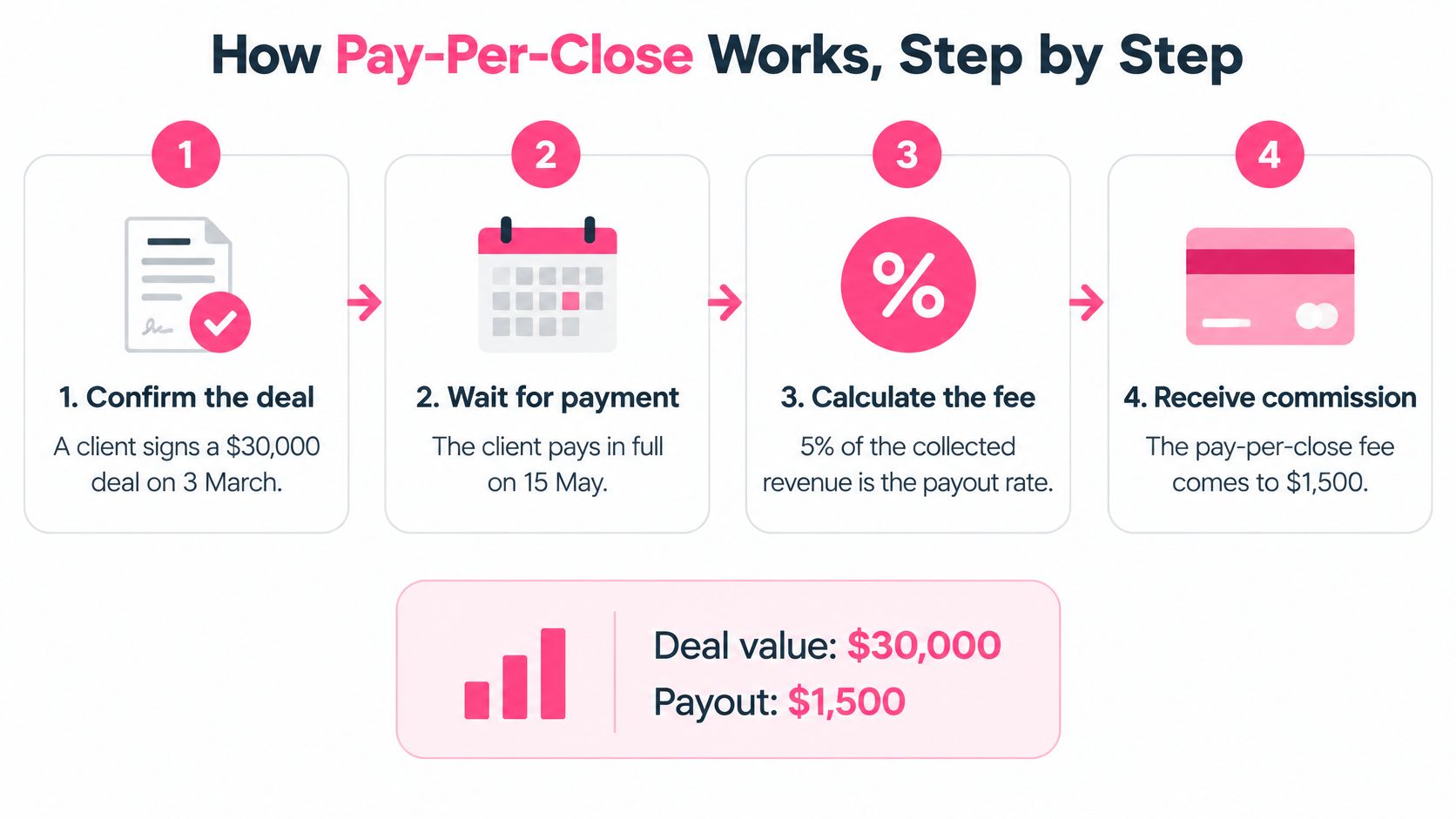
Take a hypothetical commission-bearing deal after any introductory credits have been used: the client signs for $30,000 on 3 March, pays in full on 15 May, and an illustrative 5% fee produces a $1,500 payout. Assume the entire payment qualifies, with no excluded amounts.
Follow the transaction, not the celebration
Confirm the deal is signed and attributable to the provider. Match the accepted agreement to the CRM opportunity and its recorded source. This establishes that the transaction belongs in the commission ledger rather than merely appearing in the same sales pipeline.
Wait for the client to collect the revenue. In this scenario, the earning event is cash received, not the March signature. Keep the opportunity marked as awaiting collection until the May payment is verified.
Remove excluded items to find the eligible base. Deduct any contractually excluded refunds, taxes, and pass-through costs. This prevents commission from being calculated on money the agreement never intended to share.
Apply the rate to the eligible base. For this hypothetical deal, the full collected amount qualifies, producing the payout above. If exclusions reduce the base, recalculate before approving the commission.
Record the deal in a ledger. Include opportunity ID, close date, collected amount, eligible base, rate, exclusions, and payout status. The purpose is reproducibility: another person should reach the same result from the same records.
Invoice monthly in arrears. The hypothetical May collection appears on the next monthly invoice. This separates a payment becoming eligible from the administrative act of billing it.
A Harvard Business School sales-compensation review provides the broader analytical context for commission design. Operationally, keeping crediting, calculation, and payment records separate makes the arrangement easier to reconcile.
Keep transaction earnings separate from service costs
At Ever Outbound, we're pay-per-close. For a commission-bearing initial deal, the success commission is our only payout earned from that deal; separate monthly charges cover infrastructure and tools rather than an additional share of the transaction.
A refund after calculation reverses the affected commission in this worked example. Whether that means reducing an unpaid invoice, offsetting a future payout, or returning cash must be settled by the clawback clause.
Tiers, Splits and Accelerators in Practice
Illustrative tiered commission bands
The following hypothetical schedule applies each rate only to revenue inside its band.
| Tier | Rate | Payout on band |
|---|---|---|
| Band 1, first $50,000 | 5% | $2,500 |
| Band 2, next $100,000 | 7.5% | $7,500 |
| Band 3, next $50,000 | 10% | $5,000 |
| Total at $200,000 cumulative eligible revenue | Blended across bands | $15,000 |
A tier changes the rate at a stated threshold. An accelerator raises the rate after a performance milestone. A split divides a commission among contributors rather than increasing the total commission.
For the hypothetical schedule, calculate the payout band by band:
- Opening band: The first $50,000 produces $2,500.
- Middle band: The next $100,000 produces $7,500.
- Upper band: The remaining $50,000 produces $5,000.
The illustrative total is $15,000, not the result of applying the highest rate to all revenue. That distinction needs to appear in the agreement, not emerge during the first disputed payout.
Separate allocation from acceleration
For a hypothetical split, a 5% commission on a $30,000 deal creates a $1,500 pool. Dividing it 60/40 between referral partners pays $900 and $600. The partners share the pool; the client doesn't owe separate full commissions to both.
Published Avoma sales-compensation guidance describes accelerators at 1.5x to 2x the base rate, so an illustrative 5% base could become 7.5% to 10% beyond the target.
A flat rate gives the provider the same marginal incentive on each eligible close. An accelerator makes additional eligible revenue more valuable after the milestone. That can encourage larger deals, but it can also encourage sellers to manipulate timing if the reset rules make postponement attractive.
Margin check: Model the cost of winning, not just the cost of losing. Additional customers still need setup, delivery, and support.
Don't confuse revenue-based acceleration with buying more prospect volume. A pay-per-lead arrangement rewards a different deliverable and needs its own quality controls.
Before accepting a tier, ask: does the rate change on total revenue, or only on the band above the threshold?
Commission Rates by Sales Motion
Benchmark commission rates by sales motion
The employee-sales benchmarks below come from the Business in a Box sales commission plan, which places SaaS inside sales at approximately 8–12%, enterprise field sales at 5–10%, and retail or transactional sales at 2–5%.
| Sales motion | Typical rate | Usual base | Why the rate differs |
|---|---|---|---|
| SaaS inside sales | 8–12% | Annual contract value | Recurring revenue can support a higher rate |
| Enterprise field sales | 5–10% | Contract value on larger deals | Larger deal values affect the required percentage |
| Retail or transactional sales | 2–5% | Transaction value | Thin margins and high volume constrain payouts |
| Outbound appointment or pay-per-close services | No standard established by these benchmarks | Collected revenue on closed deals for pay-per-close; per meeting for appointment services | Confirm the contractual rate and base |
These are comparison points, not interchangeable price lists. Employee compensation and an outsourced acquisition service don't necessarily include the same work, salary support, expenses, or payment risk.
Consider a hypothetical 10% commission on a $1,000 one-time order. The payout is $100. If gross profit on that order is smaller, the business has already spent more than its gross profit on commission before paying overhead.
Check the denominator before negotiating
An annual-contract-value rate belongs beside annual contract value. Applying it casually to a low-margin transaction can make an apparently ordinary percentage unaffordable.
For another commercial context, PuppetVendors' commission guidance for Shopify consignment stores helps frame a different question: what value does each party contribute, and which costs does each retain?
The same discipline applies when evaluating pay-per-meeting pricing. A meeting fee purchases a defined sales opportunity, not a guaranteed amount of collected revenue.
Use this check before calling any rate fair:
- Base: What amount gets multiplied?
- Entitlement: When is the commission earned?
- Margin: Does the deal still work after paying it?
A benchmark starts the conversation. It doesn't approve the economics.
Contract Terms That Decide Who Gets Paid
Clauses every commission agreement should define
These example values illustrate drafting choices, not universal requirements or a complete statement of our terms.
| Clause | What to define | Example value |
|---|---|---|
| Earning trigger | Signature, delivery, or cash received | Earned when the client's payment clears |
| Commission base | Gross, net, or margin | Net revenue after pass-through costs |
| Exclusions | Refunds, taxes, chargebacks | Refunded amounts reduce the base |
| Attribution window | How long a lead counts as yours | Illustrative: credited for 90 days from first touch |
| Payment timing | Frequency and deadline | Illustrative: monthly, paid within 15 days after the period |
| Reporting and audit trail | Ledger fields and report frequency | Opportunity ID, close date, collected amount, and status |
| Clawback and dispute window | Reversal rules and deadline | Illustrative: reversal only on refunds; disputes within 30 days |
| Survival after termination | Whether commission obligations continue | Pays on deals closed before termination |
Providers either secure or lose payouts they expected. The LegalTank commission agreement template outlines the essential documentation: the rate, revenue base, qualifying sale, payment schedule, reporting, and dispute process.
Clarity isn't merely administrative. WorldatWork's analysis of a sales-compensation settlement emphasizes explicit payout timelines and compliance with applicable payment laws.
Employee wage obligations and business-to-business service fees aren't automatically governed by identical rules. Jurisdictions differ, so have a lawyer review earning conditions, payment deadlines, and reversal rights before signing.
Apply the clauses to a real agreement
At Ever Outbound, we're pay-per-close, and our terms distinguish a closed deal from the timing of commission payment. A Closed Deal means a signed agreement or accepted order between the client and an opportunity generated through our services.
Commission becomes payable as and when the client collects revenue, and we invoice monthly in arrears. That distinction matters when a signed order is paid in installments rather than settled immediately.
Our net revenue definition excludes third-party pass-through expenses, including infrastructure costs, vendor fees, implementation costs, and software installed behind a client's firewall. Those exclusions prevent the commission base from automatically including every line on a customer invoice.
Termination needs its own answer
Upon termination, access to our services ceases immediately. Termination doesn't extinguish commission payable on closed deals generated before termination.
That isn't the same as claiming every future sale to a customer. We're not entitled to revenue share on renewals, ongoing usage, license extensions, upsells, expansions, or additional support beyond the initial closed deal.
For any agreement, attach enough reporting detail to resolve disagreements with records rather than recollections. Specify who submits evidence, who reviews it, and how an approved correction appears on the next statement.
Which clause would cost you the most if it were vague?
Choose the Payout Structure That Fits Your Agency
- Deal data: Do you have clean deal values and collected-revenue records?
- Sales cycle: Does your buyer decide in a few weeks or several months?
- Cash tolerance: Can you absorb a retainer when results are weak?
- Outcome preference: Does the client want the provider's success fee tied to commercial outcomes?
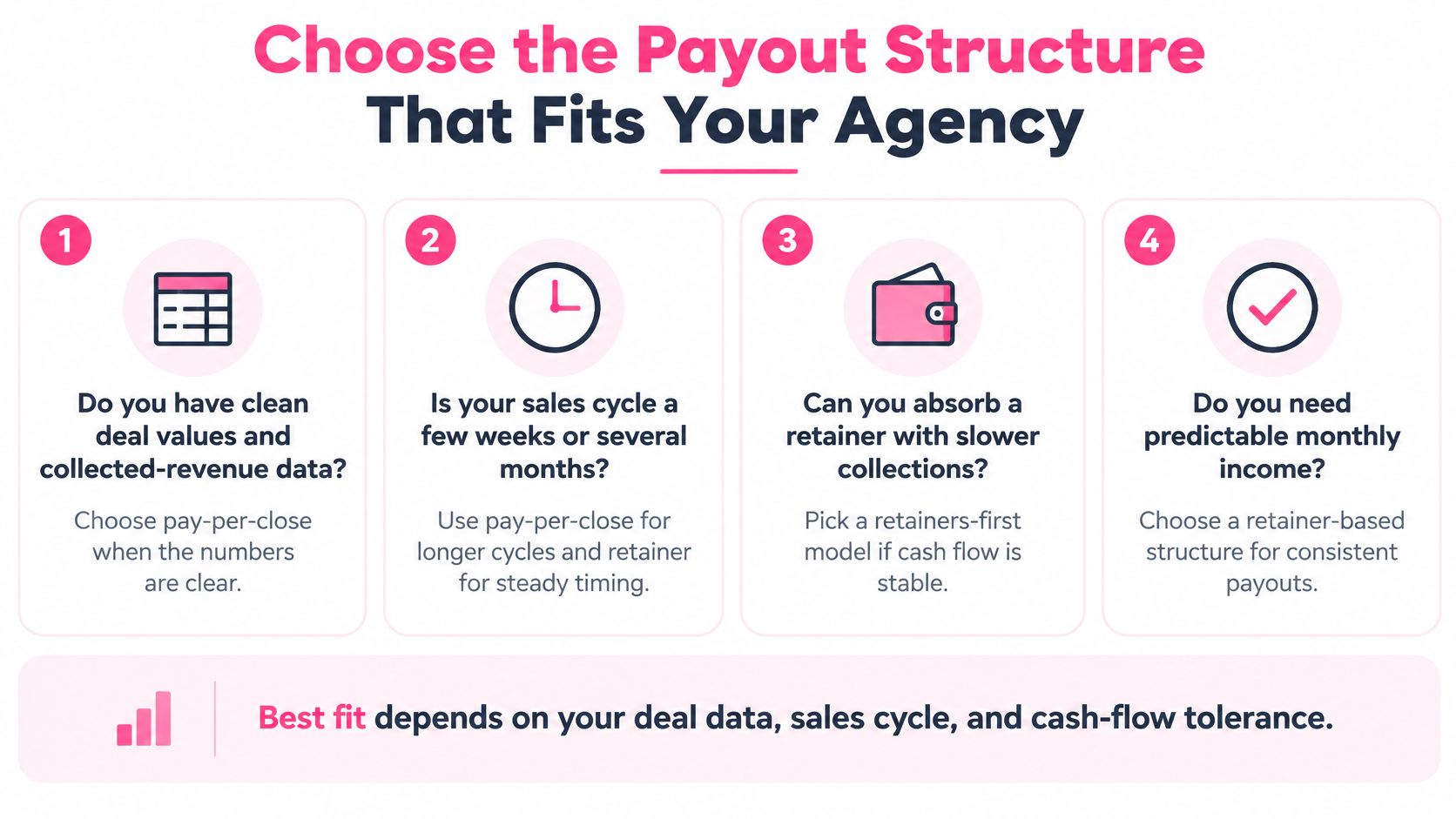
Choose a retainer when the channel needs sustained experimentation and reserved delivery capacity. Choose pay-per-close when the buyer wants the provider to share acquisition risk and both parties can verify attributable collections.
Long sales cycles don't automatically make pay-per-close the best choice. They make the provider's funding requirement more important. Tiers suit an in-house team with a steady pipeline and visible attainment; splits suit referral networks that agree on opportunity ownership before closing.
Test an ordinary deal before signing
Model a realistic transaction using deal size, close probability, sales-cycle length, expected refunds, and work completed before revenue arrives. Include fixed costs separately so a modest success fee doesn't disguise the total acquisition bill.
Visibility deserves attention: CaptivateIQ's 2025 State of Incentive Compensation report found that 66% of companies reported overpaying or underpaying commissions. A reproducible ledger is more useful than another promise that the percentage is competitive.
At Ever Outbound, we're pay-per-close: the first two closed deals generated through our services are commission-free, then we receive 5% of net revenue collected for each subsequent initial closed deal. Our monthly fees cover infrastructure and tools; confirm the current fee, commission base, and introductory terms in writing alongside our current pricing details.
Before signing, request the earning trigger, clawback rule, and a sample ledger in writing. Test those answers against the model comparison, then follow an ordinary deal through the proposed calculation until you can explain every charge.
At Ever Outbound Inc., we're pay-per-close and provide done-for-you B2B client acquisition, including prospect research, human-written outreach, reply management, and qualified-call booking. Visit us to compare our collection-based success fee with your deal economics and review the payment terms before choosing your acquisition structure.