October 21, 2026
Best Time to Send Cold Emails and What Research Really Shows
A dataset covering 7.5 million cold emails found that the morning window didn't just win on replies, it also won on meetings. That distinction matters more than any single send hour. Most advice about the best time to send cold emails optimizes for opens, a metric you can't deposit, while your actual job is to earn positive replies and booked meetings. Once you judge timing by those outcomes, the question changes from finding one magic hour to finding the windows that fit your prospects, in their time zones, by role and region.
Table of Contents
- What the Data Actually Says About Cold Email Timing
- Hour-of-Day Windows That Hold Up Across Studies
- Why Tuesday Through Thursday Dominates the Calendar
- Local-Time Scheduling Across Regions and Roles
- Pairing Send-Time With Follow-Up Cadence
- Designing a Send-Time Test You Can Trust
- Why Timing Is One Lever Among Many
What the Data Actually Says About Cold Email Timing
Start with the clearest outcome-based result available. Belkins' analysis of 7.5 million cold emails found sends between 8:00 a.m. and noon produced the strongest overall reply rate at 0.54% and the highest meeting-conversion rate at 0.40%. That's a useful baseline because it connects timing to conversations and calendar bookings, not curiosity clicks.
Why Opens Get Too Much Credit
Opens dominate published research because they're easy to measure at scale and arrive quickly. Replies are rarer, messier to classify, and they require a human to decide whether "not now" counts as progress. So vendors publish open-rate charts, operators repeat them, and teams end up choosing send times that make reporting look good while pipeline stays flat.
That doesn't make opens useless. A sudden drop can warn you about inbox placement, which is why checking your setup with an email deliverability checker belongs in your routine before you blame the clock. Think of opens as a health signal. Think of qualified positive replies as the scoreboard.
Working rule: If a time slot lifts opens but not replies, it hasn't improved your campaign. It's improved your chart.
What You're Actually Looking For
The best time to send cold emails isn't a point on a clock. It's a distribution of windows shaped by weekday, local time, seniority, and how a prospect's job structures their day. An executive clearing messages before standups and an operations manager working through a queue at midmorning don't share an inbox rhythm, even if they work at the same company.
Human energy follows a rhythm too, and if you're curious about your own peaks you can browse the productivity quiz from Fluidwave. For outbound, the practical move is to treat every benchmark below as a hypothesis, run it against your own list, and keep only what survives contact with your reply data.
Hour-of-Day Windows That Hold Up Across Studies
Different datasets, collected years apart with different methods, keep landing in the same neighborhood. HubSpot's 2015 analysis of business email found weekday opens were highest between 10:00 a.m. and 12:00 p.m., peaking at 11:00 a.m. Eastern Time. The reasoning was behavioral, not mystical. By late morning, people have started their day, cleared the urgent internal messages, and are actively working their inbox.
A later survey points the same direction with a wider band. HubSpot's survey of more than 150 U.S. marketing and advertising professionals found 47.9% of B2B marketers reported their highest engagement between 9:00 a.m. and noon, with 12:00 to 3:00 p.m. as another strong period. Adobe's synthesis of multiple datasets adds Intercom's B2B finding that open rates peaked between 10:00 and 11:00 a.m., while Sendinblue flagged 10:00 a.m. and 3:00 to 4:00 p.m. as useful engagement points.
Hour-of-Day Engagement Windows From Major Studies
| Source | Window Identified | Metric Measured | Audience |
|---|---|---|---|
| HubSpot 2015 | 10:00 a.m. to 12:00 p.m., peak 11:00 a.m. ET | Opens | Business email recipients |
| HubSpot survey | 9:00 a.m. to noon, plus noon to 3:00 p.m. | Engagement | U.S. B2B marketers |
| Intercom via Adobe | 10:00 to 11:00 a.m. | Open rates | B2B audiences |
| Sendinblue via Adobe | 10:00 a.m. and 3:00 to 4:00 p.m. | Engagement | Mixed email audiences |
Why Late Morning Works
The mechanism is inbox triage. Your email needs to arrive after the recipient starts work but before the day fills with meetings and accumulated task load. Too early and you're buried under overnight mail. Too late and you're competing with everything the day has already thrown at them, so even a relevant message gets deferred and then forgotten.
Here's the honest caveat an analyst owes you. Most of this evidence measures opens or engagement, not closed revenue. So defend 9:00 to 11:00 a.m. recipient local time as your baseline to a skeptical manager, keep an early afternoon cell in your test plan, and let positive replies and qualified meetings settle the argument.
Why Tuesday Through Thursday Dominates the Calendar
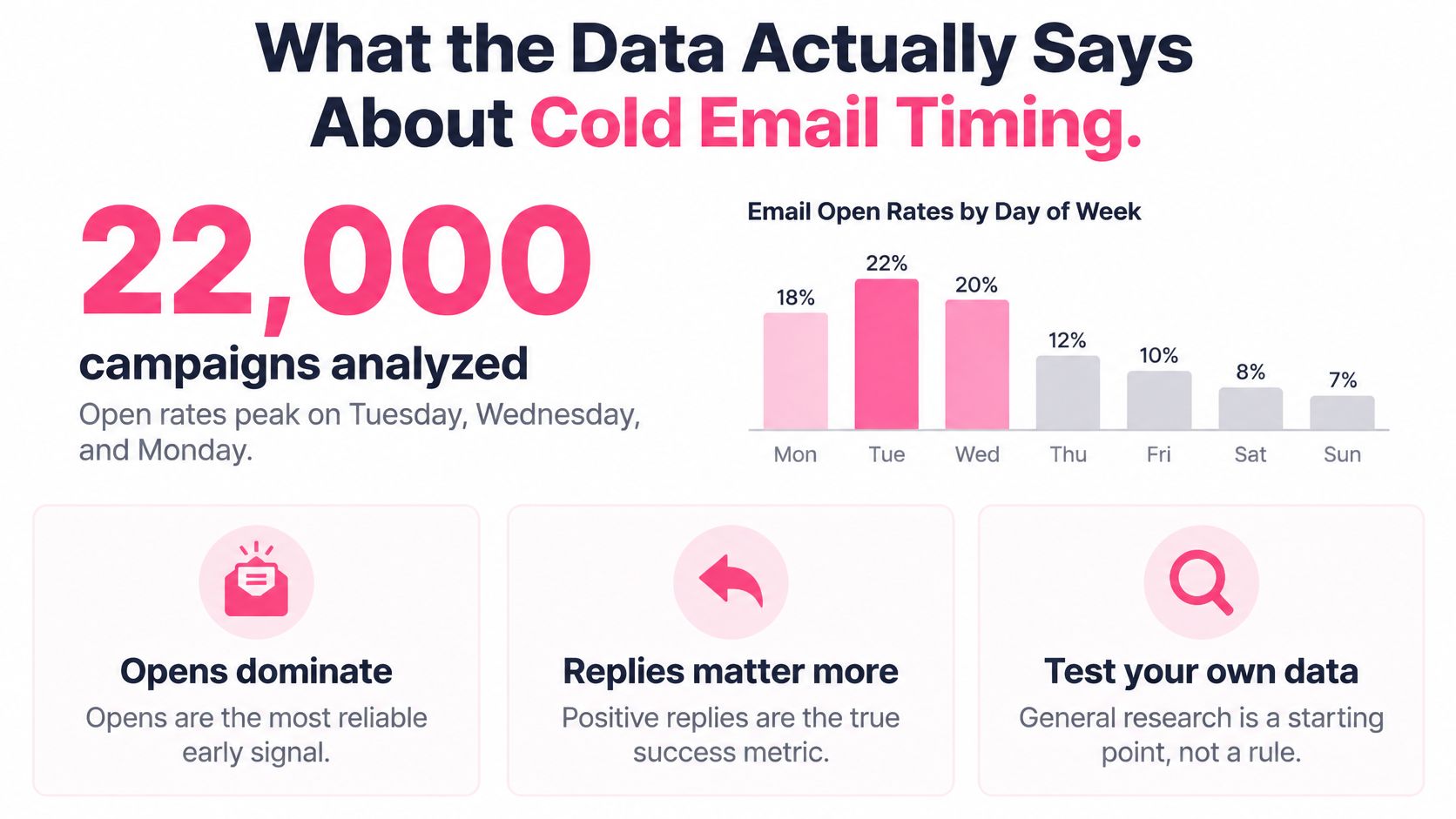
Weekday evidence is less tidy than the hour evidence, and that untidiness is informative. Adobe's synthesis of email timing research reports Klaviyo analyzed 22,000 campaigns and found the highest open rates on Tuesday, Wednesday, and Monday, in that order. Salesforce's B2B framing in the same synthesis puts the emphasis on Tuesday through Thursday, when professionals are more likely to engage during the workweek.
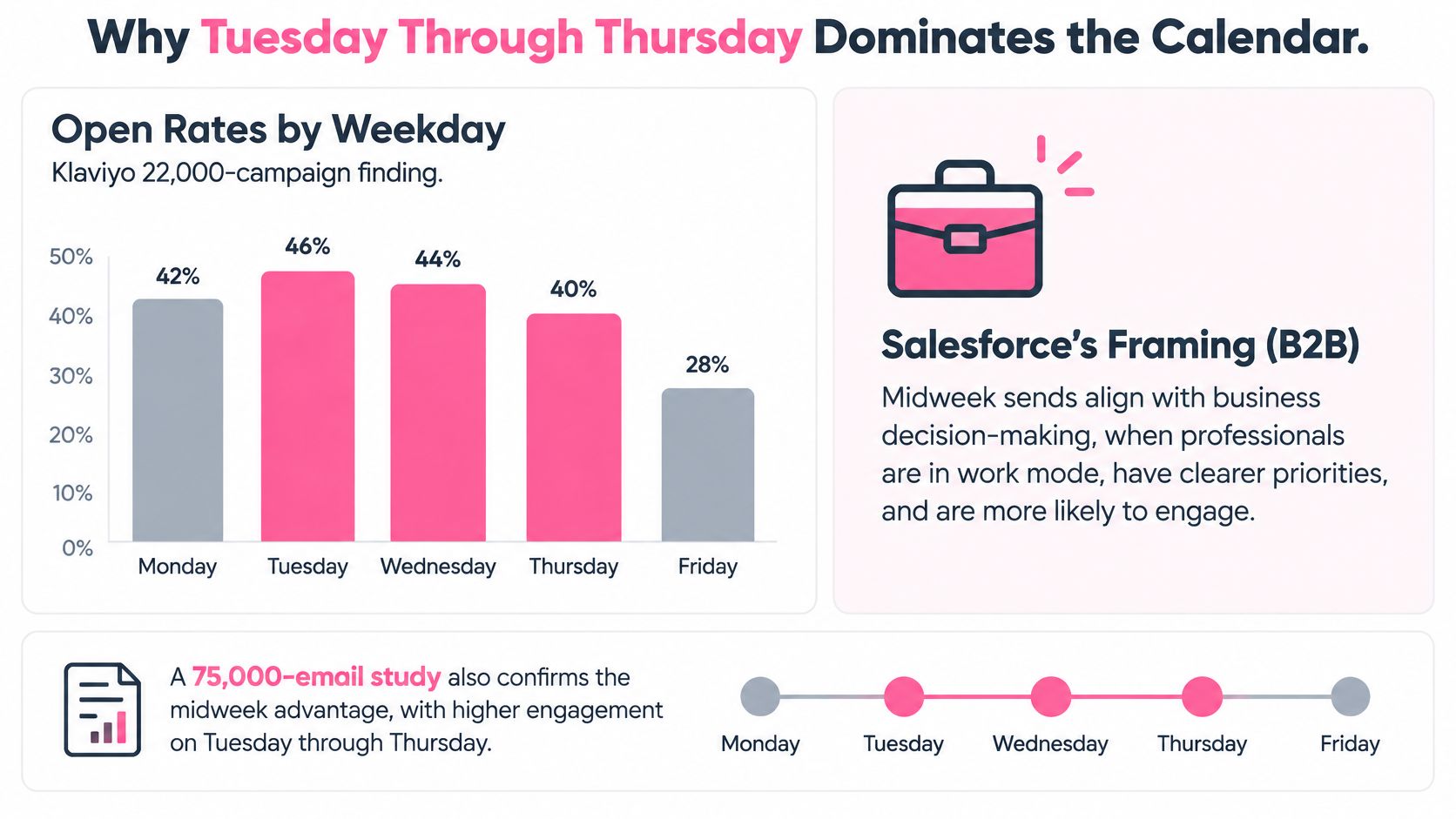
Reply data sharpens the picture further. Qualtir's summary of cold email timing benchmarks cites a 75,000-email study reporting a 4.8% reply rate for Tuesday sends between 9:00 and 11:00 a.m. The same summary notes that in another dataset, Wednesday and Thursday produced the highest weekday reply rates, and that afternoon sends from 12:00 to 5:00 p.m. generally underperformed the morning despite representing a large share of total sends.
The Behavioral Explanation
Monday inboxes carry weekend backlog, so a cold email competes with two days of internal messages and loses. Friday sends face the opposite problem. People are closing out the week, and a new vendor conversation is easy to push to Monday, where it dies. Midweek sits between those failure modes, when work rhythm is set and people still have decision-making energy left.
How to Use the Midweek Edge
Don't crown Tuesday and move on. Run the comparison properly:
- Rotate the weekday only: Hold subject line, offer, list quality, and sequence step constant across Tuesday, Wednesday, and Thursday cohorts.
- Keep the hour fixed: Send each cohort inside the same morning window so weekday is the only moving part.
- Judge on replies: Compare qualified positive-reply rate by day, and treat opens as a secondary diagnostic.
Tuesday is a strong starting hypothesis. Your data decides whether it stays champion.
Local-Time Scheduling Across Regions and Roles
Here's a scheduling failure that looks like a copy failure. You send at 10:00 a.m. your time to a global list, and your message lands at midnight in one market, during a commute in another, and at the tired end of the business day in a third. The email didn't underperform because it was badly written. It underperformed because it arrived when nobody was working through their inbox.
The image below captures the operational reality of scheduling across markets:

What Cross-Region Data Shows
Siege Media's review of cold email timing studies cites CIENCE's analysis of roughly 600,000 cold-email records with known time zones, which found 8:00 a.m. generated 20% of replies and Wednesday generated 23%. The same review reports cross-region patterns that don't collapse into one global rule. EMEA engagement spans roughly 8:00 a.m. to 7:00 p.m., Central and Eastern Europe peaks at 10:00 a.m. to noon and 5:00 to 7:00 p.m., and APAC engagement aligns with 9:00 a.m. to 6:00 p.m.
"Best time" isn't one hour. It's a set of regional windows wearing a trench coat.
Segment by recipient local time first, then by region, then by role. Clean segmentation starts with clean data, so running your list through a lead list cleaner before you build time zone cohorts prevents bad records from polluting your timing results. Executives often triage email before the formal workday begins, while operational buyers tend to respond during office hours when they're processing queues. Sending both groups at the same hour because a blog post said so is how you average your way to mediocrity.
This video walkthrough covers the practical side of timing decisions for outbound campaigns:
Build separate cells for North America, EMEA, and APAC, report replies for each, and let each market earn its own schedule.
Pairing Send-Time With Follow-Up Cadence
Timing gets your first email noticed. What happens next determines whether that attention converts. CIENCE's analysis of 6 million data rows found 87% of replies arrived within 24 hours. That single fact should reorganize your operations. The day after a send isn't administrative downtime, it's your highest-value response window, and slow handling during it wastes the timing advantage you worked to create.
The Three-Day Follow-Up Rule
Benchmark reporting summarized in that analysis supports sending the first follow-up about three days after the initial message, while delays beyond five days are associated with declining response performance. The logic is memory. Three days preserves context, so the prospect recognizes your thread and recalls why it might matter, without feeling chased. Wait longer and their active priorities have rotated, your message reads like a cold start, and continuity is gone.
If you're systematizing this, Cyndra's email follow-up automation playbook is a solid resource on structuring the operational side. Pair that thinking with an email sequence generator when you're drafting multi-step flows, so cadence and copy get planned together instead of bolted together later.
The Operational Loop
Run this sequence for every send:
- Send in the morning window: Land the first touch between 8:00 and 11:00 a.m. in the recipient's local time.
- Monitor for 24 hours: Watch replies live during the window when most of them arrive.
- Route positives fast: Get a human on interested responses quickly, while the conversation is warm.
- Queue the follow-up: If nothing arrives, send the next step at roughly three days, in the same local morning window.
- Measure by step: Track reply quality and booked meetings by weekday, time bucket, segment, and sequence step.
That last step matters because step two of a sequence doesn't behave like step one. Lumping them together hides which send earned the reply.
Designing a Send-Time Test You Can Trust
Benchmarks give you a prior. Only a controlled test gives you an answer for your list, your offer, and your market. The design below fits in a normal campaign cycle and produces results you can defend in a pipeline review.
The Test Protocol
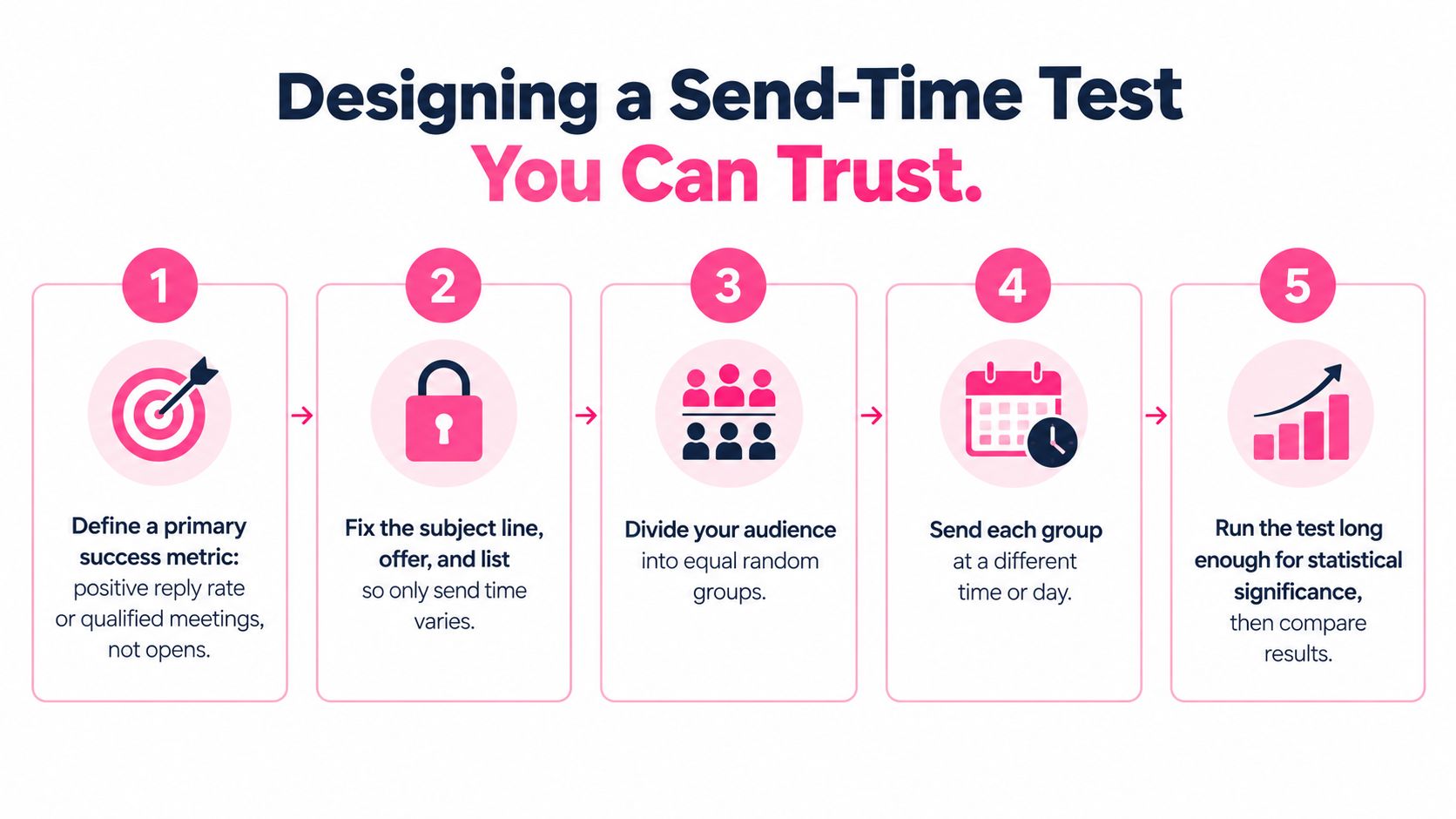
First, pick one primary metric before you send anything. Use positive reply rate or booked-meeting rate, and write it down so nobody swaps in opens later because the open chart looks prettier. Second, freeze everything else. Same subject line, same offer, same list segment, same sequence step. Third, split your audience into equal random groups and size the send properly with an outbound volume planner so each cell gets enough volume to mean something.
Fourth, rotate the variable you're testing:
- Morning cell: 9:00 to 11:00 a.m. recipient local time
- Midday cell: 12:00 to 1:00 p.m. recipient local time
- Afternoon cell: 3:00 to 4:00 p.m. recipient local time
Run each cell on Tuesday, Wednesday, and Thursday separately if volume allows, or test hours first and weekdays second if it doesn't. For deeper thinking on test validity, the A/B testing and incrementality insights from AI Optimization Services cover how to avoid crediting a variable for lift it didn't cause.
Reading the Results
Compute reply rate per cell as positive replies divided by delivered emails, and set a minimum sample size before the test starts so you don't crown a winner off a handful of sends. Watch bounce rate and unsubscribe rate as safeguards, since a slot that lifts replies while damaging your domain is borrowing from future campaigns. Global lists need parallel local-time cells per region. One global hour tested globally only proves that one global hour is wrong in several time zones at once.
Why Timing Is One Lever Among Many
Now for the conclusion the timing content industry doesn't love. The gap between the best and worst reasonable send slot is often modest, and targeting, offer relevance, and deliverability can matter more than minute-level optimization. A perfectly timed email to the wrong person with a vague offer still loses to a decently timed email that names a real problem for the right buyer. Timing is a multiplier. It multiplies whatever you already have, including a weak campaign.
Rank your levers:
- List quality and verification: Wrong or dead addresses make every other decision irrelevant.
- Offer-market fit: A specific, credible reason to reply beats clever scheduling.
- Deliverability and domain reputation: If you land in spam, your send time is "never."
- Copy relevance: Personalization tied to the prospect's actual situation earns the reply timing made possible.
- Send time: Worth testing, worth systematizing, not worth obsessing over at the minute level.
Score your current emails with a cold email grader before you run timing tests, so you're optimizing the schedule of a message that's already solid. Then build a weekly rhythm. Review reply quality and meetings by time bucket every week, check your safeguard metrics, and retire a winning window when fresh test data beats it rather than when a new benchmark article (including this one) suggests a different hour.
Send midweek, send in the recipient's morning, follow up in three days, and spend the hours you saved on a better offer.
That's the priority order the evidence supports. Timing earns attention. Everything else earns the meeting.
If you'd rather spend your time closing than running send-time experiments, Ever Outbound Inc. can help. We're pay-per-close, which means our human research, copywriting, and appointment-setting team builds and runs your outbound campaigns and we only earn when you close deals from the qualified calls we book. Visit us to see how a fully managed campaign would handle timing, deliverability, and follow-up for your market.