November 14, 2026
BANT vs MEDDIC: Which Framework Fits Your Deals?
Your calendar is filling up, but your pipeline review still sounds like a weather forecast. One rep says the prospect has budget. Another says their contact loves the proposal. Then someone asks who can approve the purchase, and everyone suddenly becomes fascinated by their notes.
The BANT vs MEDDIC debate usually starts here, with a team trying to separate genuine opportunities from enthusiastic conversations. You don't need an acronym election. You need a qualification pipeline that asks for enough evidence at the right stage, without turning every promising reply into an interrogation.
Table of Contents
- BANT vs MEDDIC at a Glance
- Where BANT and MEDDIC Came From
- Matching BANT Questions to MEDDIC Elements
- Where Each Framework Works and Where It Breaks
- Which Deal Size and Sales Motion Fits Each Framework
- Escalating From BANT to MEDDIC During a Campaign
BANT vs MEDDIC at a Glance
BANT and MEDDIC side by side
| Factor | BANT | MEDDIC |
|---|---|---|
| Qualification depth | Lightweight four-part early screen | Six-part deal-inspection system |
| Operating point | Single pass in the first discovery conversation | Revisited repeatedly across the sales cycle |
| Best stage | Triage of outbound replies before a meeting | Opportunities after a first meeting |
| Admin load | Low, a few recorded answers | High, quantified evidence for each element |
| Main risk | Rejects prospects whose budget is not yet defined | Overhead on small or transactional deals |
Triage with BANT, inspect with MEDDIC. That's the practical verdict, not a declaration that every seller needs both frameworks on every opportunity.
BANT covers Budget, Authority, Need, and Timing. MEDDIC covers Metrics, Economic Buyer, Decision Criteria, Decision Process, Identify Pain, and Champion, with the distinction being screening depth and operating point, as described in Isoglu's framework comparison. The table reflects framework logic rather than a proven win-rate gap; the available evidence doesn't establish a universal MEDDIC uplift.
Put each framework in its proper place
An outbound reply isn't a fully formed opportunity. It's an opening to establish whether a business problem deserves a conversation. BANT gives the setter a compact way to decide whether that conversation is worth booking.
MEDDIC belongs where the seller can investigate the purchase itself. After an initial meeting, the questions change from whether the prospect might buy to what must happen for the organization to buy. That's a different job, requiring more than a contact's enthusiasm.
Use meeting readiness and opportunity qualification as separate statuses. A prospect can deserve discovery without already having a complete business case, an executive introduction, and a documented purchasing process. Treating meeting-ready leads as guaranteed opportunities encourages sellers to hide uncertainty instead of investigating it.
Choose evidence over acronym loyalty
BANT breaks when a seller interprets an unknown budget as proof that no opportunity exists. A buyer may understand the problem before knowing how to fund the fix. The right response is to investigate the funding path, not automatically reject the account.
MEDDIC breaks differently. Applied indiscriminately, it can make a straightforward purchase feel like a mortgage application. Reps spend more time completing fields than helping the buyer make a decision.
Practical rule: Match the depth of qualification to the uncertainty of the purchase, not the enthusiasm of the rep.
The handoff should preserve unanswered questions. A useful setter's note tells the closer what the buyer confirmed, what remains uncertain, and what to investigate next. A row of green checkmarks isn't a handoff. It's decoration.
Where BANT and MEDDIC Came From
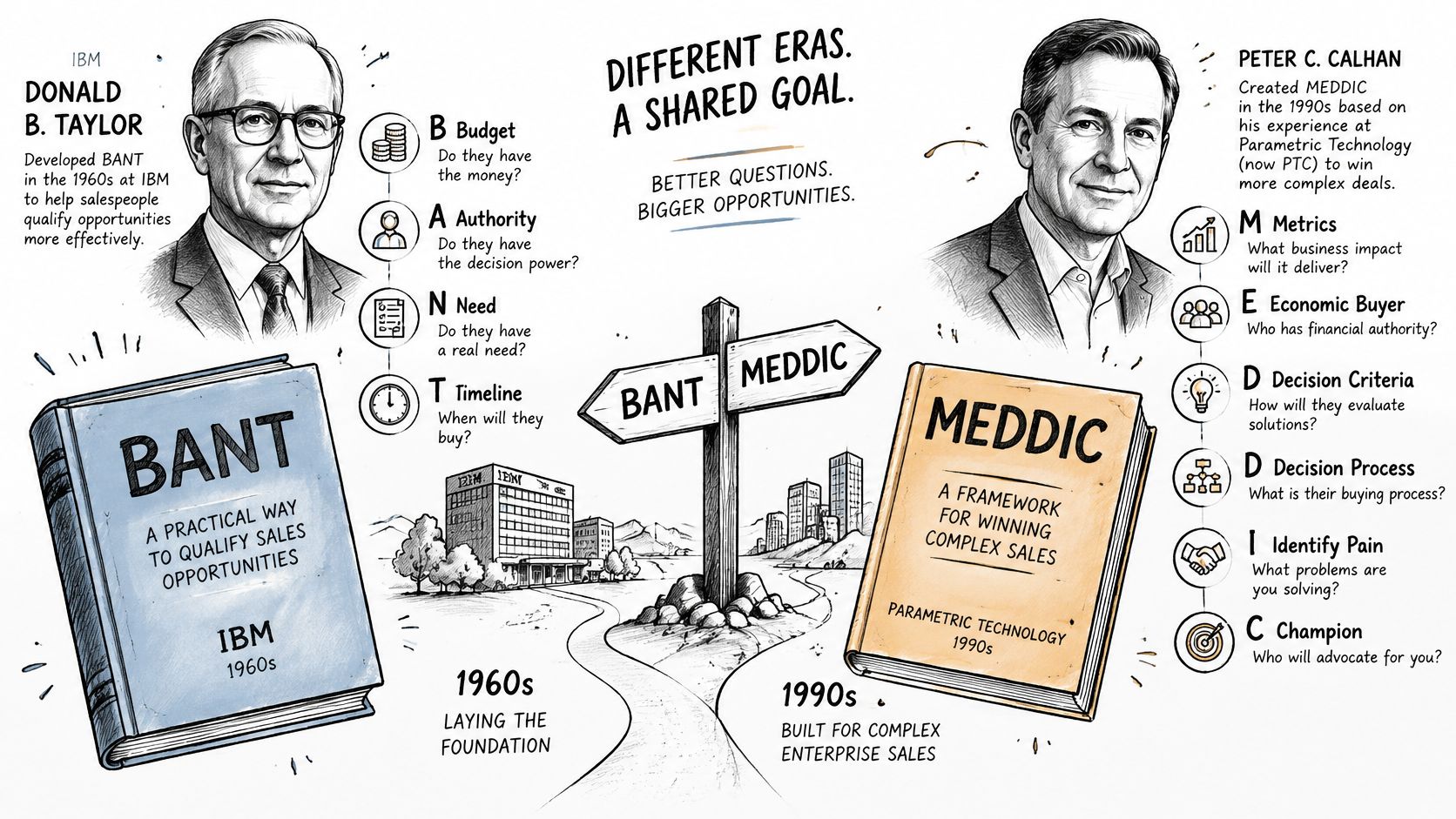
BANT's origin story gets repeated with more confidence than its documentation warrants. The familiar version places its birth inside IBM during an earlier era of enterprise technology sales, but the exact introduction remains unverified.
Arrows' historical review associates BANT with IBM and the 1950s or 1960s, while noting that no dated IBM document from either decade has been established as introducing the acronym; its oldest reported IBM BANT document is a November 2008 reseller template, followed by related partner materials from June 2012 and 2013. That's enough to describe a foundational industry practice, not enough to engrave an invention date on a plaque.
Different jobs shaped different methods
MEDDIC has a more specific organizational history: MEDDICC's account of its creation places its emergence at Parametric Technology Corporation (PTC) during the 1990s, with Dick Dunkel and Jack Napoli central to its development. The problem wasn't finding interested contacts. Sellers needed a more disciplined way to inspect complex enterprise software opportunities.
Consider the difference in the manager's question. A screening manager asks whether a prospect deserves further attention. An enterprise sales leader asks whether the team understands how the customer will reach a decision.
- BANT's practical inheritance: A compact screening method for prioritizing attention before substantial discovery.
- MEDDIC's practical inheritance: A deeper inspection method for understanding large purchases and defending a forecast.
Neither history makes its framework universally superior. It explains why asking either method to do the other's entire job produces awkward conversations and unreliable records.
Matching BANT Questions to MEDDIC Elements
Treat BANT answers as starting points, not substitutes for deeper discovery. Chief's BANT guide provides the basic qualification structure; operationally, record the answer, its source, and the date rather than guessing from a title or content download.
BANT questions, MEDDIC questions and evidence to log
| Element | BANT question | MEDDIC question | Evidence to log |
|---|---|---|---|
| Budget vs Metrics | Is there budget for this? | What measurable outcome must change, and by how much? | Dollar or KPI target with source and date |
| Authority vs Economic Buyer | Who can approve the spend? | Who controls the budget and can sign? | Name, title and confirmed access |
| Need vs Identify Pain | Does the buyer have a real problem? | What breaks if they do nothing, and what does it cost? | Quoted pain and its consequence |
| Timeline vs Decision Process | When do they plan to decide? | Which steps, people and approvals come before signature? | Dated approval path |
| No direct BANT equivalent vs Decision Criteria | Not explicitly asked | How will options be compared, formally and informally? | Written list of criteria |
| No direct BANT equivalent vs Champion | Not explicitly asked | Who inside will advocate when you're not in the room? | Named internal advocate and the action they took |
Turn answers into verifiable discovery
Budget to Metrics isn't a literal equivalence. Available money tests affordability; Metrics establish the measurable business outcome the purchase should change. Ask about funding first, then establish the target and who accepts the calculation.
Authority to Economic Buyer moves beyond a contact's apparent seniority. A marketing manager saying the team has budget doesn't identify the person who can authorize this purchase. Log that person's name, title, and confirmed access before treating authority as established.
Need to Identify Pain separates a desirable improvement from a consequential problem. Ask what happens if the buyer leaves the situation unchanged. Record the buyer's language alongside the operational or financial consequence.
Timing to Decision Process turns a desired date into an actionable sequence. Ask who must participate, what each person must approve, and which dependencies could prevent signature. A target date without an approval path is a calendar preference.
These distinctions follow Chief's MEDDIC definitions, which distinguish measurable outcomes, economic approval, evaluation requirements, decision dependencies, pain, and internal advocacy.
Add what BANT doesn't explicitly ask
Decision Criteria require their own conversation. Ask what the buyer will compare, which requirements are mandatory, and whose preferences influence the evaluation. Don't assume your demo agenda matches their selection criteria.
Champion requires action, not friendliness. A contact who arranges an executive introduction or helps prepare the internal business case provides stronger evidence than someone who replies promptly.
For technical sellers connecting evaluation work to opportunity qualification, the PreSales Unleashed MEDDPICC resources from PreSales Unleashed GmbH offer a relevant companion resource. Build your lead qualification process around evidence that another seller could inspect, not confidence that only the account owner can explain.
Where Each Framework Works and Where It Breaks
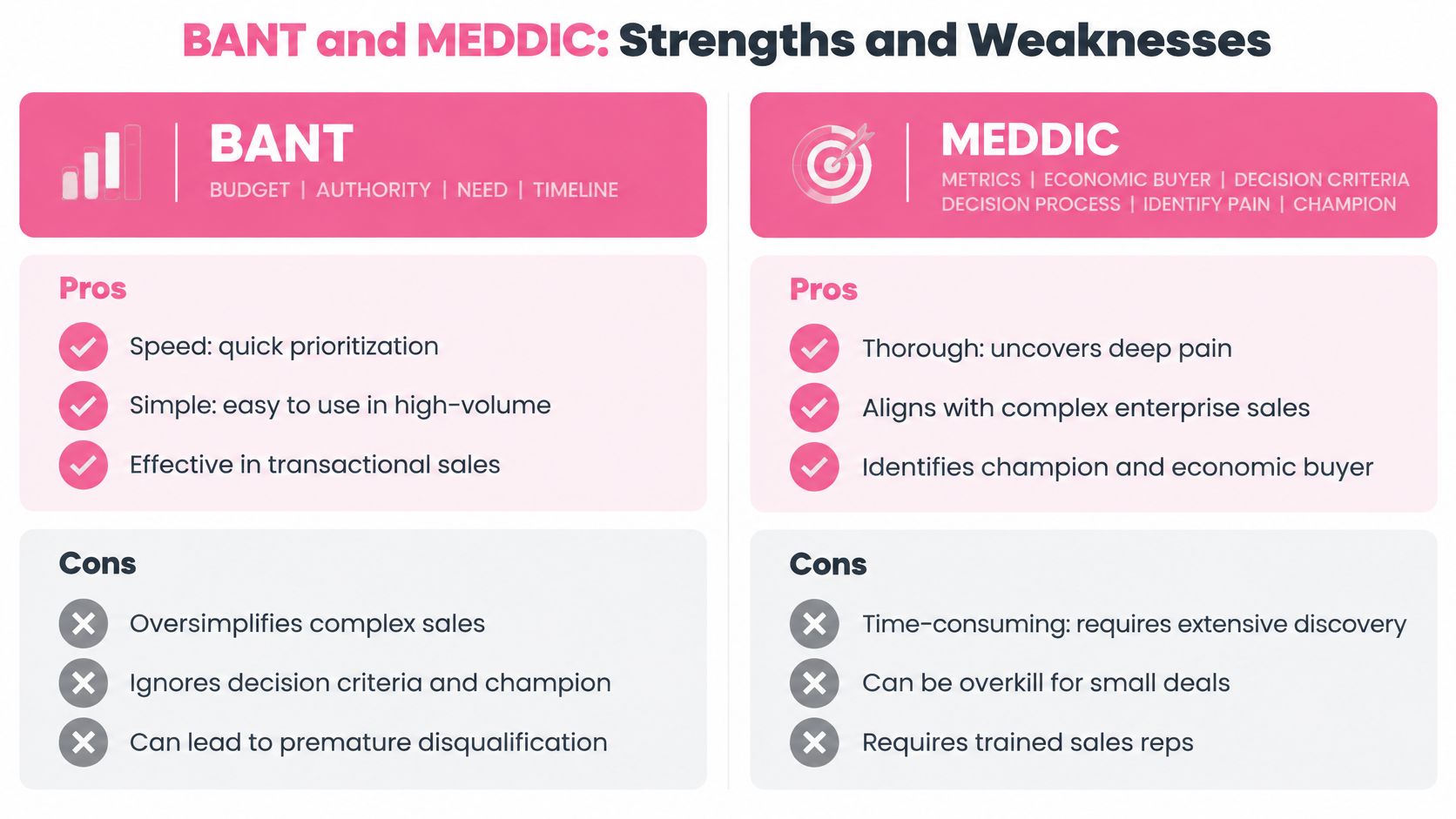
BANT works well when a seller needs to make an economical decision about where to spend attention. The questions are accessible, the answers are compact, and the next action can be clear without extensive internal investigation.
That simplicity also creates its blind spot. A seller can record a plausible budget, an influential contact, a genuine need, and a target date while still misunderstanding how the organization buys. The form looks complete because the form didn't ask enough.
BANT tests whether a conversation deserves more investment. MEDDIC tests whether the seller understands the purchase well enough to advance it.
When depth becomes unnecessary friction
Say an agency sells a tightly scoped website audit. The owner understands the deliverable, can authorize the purchase, and wants to start. Requiring the seller to manufacture a champion-development plan and elaborate evaluation map doesn't improve the buying decision.
It does create work. The seller delays the proposal, the buyer repeats information, and a routine transaction acquires the atmosphere of a parliamentary inquiry. Qualification effort should resolve uncertainty, not satisfy an internal taste for elaborate paperwork.
MEDDIC earns its keep when the seller needs a quantified business case, an approval map, and someone prepared to advocate internally. Its administrative burden becomes defensible when those details determine whether the opportunity can progress.
When a qualified deal still can't get purchased
Consider a larger IT contract. The department head confirms funding and urgency, so the seller marks BANT complete and schedules implementation discussions. Then the security team asks for an assessment nobody planned for.
Nothing about the original answers was necessarily false. They were incomplete for the purchase. That's why qualifying cold prospects must distinguish interest in a solution from organizational readiness to acquire it.
MEDDIC isn't automatically complete either. Its original elements don't explicitly name procurement, legal, security, compliance, or the competitive status quo, a limitation discussed in Spotlight.ai's comparison. You can investigate these under Decision Process and Decision Criteria, but don't assume a filled-in acronym means someone did the work.
Use explicit checks where risk warrants them:
- Security and compliance: Identify the reviewer and the evidence they require.
- Legal and procurement: Establish ownership, contractual requirements, and purchasing steps.
- Alternatives: Document the incumbent and the option of doing nothing.
Each framework's weakness mirrors its strength. BANT saves effort by asking less. MEDDIC exposes complexity by demanding more. Neither excuses a seller from noticing what the customer's purchase requires.
Which Deal Size and Sales Motion Fits Each Framework
Framework choice by deal profile
| Deal profile | Recommended framework | Typical cycle |
|---|---|---|
| Transactional deal under roughly $25,000 | BANT | Days to weeks |
| Mid-size deal with two or three stakeholders | BANT, then MEDDIC fields after the first meeting | Several weeks as a planning assumption |
| Deal above roughly $50,000 with a buying committee | MEDDIC | Three months or longer |
| Security-heavy SaaS or IT deal | MEDDIC plus a procurement and compliance map | Three months or longer as a planning assumption |
| Agency one-off project or managed-service retainer | BANT for the audit, MEDDIC for the retainer | Scope-led for projects; approval-led for retainers |
The monetary and cycle guidelines come from Lead-Spot's comparison, which positions BANT for transactional opportunities below roughly $25,000 with cycles of days or weeks, and MEDDIC for opportunities above roughly $50,000 with cycles of three months or longer. The other rows are operating profiles, not measured cycle benchmarks.
Let the purchase shape the workload
Transactional purchases need enough screening to confirm fit and a viable next step. If the buyer can evaluate, approve, and use the offering without coordinating a wider organization, keep the process light. Don't confuse a smaller contract with a smaller customer's importance.
For a mid-size opportunity, start with the same compact screen, then add discovery fields as additional decision-makers become involved. The useful distinction is whether the seller can still explain the purchase accurately without a stakeholder map. If not, deepen qualification.
Buying-committee opportunities justify fuller MEDDIC inspection. The seller needs to know how the business case will survive internal discussion, not merely how well the demo landed. Revisit the record when stakeholders, requirements, or approval responsibilities change.
Security-heavy SaaS and IT purchases need explicit risk gates regardless of commercial enthusiasm. A buyer's willingness to purchase doesn't establish that their security reviewer or procurement owner can clear the transaction on schedule.
Agencies and consultants need a flexible model
Say a marketing agency offers a small diagnostic audit and an ongoing managed-service retainer. Use BANT for the audit when the scope and approver are straightforward. For the retainer, investigate the performance target, executive sponsor, evaluation criteria, and dependencies that could affect an expanding engagement.
Don't turn contract value into qualification law. Salesforce's BANT vs MEDDIC discussion notes the absence of a comparable benchmark in its research, so the familiar dollar cutoffs shouldn't become automatic routing rules.
Use the video as a discussion prompt for your next qualification workshop.
The operational question is who collects which evidence before the next handoff. Understanding how managed outbound works should include that division of responsibility, not just campaign launch and calendar availability. Setters establish a credible reason to meet; closers investigate what it will take to buy.
Escalating From BANT to MEDDIC During a Campaign
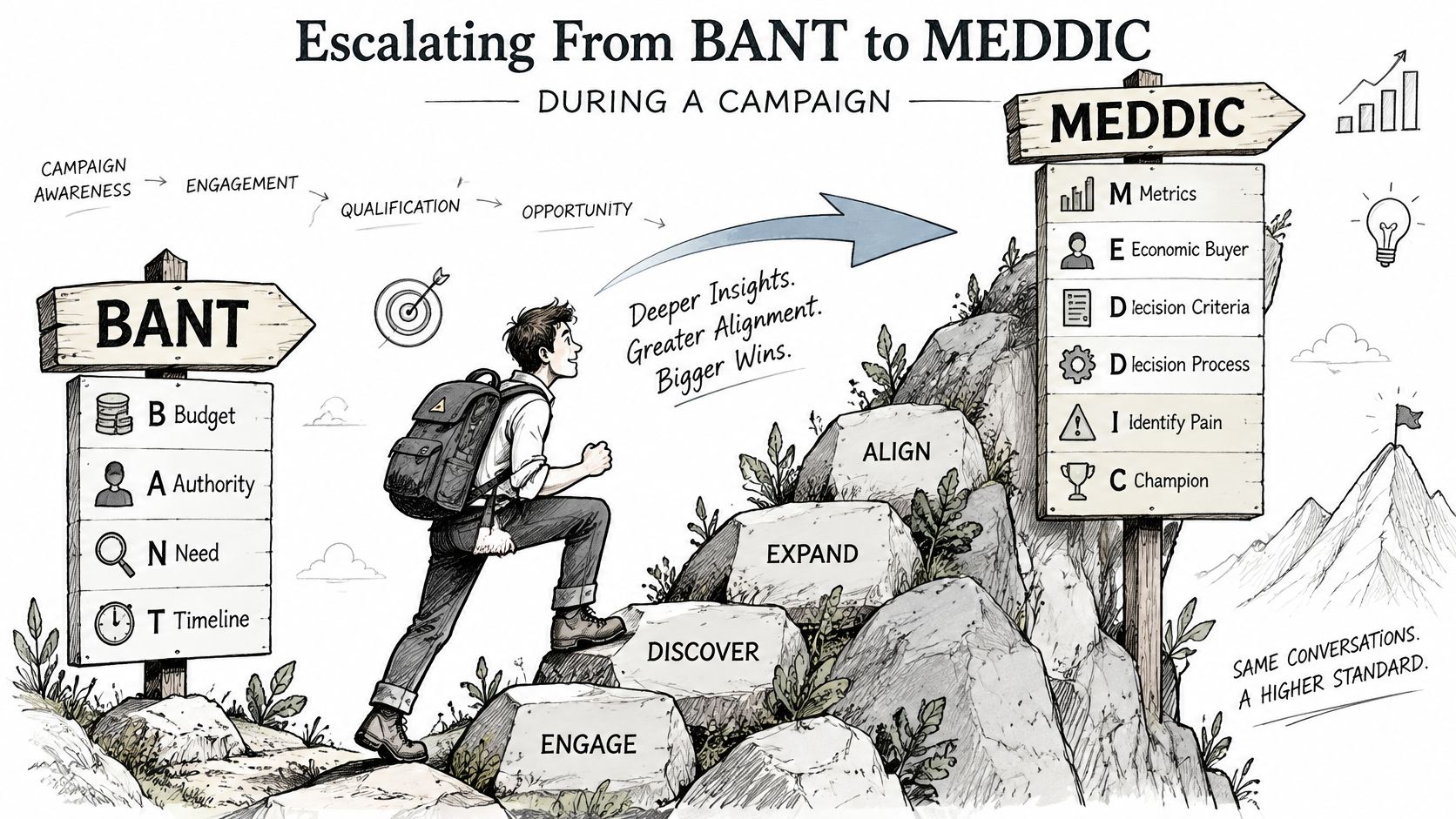
Treat an outbound reply as a BANT hypothesis, not a verdict. Start with the problem and decision window, then record what you know about funding and authority. Book discovery when the prospect has a credible business problem and a meaningful window for action, even if some purchasing details remain unresolved.
Use this escalation rule: move to MEDDIC when discovery reveals at least two complexity triggers. This is an operating recommendation, not a validated industry threshold.
- Multiple stakeholders: The contact needs other people to evaluate or approve the purchase.
- Material business case: Someone must justify the investment through measurable outcomes.
- Technical or procurement review: A separate team must assess or authorize the transaction.
- Unclear approval path: The contact can't explain who decides or what happens next.
- Extended timing: The decision now runs beyond the originally stated window.
Make escalation visible in the CRM
Record the trigger, the date escalated, and the evidence captured. Don't hide the change inside a paragraph of call notes. The next person reviewing the opportunity should understand why it now deserves deeper inspection.
Say a consulting prospect initially describes a department-level purchase. During discovery, they explain that finance needs a quantified savings case and procurement must approve the supplier. Record those statements, escalate the opportunity, and assign the next discovery action.
This approach preserves promising prospects whose pain is clearer than their funding. It also keeps straightforward purchases out of unnecessary discovery loops. Your pre-qualification process should distinguish unknown, confirmed, and disqualified rather than treating every blank field as a rejection.
Manager's test: Ask what new evidence changed the qualification decision. If the answer is only that the rep feels better about the account, nothing has changed.
Configure the campaign before judging the method
Set BANT as the default reply screen. Give setters fields for the business problem, timing, funding status, and approval role. Permit an explicitly unknown answer, but require a next action where the gap matters.
Require MEDDIC evidence before sales-qualified status. Add quantified impact, economic buyer access, decision process, and champion evidence. These fields must contain buyer-supported information, not entries such as good ROI or supportive contact. A booked meeting remains a booked meeting until discovery establishes the opportunity.
Add a post-MEDDIC gate for enterprise opportunities. Define your enterprise threshold internally using value, implementation exposure, and buying complexity. Record security and legal requirements, the procurement owner, the incumbent or do-nothing alternative, and the required evidence and clearance date for each gate. Apply the same gate below that threshold whenever risk warrants it.
Review outcomes quarterly by qualification route. Compare stage-to-win, no-decision, and disqualification rates against meeting volume and cost per opportunity. Keep the entry cohorts comparable so you aren't crediting a framework for differences in customer segment or deal difficulty.
Isoglu's evidence review supports inspecting business value, stakeholder authority, and decision mechanics rather than claiming a universal framework-driven win-rate advantage. Use your CRM to test whether the added qualification effort helps your team, not to manufacture a victory for your preferred acronym.
Separate booking activity from opportunity outcomes
Keep booking records distinct from qualification records. Our API's /v1/meetings endpoint returns the booked calls shown in your dashboard and accepts since, until, page, and per_page parameters, filtered on when the call was booked. That booking timestamp isn't the meeting date, a sales-qualified date, or a closing date.
At Ever Outbound, we're pay-per-close, so we earn only when a deal from our campaigns closes. That makes the distinction practical: a full calendar is an input, while a closed deal is an outcome.
Assign someone to maintain qualification evidence after the handoff. Otherwise, the setter's initial answers become permanent CRM folklore while the actual purchase changes around them. Run BANT for entry, escalate on observable complexity, and make every additional field earn its place.
At Ever Outbound Inc., we're pay-per-close and provide done-for-you B2B client acquisition, from prospect research and human-written outreach to follow-up and qualified call booking. Visit us to discuss a campaign that screens for meeting readiness and gives your closers useful qualification context, not just another name on the calendar.