November 11, 2026
Apollo vs Instantly: Which Cold Email Tool Wins in 2026
The most popular Apollo vs Instantly advice is tidy and wrong. People say buy the platform with the bigger contact pile, or the one with the lower monthly sticker, and the meetings will follow. They won't. A cheap seat that can't find the right people, and an unlimited mailbox pool pointed at a dirty list, both burn the same thing: your chance of a closed deal.
I would ignore brand size and start with the bottleneck. If you can't name whether you're stuck on lead discovery or sending volume, you're about to pay for the wrong half of the job.
Table of Contents
- Apollo vs Instantly at a Glance
- Data, Automation and Integrations Compared
- Sending Limits and Deliverability Controls
- Pricing and Cost per Closed Deal
- How to Switch Tools Without Losing Sender Reputation
- Which Team Should Choose Which Tool
Apollo vs Instantly at a Glance
Subscription price stops too early. Apollo and Instantly change different parts of the path from a login to a closed deal, once you add the list, verification, mailboxes, and reply handling.
Apollo finds contacts and sequences them across email, phone, and social. Instantly sends email at mailbox scale and expects the list to arrive already built. That split drives the rest of the comparison.
| Criterion | Apollo | Instantly |
|---|---|---|
| Core strength | Prospect database plus multichannel sequences | Email sending at volume across many mailboxes |
| Built-in prospect database | Yes. Smarte's Instantly vs Apollo breakdown puts the database above 240 million contacts and 30 million companies | No. Lead data is a separate credit purchase |
| Sending model | Seat-based, with daily sending limits on lower tiers | Workspace-level monthly email volume on outreach plans |
| Pricing model | Per user per month, billed annually | Per plan, by monthly emails and uploaded contacts |
| Best fit | Teams that need list building and sequencing in one tool | Teams with verified lists running many campaigns |
A directory that large is still a brochure until you test it on your market. Record count is not the same as people who match the offer, still hold the job, and will accept mail. Teams that choose on database size often spend weeks cleaning titles that never matched the search.
I would score a trial on cost per closed deal. Add the subscription to list or credit spend, verification, the mailboxes you warm, and the hours spent qualifying replies. Divide by deals won, not by meetings on the calendar. Apollo folds discovery into the seat, so a sloppy search spends credits before a send goes out. Instantly prices the send, so a dirty upload or a slow reply process can make a low plan expensive per deal.
Data, Automation and Integrations Compared
Where do the names come from?
Apollo searches its own database. You filter on those 65+ targeting criteria, reveal a contact, and keep the person inside the same workspace that will email, call, or queue a social touch. Each enrichment reveal spends credits, so a sloppy search is a credit leak, not a free browse.
Instantly assumes you upload or otherwise provide the contacts. Its outreach plans measure monthly emails and uploaded contacts, and credits for other work sit on a separate table. The Instantly pricing table lists Growth at 5,000 monthly emails and 1,000 uploaded contacts, and Light Speed at 500,000 monthly emails and 100,000 uploaded contacts. If the list isn't yours yet, the sending plan doesn't conjure it.
A team with a clean, verified list of a few thousand names needs capacity and reply handling. A team building its first target list needs discovery. Mixing those jobs is how you end up paying twice, once for a database you barely use, or once for a sender that has nothing decent to send.
Who builds the sequence, and what does it plug into?
Apollo sequences across channels in one queue, so a rep can mix email steps with phone and social tasks without exporting a CSV mid-campaign. CRM integrations show up from the paid Basic tier, which matters if Salesforce or HubSpot is already the system of record.
Instantly runs multi-step email sequences and handles replies in the sending workspace. CRM and webhook access arrive on higher plans, not as the default shape of the cheap tier. That's fine when email is the whole motion. It's a gap when the next step is a call or a LinkedIn task that has to live somewhere else.
Personalization depth tracks the data behind the sentence, not the size of the catalog. A giant database with a wrong title still produces a generic opener. An uploaded list with a verified role, a real trigger, and a deliverable address will beat it.
Apollo's contact records are vendor-reported, so test them against your market before you trust the label. Instantly receives whatever you upload, so its bounce rate tracks the verification you ran first. Pull a sample of 100 contacts from each source you might buy. Check role accuracy, company fit, and whether the address is deliverable. If either sample fails that pass, fix the source before you argue about sequences.
Run this before you subscribe:
- Source: Where do contacts come from today, a built-in search, a CSV, or a mix you haven't verified?
- Channels: Do you need phone and social in the same sequence, or is email the only send?
- CRM: Which system already holds the pipeline, and does this plan connect to it?
If that sample looks ugly, run it through a lead list cleaner before either platform sees it. Bad rows don't get kinder inside a prettier UI.
Sending Limits and Deliverability Controls
The throttle that stops a campaign shows up on a Tuesday afternoon, after the provider starts slowing you down.
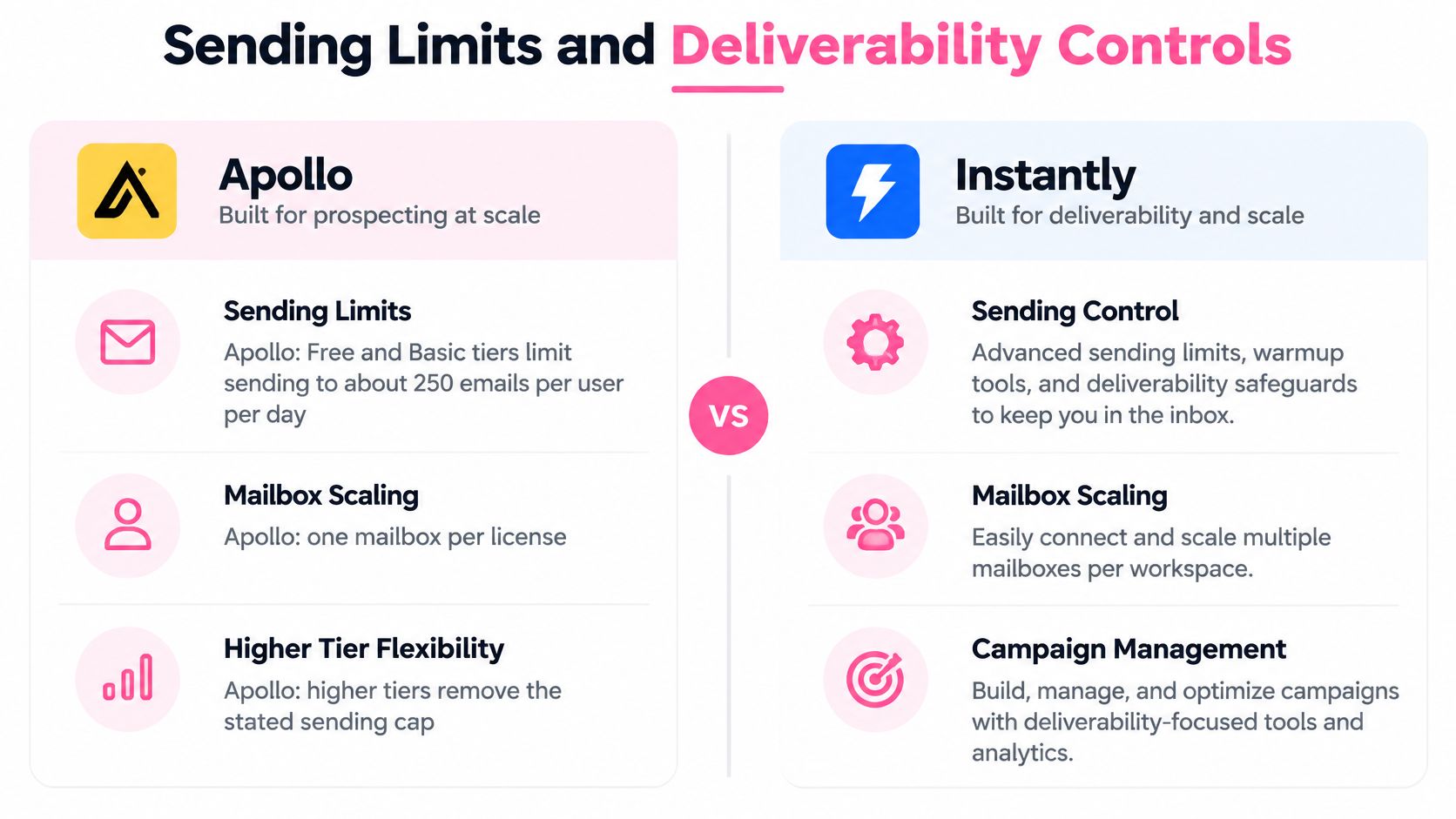
Apollo Free and Basic land near 250 emails per user per day, commonly with one mailbox per license. Higher Apollo tiers add mailbox connections and drop that stated daily cap, still subject to fair use and to Gmail or Microsoft limits. Instantly includes unlimited sending accounts and warm-up on outreach plans, then meters the workspace by monthly campaign volume: 5,000 emails on Growth, up to 125,000 on Hypergrowth, and 500,000 on Light Speed.
Run the month in the open. 250 emails a day across 22 working days is about 5,500 sends per mailbox per month before provider throttling. Instantly's 5,000-email Growth allowance is one workspace budget you can spread across every mailbox you connect. Same ballpark of mail, different shape. Apollo stacks by seat and by mailbox. Instantly stacks by monthly volume and lets you slice it.
| Plan | Sending limit | Mailbox rule |
|---|---|---|
| Apollo Free and Basic | About 250 emails per user per day | One mailbox per license |
| Apollo higher tiers | Daily cap removed, subject to fair use | More mailboxes per license |
| Instantly Growth | 5,000 emails per month | Unlimited sending accounts |
| Instantly Hypergrowth | 125,000 emails per month | Unlimited sending accounts |
| Instantly Light Speed | 500,000 emails per month | Unlimited sending accounts |
More room to send is not inbox placement
Domain age, authentication, list quality, complaint rate, provider throttling, and copy relevance decide whether the mail lands. Extra mailboxes do not vote on any of those. They only decide how fast a weak list or a weak offer can damage a domain.
That damage is a cost problem, not a feature problem. List spend, verification, mailbox warmup, and the hours spent on replies all sit on the same bill as the sends. Mail that never lands, and replies nobody works, inflate cost per closed deal long before the plan name does. I would not buy more volume until those four lines are already under control.
Instantly's higher tiers put budget into deliverability tooling: a Deliverability AI Agent, blocklist triggers, reply labels, and private-server or IP-rotation options. Apollo's higher plans spend that budget on workflows, enrichment, intent, and multichannel steps. Neither stack watches the domain for you.
Who watches the mess
Name an owner before the first send. That person checks bounce rate daily, suppresses opt-outs across every mailbox (not only the one that received the reply), and escalates the hour a domain hits a blocklist. Privacy rules travel with the contact, not the software: GDPR if you mail people in the EU or the UK, CAN-SPAM if you mail in the US. A tool can store a suppression list. It cannot confirm that a deletion request was honored.
A bigger monthly ceiling raises risk when you scale volume before the offer and the suppression process are proven.
Before you raise a cap, run the domain through an email deliverability checker. Shaky placement at a few hundred sends gets louder at 125,000 a month, and the list money goes with it.
Pricing and Cost per Closed Deal
Sticker price is a distraction. The number that matters is cost per closed deal after lists, verification, mailboxes, and the human work of replies are in the bill.
| Plan | Price | Included limits |
|---|---|---|
| Apollo Free | $0 | 900 credits per year, two sequences |
| Apollo Basic | $49 per user per month, billed annually | 30,000 credits per year, unlimited sequences |
| Apollo Professional | $79 per user per month | 48,000 credits per year, five mailboxes |
| Apollo Organization | $119 per user per month, billed annually | Custom package above the Professional credit and mailbox set |
| Instantly Growth | Outreach plan priced by monthly volume, not per user | 5,000 emails and 1,000 uploaded contacts per month |
| Instantly Light Speed | $358 per month | 500,000 emails and 100,000 uploaded contacts per month |
| Ever Outbound Scale + AI Setter | $497 per month plus 5% of closed deals | Everything in Scale plus AI Appointment Setter, we're pay-per-close |
Apollo's published comparison lists Free at $0, Basic at $49 per user per month billed annually, and Professional at $79 per user per month, with Custom above that, per Apollo's plan comparison. A later Apollo walkthrough puts Organization at $119 per user per month on annual billing, alongside those same Basic and Professional annual rates, in Apollo's plan details. Free includes 900 credits a year and two sequences. Basic includes 30,000 credits a year, unlimited sequences, CRM integrations, and six intent topics. Professional includes 48,000 credits a year, a US dialer, five mailboxes, automated workflows, and AI research.
Instantly's Help Center listed Light Speed at $358 per month, with 100,000 uploaded contacts and 500,000 monthly emails, in its plans overview. Growth stays a volume plan. You still buy or verify the list somewhere else.
Three buyers, three real bills
Say a founder already holds a verified list of 800 names. Apollo Basic at $49 still charges for a login, and a second login doubles it, even if only one person sends. Instantly Growth spends against emails and uploads. The founder's extra cost is reply sorting, not another seat. Here Instantly is the cheaper path, because the data and the skill already exist.
Say an internal SDR team has no list. Five Apollo seats at Professional is five times $79 even if only two people send, because the price is per user. Those seats also buy the search, the credits, and the dialer. Building that same list for Instantly means a separate credit spend plus someone to research, personalize, classify replies, and book. Apollo can be the cheaper system when discovery is the bottleneck.
Say a white-label agency runs four client campaigns that must stay isolated. Seat math punishes Apollo as logins multiply. Instantly's workspace budget and mailbox pool fit campaign isolation better, until you add the labor of list building for every client. That labor, not the subscription, usually dominates.
The formula, then the managed option
Divide monthly tool cost by meetings booked, then by deals closed. A $49 seat that books nothing costs more than a pricier plan that books two.
Ever Outbound's Scale + AI Setter plan is $497 per month plus a 5% commission on closed deals. The AI Setter qualifies replies, books into your calendar, and runs 24/7, and it's included at no separate charge. We're pay-per-close, so that 5% lands only when a deal you close comes from the work. Put that next to software-only math with a cold email ROI calculator before you treat the lowest sticker as the winner.
I would not call Instantly cheaper in general. It's cheaper when clean data and operators are already on the payroll. Apollo wins the spreadsheet when the missing piece is the list.
How to Switch Tools Without Losing Sender Reputation
Moving the login is easy. Moving the reputation without a faceplant takes a week of restraint. Do it in this order, whether you're leaving Apollo for Instantly or the other way around.
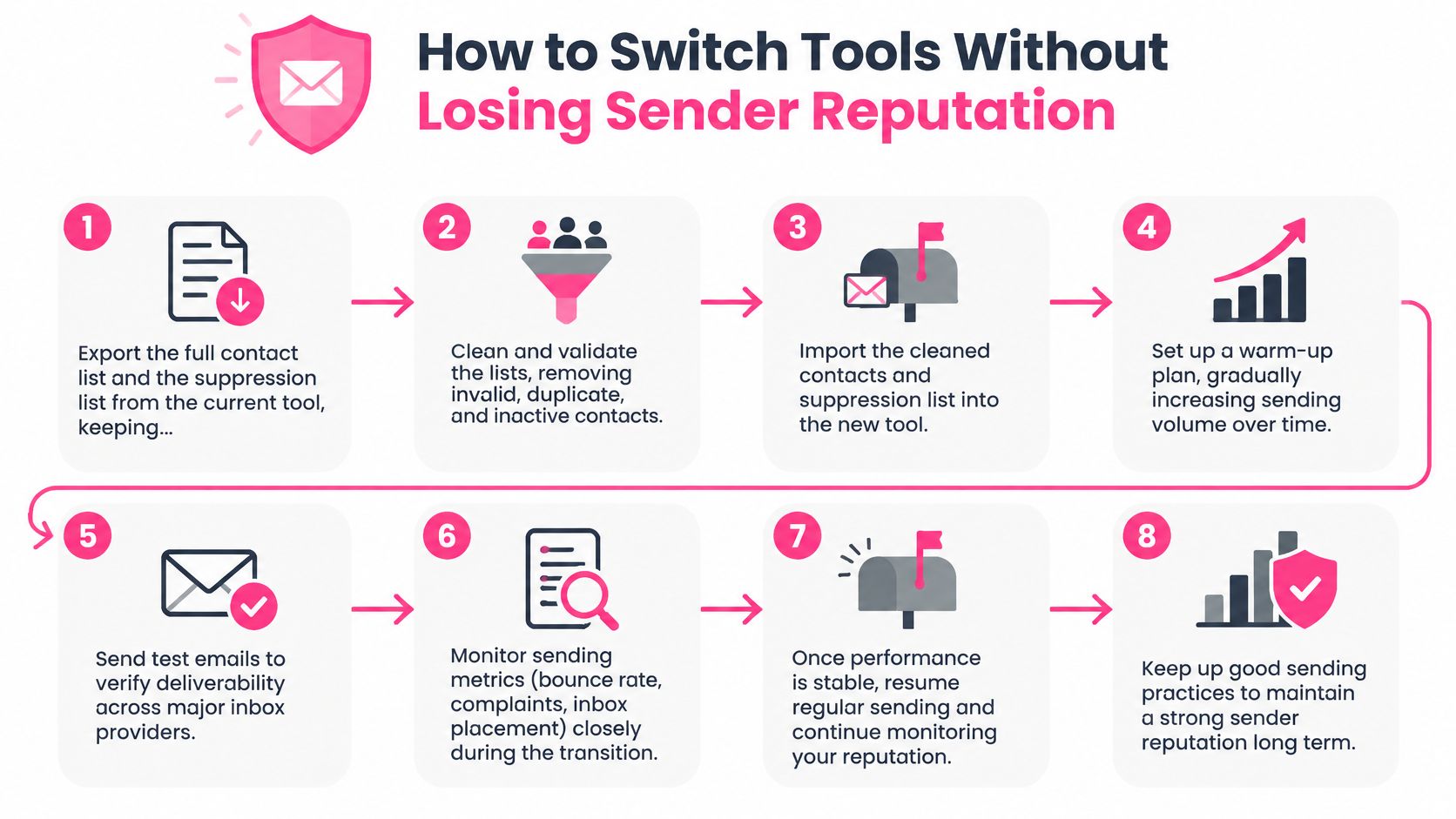
- Export the full contact list and the suppression list from the current tool. Keep opt-outs and bounced addresses out of the new import, or the new platform inherits your worst rows on day one.
- Import the suppression list before any other contacts. One opted-out person mailed by accident is a complaint you didn't need to buy.
- Connect the new mailboxes and let warm-up run for at least two weeks before campaign volume. A cold domain with a fresh sequence is how placements die in the first hundred sends.
- Start each mailbox at 20 to 30 sends per day. You're building a clean sending history, not clearing a backlog.
- Raise volume by a small step every two to three days, and only while bounce rate stays under about 2 percent and spam complaints stay under about 0.3 percent. Miss either line and you hold, you don't "push through."
- Split remaining contacts so each prospect sits in only one active sequence. Pause the old campaigns once the new setup holds steady volume, or you'll double-tap the same buyer from two tools.
- Review the first week. Classify replies, remove bounces, and run a blocklist check on every sending domain before you call the move done.
Sketch the ramp on an outbound volume planner so the daily step is a number you chose, not a mood.
A clean switch looks boring, which is the point. Inbox placement stays steady, replies land in one inbox, and nobody gets two sequences from two logins. If any of those three slip, you didn't switch. You cloned the risk.
Which Team Should Choose Which Tool
Verdict first. Apollo if discovery is the hole. Instantly if you already trust the list and need volume across isolated campaigns. A managed pipeline if nobody in-house can research or work the replies.
Apollo, the short version
- Fits when one workspace has to hold data, sequences, and calling.
- Frustrates high-volume senders, because seat pricing and the daily caps on lower tiers fight the way a mailbox pool wants to grow.
Instantly, the short version
- Fits when you need mailbox scale and campaign isolation on lists you already trust.
- Misses a built-in prospect database, so the list is your problem before the first sequence exists.
| Team | Better fit | Why |
|---|---|---|
| Founder with a verified list | Instantly Growth | Needs sending volume and sequences, not a database |
| Founder starting from zero leads | Apollo Basic or Professional | Discovery and sequences in one seat |
| Internal SDR team | Apollo Professional | Research, sequences and calling in one workspace |
| Agency running separate client campaigns | Instantly | Isolated campaigns and mailbox pools |
| Service firm with no outbound staff | Managed service such as Ever Outbound | Research, copy and booking handled by people, we're pay-per-close |
A service firm with no outbound staff is the odd row, and it's the honest one. Software still needs a human to pick the market, write the note, and catch the reply. Ever Outbound's AI Setter nurtures interested prospects and books qualified calls straight onto the client's calendar, 24/7. Researchers, copywriters, and GTM engineers run every campaign and use AI as a multiplier, not a stand-in. We're pay-per-close, so you compare that spend with paying only when a deal you close comes from the work, not with a seat that sits idle.
Before you sign anything, answer three checks. They take ten minutes and they beat another feature grid.
- List quality: Could you mail 100 of these contacts tomorrow without a verification pass?
- Next quarter's volume: What daily send do you need, not the number that sounds ambitious?
- Reply owner: Who classifies replies and pulls bounces the same day, by name?
Those three answers pick the tool. Headcount doesn't. A two-person team with a clean list and a named reply owner is an Instantly shop. A ten-person team with no list is still an Apollo problem, or a managed one, until someone owns discovery.
If you want the meeting cost in dollars before you choose, run the seats, the volume plan, or the managed fee through a meeting cost calculator. The lower number per booked meeting, after labor, is the purchase. The prettier dashboard is not.
Ever Outbound Inc. runs done-for-you B2B outbound for teams that don't want to pick between a database and a sending engine, covering research, copy, mailbox setup, and booked calls in one pay-per-close service. You show up to the meetings and close, and the first two closes are commission-free. See how that compares with running Apollo or Instantly yourself at Ever Outbound Inc..